
Craft Beer in the Public Arena
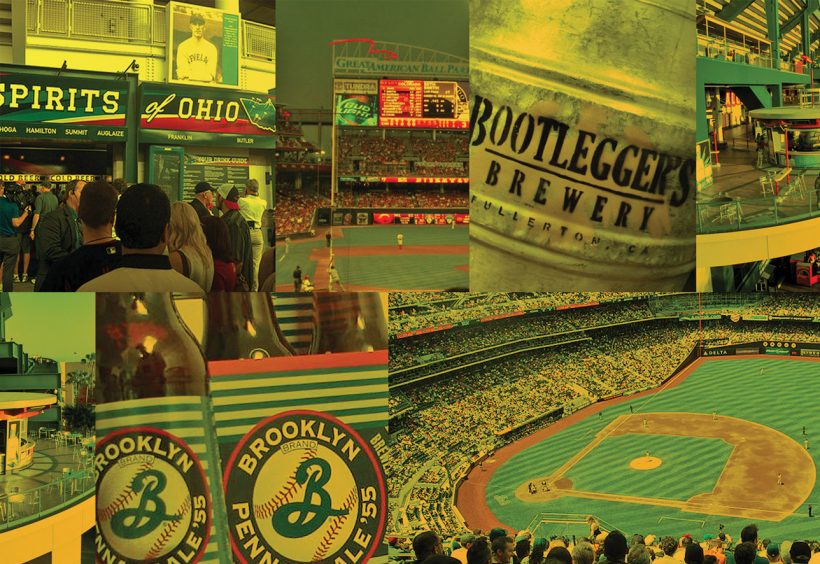
Baseball and beer have always gone together. But craft beer? Here’s a region-by-region look at how ballparks are responding to increasing demand for better beer.
Central
The fact that you can buy a $28, 22-ounce Double IPA at Progressive Field in Cleveland is one sign that palates are changing—and teams are listening—at ballparks across the country. “We got a lot of publicity for serving that,” says Dan Smith, vice president of food and beverage for the Cleveland Indians, referring to the bombers of Mean Manalishi from the Hoppin’ Frog Brewery that are available at the stadium. “We sell more than we expected, actually.”
A craft beer advocate, Smith is selling to a group of baseball fans who are tired of the status quo. At a stand called “The Spirits of Ohio,” Smith also serves one beer from each brewery in the state, like bottles of Crooked River’s Settlers ESB Ale and Buckeye Brewing’s Hippie IPA. “There’s a need to do something different,” Smith says. “It’s one beer stand out of 28. We’re not going to sell a hell of a lot of it. But it’s not going to walk all over our sponsors.”
In Missouri, the Kansas City Royals have started serving beers from nearby Boulevard Brewing, which just signed on as the Royals’ official sponsor. This season, the Cincinnati Reds will debut three Founders beers—Centennial IPA, All Day IPA (a session ale) and a dry-hopped Pale Ale—at the Great American Ballpark in Ohio. “A lot of these things are driven by consumer demand,” says Dave Engbers, co-founder of Founders. “But when the big boys are involved, it can get pretty muddy.”
The big boys, of course, have traditionally supplied ballparks with macrobrews like Bud Light and Coors. According to Engbers, it took a burgeoning friendship between a craft-beer-loving maintenance man for the Reds and a salesman for Founders to make their current deal happen. Engbers says discussions are underway with the Detroit Tigers for a similar arrangement.
“These are relationships that take years,” says Engbers. “It’s starting. And I don’t think it’s anything that we’re doing. I think it’s really being driven by the growth in our industry. You can’t deny the numbers that craft beers are on the rise and domestics are stagnant if not falling. … These venues are businesses. They’re going to do what’s best for their bottom lines.”
West
For Jeff Grupe, manager of premium services at Angel Stadium in Anaheim, Calif., it was both his love for beer and a keen eye on the bottom line that led the Angels to introduce craft beer from California brewers Hangar 24 and Bootlegger’s at games this season. Grupe works for food-service giant Aramark, which services 11 of the 30 Major League ballparks. He says that customer demand for better beer in the stadium’s club seats was a sign that the Angels could have some success selling craft beer.
“It’s baseball,” Grupe says. “People want their Coors Lite and Bud Light. But it coexists just fine. It will never be more craft beer than the other way around, but there’s still room to grow.”
For the brewers, the chance to serve craft beer at their local ballpark was too good to pass up. “We’re elated that we had the opportunity even to have the discussion,” says Aaron Barkenhagen, owner of Bootlegger’s Brewery. “It’s going to be huge in terms of exposure.”
Bootlegger’s agreed to sponsor the Angels as part of the agreement to serve beer in the ballpark; the brewery gets ad pages in the program in addition to radio spots. Barkenhagen says he waited until his brewery had the capacity to brew beer for the ballpark—the beer he brews for the Angels makes up about 2 percent of his total production—to seek the arrangement. “You don’t want a stadium to be your wholesale business,” he says.
Also in the West, the San Francisco Giants serve beers from Anchor Steam, Lagunitas and 21st Amendment, while the Seattle Mariners offer up brews from Georgetown, Fremont and Harmon breweries.
East
With a high concentration of craft breweries in the Northeast, it might be surprising that the area has struggled to get craft beer into big-league parks. Boston’s Fenway Park serves beer from Boston Beer Co., Harpoon and Wachusett, but the region has scores of microbreweries not represented in the park. In New York, Citi Field’s craft beer stands offer Blue Point, Sixpoint and Ommegang, among others, but Brooklyn Brewery was priced out of a deal to sell anything more than cans of their lager at the stadium.
“When you sell in baseball stadiums, so much of it hinges on prices,” says Ben Hudson, marketing manager for Brooklyn Brewery. “It is very difficult for a brewery to make money.” Before the 2011 season, Brooklyn offered up their beers for food pairings at several Citi Field restaurants. “It was not our decision at all,” Hudson says on the choice to remove Brooklyn beers from the Citi Field’s restaurants. “We loved it. We’re game [to do it again].”
The Mets declined to comment for this story.
But a little further south, Philadelphia Phillies fans can drink beers from Victory and Troegs at Citizens Bank Park; at PNC Park, home to the Pittsburgh Pirates, bottles of Bell’s and Straub are actually cheaper than Miller High Life. And at Camden Yards in Baltimore, Md., the Orioles offer up beers from Dogfish Head and Heavy Seas. ■
 Previous: Merry Monks by Weyerbacher
 Next: History in a Bottle