
Dave Fleming
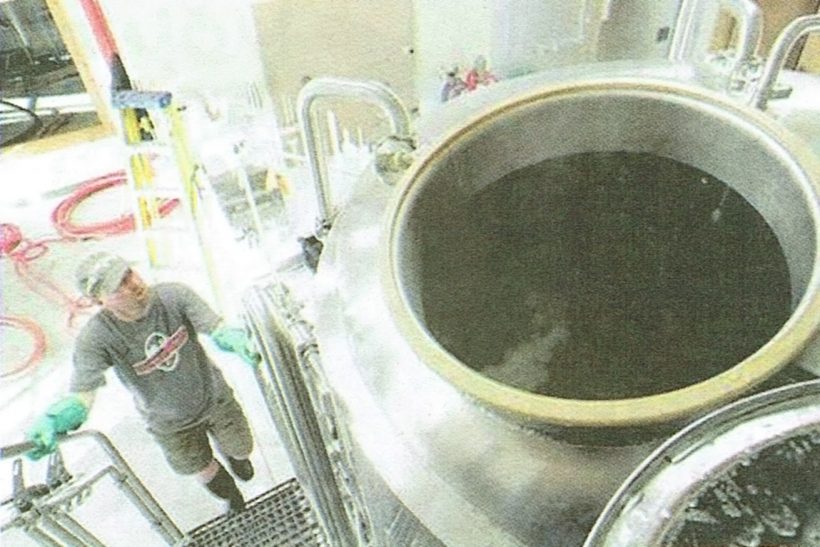
Dave Fleming, head brewer at Portland’s New Old Lompoc Brewery, commands respect in a town full of respected brewers. He does it by combining an openness to new flavors with a simple, straightforward brewing ethos. “I’m a purist,” he argues. “Look at the ingredients. Keep it simple. Use your eyes and nose.” The brew kettle isn’t much different than the stock pot, he says. “The stuff that’s really standing out is stuff that’s simple and fresh.”
1. Find out
Dave Fleming discovered good beer in the early 1980s, when he was a teenager and the brewing landscape was dominated by macro lagers and imports. His father bought a book that rated beers across the globe—Fleming picked it up and instantly got hooked. “It had something like 500 beers,” he recalls. “I had no idea there were that many beers in the world, that there was that much beer culture in the world. I thought, whoa, what’s this all about?” So he decided to find out.
2. We would not recommend it, either
Fleming started homebrewing in his college dorm. His first batch? “Shower Stall Stout,” he says. It was exactly what it sounds like: A recipe built off a can of extract, a glass carboy that needed to be topped off, and a dorm shower. “College, the mother of invention. It actually turned out pretty good. There was no infection, nothing went wrong. It was fortuitous, for sure.” He’s quick to add, though: “I wouldn’t recommend it to anyone.”
3. Venture off the path
When he was 25, Fleming moved to Portland, Ore., and started hanging out with fellow beer enthusiasts. “There was quite a buzz. Widmer, Full Sail, Bridgeport and Deschutes were rocking the world.” Fleming wound up brewing at the newly opened Lucky Labrador brewpub. “It was the second wave of smaller brewpubs. Bridgeport and Widmer had done their thing. They had a certain path. They knew they had to grow or die. It was very important for them to set a benchmark like that. The second wave captured the essence of, this is what Bridgeport did back then, and made it our own.”
4. Seek out genuine hearts
“I’m sure lots of people have a career goal and know what they want to do,” Fleming says. He didn’t set out to be a brewer. Instead, brewing grabbed him and wouldn’t let go. “For me, it was the attitude of the people behind it, the openness. It’s just such a good, genuine-hearted business. It wasn’t big business. It was, let’s get together and go out on a path, and I think we still do that to some point. The Lucky Lab was part of a revolution. I feel like we caught this wave and ran with it.”
5. Earn your place in Beervana
There is some pressure to keep up with Portland’s pioneering brewers. On the other hand, Fleming says, that challenge is eased a bit by the city’s fierce devotion to its favorite beverage. At the Lab, for instance, Fleming was brewing rye beers and aging in barrels before extreme beer existed as a distinct entity. “People are crazy here,” he says. “They will try anything. It’s such a great culture. If you don’t try, if you’re just going to rest on your laurels, you won’t get anywhere. There are just so many great brewers. You want to keep up with people. These guys are phenomenal. I feel lucky to be mentioned in the same sentence, or the same paragraph, or maybe even at the end of the book.”
6. Talk it out
Lompoc founder Jerry Fechter and Fleming were friendly during Fleming’s Lucky Lab days, and the two would trade recipe ideas over pints. Lompoc’s signature C-Note Imperial Pale Ale married Fechter’s malt bill with Fleming’s suggestion that Lompoc brew a 100-IBU monster with all of the seven hops that start with the letter C. That spirit continues now that Fleming is on the payroll. “We’d come up with so many ideas talking over beers. He’s very open. We’re tossing out ideas and just running with them.”
7. Get down with the funk
Fleming brought a serious nose for hops to Lompoc, but the biggest change he’s overseen has been a dramatic expansion of the brewery’s barrel program. At last count, he had 104 barrels worth of beer in wood “or in some kind of funkadelic position.” They include barrel-aged and -fermented ales, fruit beers in stainless barrels and a batch of Gueuze that’s been fermenting since Superbowl Sunday. One Pale Ale was aged and fermented in a Cab-Franc barrel with sour cherries. Lompoc has even opened a new tasting room whose only purpose is to host weekend tasting parties of crazy-ass beers. “We’re really trying to keep up with the Joneses, and also be a Jones ourselves.”
8. Fail to succeed
Not every experimental brew Lompoc puts out will be a killer. And Fleming’s OK with that. “We don’t mind making a few dogs if, every now and then, we make something phenomenal,” he reasons. “We don’t look at that as our bread and butter. It’s our fun project. We’re trying to learn as we go along.” The Superbowl Gueuze, for instance, was born because Fleming and Fechter had a spare barrel and some time to kill before kickoff. “It’s fun. It’s a hobby. Like going fishing. Why not? It’s not costing anything.”
9. Don’t forget the masses
For all the experimentation happening at Lompoc right now, the brewery remains driven by the volume of strong, hoppy beers. Fleming views the national craft beer landscape much the same way—he welcomes the industry’s rapid embrace of new flavors, but believes hoppy American ales will continue to dominate the industry. “The IPA is still number one. I can’t see sour beer selling that much. I love them, [but] how much can you really drink? We still make beer for the masses. And there are only so many times I want to brew a rye-mosa.” ■
 Previous: Running the Homebrew Rally
