
Pale Stout
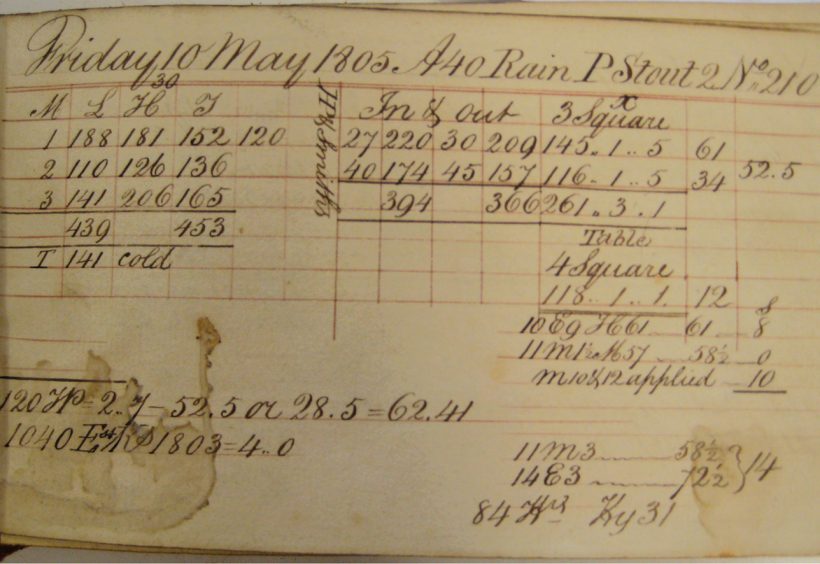
I know. Pale Stout sounds like a contradiction in terms. But if Black India Pale Ale can exist, why not Pale Stout? Going back to the original meaning of Stout, it’s not as daft as it first appears.
Stout only acquired its definition as a specific type of dark, hoppy beer in the early 19th century. Before that, it was a much more vague term, denoting a strong beer of any style. What we know as Stout today was initially, and more accurately, called Brown Stout, a designation that still lives on in beer names around the world.
I can recall my shock when I stumbled upon a Pale Stout in the brewing records of Barclay Perkins. P Stout was the beer’s name. What on earth could “P” stand for, I wondered? I twigged when I looked at the ingredients. There was only one malt: pale malt. I’d found one of the final brews of Barclay’s Pale Stout, a beer that had been of great importance for the London brewery in the second half of the 18th century.
“On the export of this expensive beer [Pale Stout] away from London, the brewery was able to outstrip its London rivals. For technical and economic reasons it was the expensive beers which were sent to the provinces and beyond the seas. First a rough sea voyage and a hot climate needed a strong beer to survive without depreciation, and therefore an expensive beer. Economically, too, a beer which was more valuable in relation to its bulk could travel to a wider market than the ordinary porter.”
“The Anchor Brewery, Park Street, Southwark” by Peter Mathias, in Brewery History Society Number 145, page 19.
That story of shipping beer long distances by sea sounds familiar. Here’s an intriguing thought: Was the early IPA a version of Pale Stout? Hard evidence about the first Pale Ales shipped to India is pretty sketchy. But we do know that they came from London and that the first to make a name for his Pale in India was Hodgson, a Porter brewer.
Examining Barclay’s Pale Stout closely, the answer is probably no. The gravity looks too high, the hopping rate too low and the attenuation too poor to be an early type of IPA.
Having already trawled through the earliest surviving brewing records from London, I doubted I would ever find another Pale Stout. Imagine my surprise and joy when I bumped into one in a most unexpected place: the brewing records of Devenish, a small, provincial brewery in the Southwest of England.
The location explains why they were still brewing a Pale Stout in the 1820s. Distant from London, brewers in Devon were likely to be behind the times, both in terms of brewing techniques and types of beer brewed.
 In the table, I’ve included Barclay’s Brown Stout for purposes of comparison. Before 1780, its grist was as simple as Pale Stout’s: 100 percent brown malt. By 1805, that had changed to 60 percent pale malt, 40 percent brown malt.
As Pale Stout faded from memory, the adjective in Brown Stout was rendered superfluous. The term “Stout” became exclusively associated with a dark, roasty beer. I think it’s time for a Pale Stout revival. ■
 Previous: "It's Just Beer."
 Next: A Note on Saisons