
New Legislation Brings Changes to Michigan’s Brewing Landscape
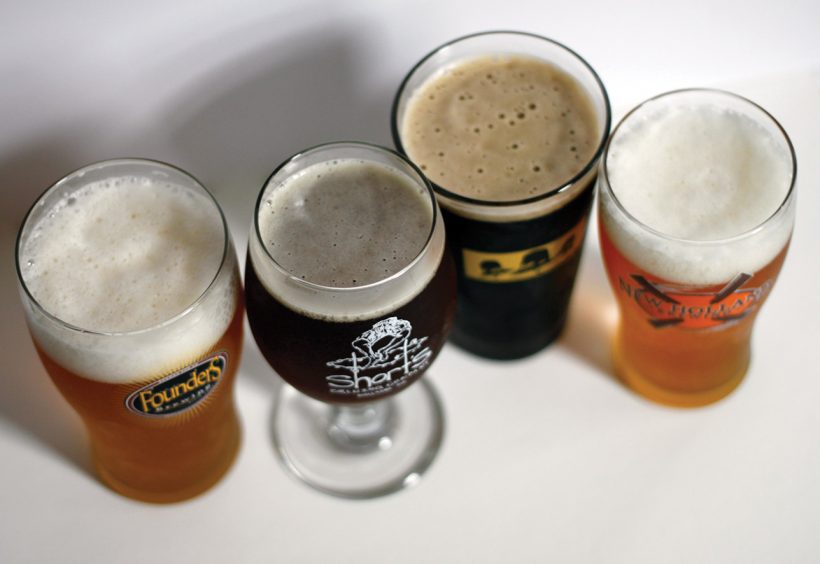
In March, when Michigan’s Republican Gov. Rick Snyder signed a nine-bill legislation package aimed at strengthening the state’s craft beer industry, it seemed like a toast was due for all involved. Topping states like Florida, North Carolina and Illinois, Michigan now has the fifth-most breweries in the nation, including companies large (like Bell’s and Founders, both in the top 50 according to sales volume) and small (like Beards, which produced just 250 barrels last year).
One of the biggest legislative changes is the new definition of a microbrewery. Upping the existing microbrewer threshold from 30,000 to 60,000 barrels, Public Act 42 has doubled how much beer a company can brew while keeping the same license. In most cases, the law simply avoids more licensing headaches for breweries like Short’s, one of the state’s fastest-growing beer businesses. As the third largest microbrewery in the state, Short’s is poised to produce more than 35,000 barrels this year with planned brewpub and production facility expansions, making it easy for them to get behind the new legislation.
“It is no coincidence that we announced our Bellaire expansion the day it passed out of committee,” says Scott Newman-Bale, a partner at Short’s. “It was important to know that the state agreed with us and the public in general that breweries add economic value and contribute to building a viable community.”
Michigan, along with California, Colorado and Oregon, has paved the way for favorable legislation for breweries and has seen tremendous industry growth as a result, says Paul Gatza, director of the Brewers Association. And craft breweries around the country continue to accumulate wins: in April, Tennessee passed a bill allowing the sale of high-gravity beers in supermarkets; in May, Florida won a major battle concerning growler sizes and distributor sales; and in June, New York passed legislation allowing manufacturing breweries to sell their beer on-premises. Yet some states, particularly those in the South, are still playing catch-up with their more progressive peers.
“Look at Colorado, Washington and California—there’s a reason they’re leading the country in this industry,” says Paul Leone, executive director of the New York State Brewers Association. “The laws are restrictive in many states because it’s beer; [lawmakers] still don’t see the bigger picture in terms of the jobs and economic impact this industry is creating. They will in time.”
Even in growing beer states, the fight isn’t always easy. In Florida, the growler law sparked major disputes between brewers, distributors and the state leaders. According to Josh Aubuchon, executive director and general counsel of the Florida Brewers Guild, everyone needed a month or two to “calm down.” Still, Aubuchon is excited to see real change—and a younger class of pro-craft beer legislators—in the government. “It’s wiping out the old guard mentality of how it’s always been done,” he says. “You get younger folks saying, ‘I love craft beer,’ which influences them over paid contributions.”
The major issues that Michigan brewers will fight for in the next legislative session are self-distribution laws (only breweries making less than 1,000 barrels can self-distribute now), brewpub licensing for off-premise distribution, and franchise law reform, says Gatza. “These battles pop up every year. There’s something going on in every state. It’s not like problems get permanently solved. Beer drinkers have to pay attention and stay vigilant.”
Nevertheless, even the smallest changes in legislature are promising to brewers. “Everything we’re working for is a stepping stone to creating a better industry as a whole,” says Benjamin Slocum, owner and founder of Beards Brewery in Petosky, Mich. “Everything is helping us move forward and grow.” ■
 Previous: Belle Royale by Driftwood Brewery
 Next: Out of Thin Air