
Dutch Oud Bruin
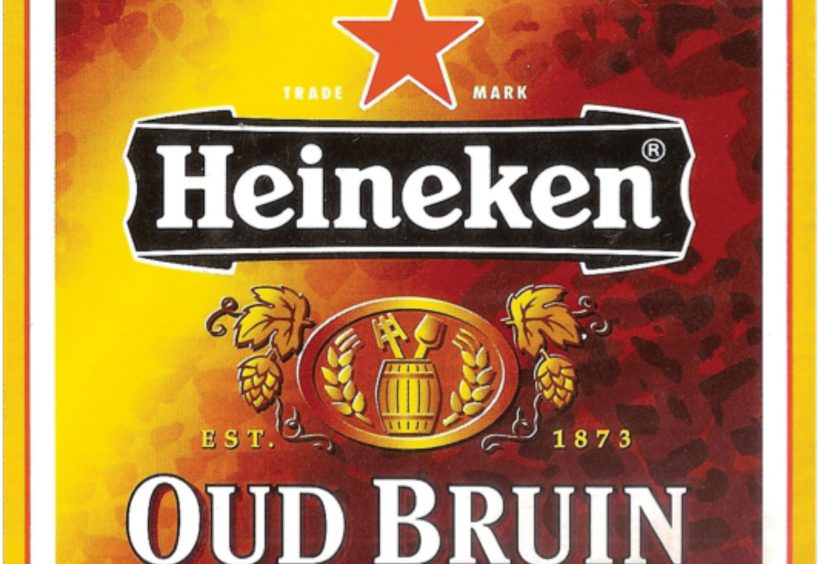
Whenever someone claims every style of beer is brewed in the US, my response is always: What about Dutch Oud Bruin?
It’s not so much misunderstood as totally overlooked. BeerAdvocate calls examples Euro Dark Lager, Belgian Dark Ale or Flanders Oud Bruin. On RateBeer sometimes it’s Low Alcohol, and sometimes Brown Ale. Euro Dark Lager, in all its vagueness, is the only one that’s reasonably close. Because Oud Bruin isn’t an ale and has nothing to do with Belgium.
So what is it? A surprisingly recent style for a lager, it appeared in the 1930s, when lager brewers in Northern Holland were trying to wean older drinkers in the South off traditional top-fermenting beers. Sweet, dark and low in alcohol, Dutch Oud Bruin was intended to resemble those older styles. But it was only after WWII that most brewers introduced one. At Heineken, Oud Bruin replaced the low-gravity Donker Lager they brewed before the war.
There was a top-fermenting style of Oud Bruin brewed in the 19th century that was similar to the Belgian version and had probably been around for centuries. Aged for years in oak vats and then blended with fresh beer, it was described as “strong and aged, at least as comforting as aged wine … powerful, tasty, bright.” So pretty much unlike the modern beer in every way. This style vanished in the early 20th century.
After WWII, as older drinkers began to die off, a new group of customers was needed, so Oud Bruin was unashamedly marketed as a beer suitable for women because it was sweeter. “Try a sip of your man’s Madame, you will certainly find it delicious as Oud Bruin is truly a treat!” claimed one Oranjeboon advert from 1957.
Here’s a Heineken advert from the early 1960s: “Yes you too, ma’am! Your husband will find it cozy if you drink a glass of Heineken Pils with him. That is modern. Or do you prefer to drink a sweeter beer? That’s possible! Try a Heineken Oud Bruin!”
As Oud Bruin’s popularity slipped, some brewers couldn’t be bothered to brew it separately and began concocting it from Pils, caramel and artificial sweetener. Lovely. Though, to Heineken’s credit, in the brewing records I’ve seen, it was always brewed properly.
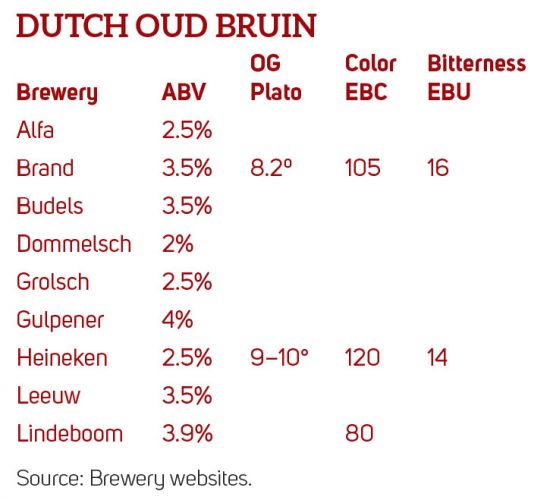 Modern versions vary between 2 percent and 3.5 percent ABV, as the table shows. Though I’d be suspicious of Heineken’s 2.5 percent ABV. In the brewing records I have from 1959, it’s actually just 2.25 percent, despite the label of the period claiming 2.5 percent.
My first encounter with the style was in Deventer, a pretty town in Eastern Holland, during the second stop of a beery trip with a couple of mates. Tiring of an endless diet of Pils, I asked the barman if they had any dark beer. They did. I got all excited when it poured the color of Dark Mild. That excitement disappeared on the first sip: thin and ridiculously sweet.
Not having tried one for years, I decided to pick up a bottle. It was harder than I expected. The supermarket didn’t stock any. Even my local off-license, which stocks hundreds of beers, only had one example (Heineken), hidden away in a dark corner. It looks pretty in the glass, dark brown with red highlights. The aroma has a touch of smoke and fruit, but in the mouth it’s very sweet and thin, the sugar sweetness almost totally overpowering everything else that might be going on. Not great.
Given its characteristics, I can’t see anyone rushing to brew an Oud Bruin in the US. Then again, maybe someone will prove me wrong. ■
 Previous: Dizzying Prospects
