Robert Turley, Head Brewer, Community Beer Works
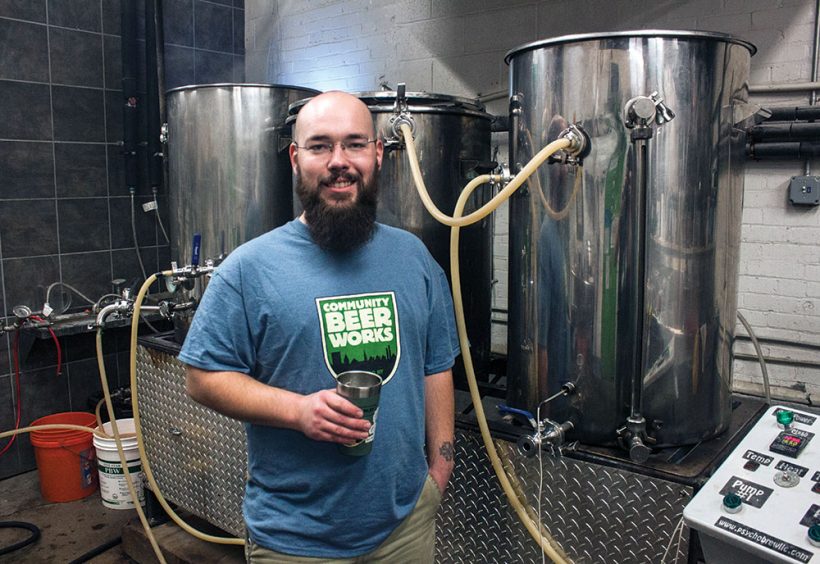
Robert Turley sees potential in his hometown of Buffalo, N.Y. “When you look around here, you don’t see as much industry anymore, but you see the effects of industrialization, and it’s suited for making beer,” he argues. “Beer can be a driver of productive American jobs in this area.” As head brewer of the fast-growing Buffalo nanobrewery Community Beer Works, Turley and his brewing crew churn out flavorful American ales that reflect the city’s character. “This is where I’m from; a large chunk of this company are Buffalo natives,” Turley says. With a bigger production space and a Niagara Falls brewpub in development, Community Beer Works will be able to reach even more of its neighbors. “The name says it all: We have a desire to not only make beer, but to build a better community.”
1. Get obsessed
Before Robert Turley was a brewer, he was a home cook and baker. Homebrewing, a habit he picked up from a roommate, scratched the same itch. Turley credits Ithaca Flower Power IPA for turning him on to better beer. He quickly grew obsessed, building his own equipment and buying grain by the sack. “I was making beer in my basement constantly,” Turley recalls, “and I decided I had to make this a career, because, otherwise, I was going to go broke.”
2. When things fall from the sky, catch them
“I had this impression that one has to go to school, that there’s this certificate that makes you a brewer,” Turley recalls. Not so at Community Beer Works, a collaborative nanobrewery launched by a group of Buffalo homebrewers in 2012. While working at local bottle shop Village Beer Merchant, Turley wowed the team with his homebrew recipes, and managed to turn a brewhouse internship into a job, eventually working his way up to head brewer in February 2016. “This is something I had wanted to do for a long time, and it came out of the sky,” Turley recalls. “I figured it would be 10 years before I got to do recipe development.”
3. Build community
The founders’ original vision of a homebrew collective still guides Community Beer Works: The brewery is deeply rooted in its surrounding community. “We’re trying to be Buffalo’s brewery,” Turley explains. “We do our best to draw in people from all walks of life, and engage people, not just around beer, but also around their lives.” And any growth comes with locals in mind. “We don’t have ambitions to go to other states or countries. We’re concerned with filling every glass in Buffalo with our beer.”
4. Tell a story
Community Beer Works brews four core beers—a Pale Ale, a Brown Ale, a Cream Ale, and an IPA—alongside scores of rotating seasonals and one-offs. When Turley’s experimenting, he’s as likely to be trying to dial in a historical style as he is to be dabbling in extreme ingredients. “Historical beer styles are a good counterpart to the weird, wild American innovation we all love so much,” he says. “There are so many options [for] the customer, so if you can tell them a story—this is what this beer used to taste like, like a time machine—it grabs people’s attention.”
5. Hang with a neighbor
Frank, Community Beer Works’ flagship Pale Ale, aims to be a subtle standout. “Frank is designed to be a beer you could drink every day for the rest of your life,” Turley explains. Its malt base—a blend of Pilsner, Weyermann Abbey, Cara Blond, and Acidulated malts—is far lighter and crisper than a traditional Pale, while a blend of Columbus, Centennial, and Zythos hops contribute notes of pine and grapefruit. “It’s like a piece of toast with orange marmalade,” Turley says.
6. Keep things dark
“If you want a hoppy Brown Ale,” Turley theorizes, “what you really want is an IPA.” Because he gives hopheads their fix with his well-stocked IPA arsenal, Turley’s been able to dial back the hop presence in The Whale, his flagship Brown, while refocusing the recipe on dark, complex malt characteristics. It’s roasty, with lots of chocolate and coffee, and it’s far darker than a traditional Brown would be. “You can have it with a burger, a steak, with jambalaya. Whether you’re eating something spicy, salty, rich, hearty, or greasy, you want The Whale to stand up to it.”
7. Hop in the pool
The current iteration of Turley’s flagship IPA, dubbed That IPA, was forced into existence when Community Beer Works couldn’t maintain a steady supply of Galaxy hops. In the reformulation that followed, Turley lightened his IPA’s body and alcohol content. He not only dropped Columbus hops, but ceased using any hops in the boil. Instead, Turley dumps “a tremendous amount” of Simcoe, Mosaic, and Zythos in the whirlpool. “There’s enough bitterness for the style, and it’s really changed the mouthfeel and aromatics,” he says. “Those palate-wrecking IPAs still have fans, but others who are getting into craft now don’t have that masochistic love of bitterness. So we’ve balanced it out.”
8. Sip the sun
Community Beer Works rings in the summer months with Rutherford B. Haze, a wild mashup that Turley describes as lingering “fairly off the beaten path.” Haze drinks like a drier cousin of a Belgian Blonde, but with a hop profile reminiscent of a Pale Ale, and loads of Saison-ish esters, thanks to Westmalle yeast. “It shares characteristics with all those styles, but it falls between all of them. It’s a good picnic beer: it looks like sunshine, and you can pair it with a hot dog and potato salad.”
9. Grow up
Community Beer Works’ original 1.5-barrel nano system has fostered creativity across the crew, and helped impose a discipline geared toward making every keg count. But after years of grinding out tiny batches, the team is confronting the imperative of growth. “If we want to be more than a novelty, we have to be within customers’ reach, consistently,” Turley argues. Two expansion projects—a 3-barrel brewpub in Niagara Falls, and a new 20-barrel Buffalo production facility, taproom, and kitchen set to open later this year—will enable Frank, The Whale, and That IPA to reach all of Western New York. “But we’ll also keep what we have here now, to do weird little one-offs, and keep the brand weird.” ■