
Josh Davies
How to go from being you to a Ringwood yeast tamer in nine easy steps
 mlive.com
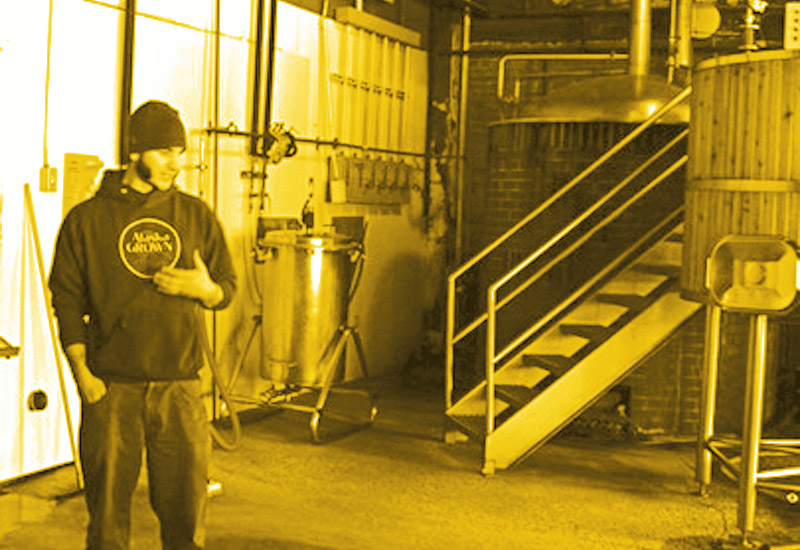
Why is Arcadia Brewing Company growing rapidly and gaining fans far outside its Michigan home base? For one, its head brewer, Josh Davies, goes to work at 3:30 in the morning to make sure his yeast is happy.
1. Good people will lead you to good places
A couple weeks after Davies turned 21, he and a friend drove up to a local beer fest. He was looking for a good time, not a career. “We had Oberon, we’d rock some Guinness, we’d rock some Bass, but nobody knew anything about microbrewed beers,” he says. The two hung out and drank with the brewers at Arcadia all day; the brewers wound up inviting Davies over to the brewery. Every Monday for two years, he volunteered on Arcadia’s bottling line, learning about brewing and getting drawn in deeper and deeper.
2. Come on home
Davies worked as an EMT and homebrewed on the side. “It got to the point where I thought, saving people’s lives is sweet, it’s fun and it’s a big adrenaline rush, but I just really want to make beer.” He landed a job running the Michigan Brewing Company’s homebrew shop, and immediately began working over the owner and production manager, begging them to let him inside the brewhouse. He eventually got in, rocked it, and brewed for Michigan for two years—until his buddies at Arcadia called him up and asked him to come home. “It was awesome,” he says. “My heart didn’t quit racing for a week.”
3. Get tanked
I ask whether Davies’ initial homebrews were any good. He laughs and says he never had a chance to make bad beers. A friend had sold him a $1,000 homebrew system, complete with several kegs, carboys and a counterflow heat exchanger, for $100. The friend threw in an oxygen tank. That’s what made everything click. Davies, the EMT, was “directly oxygenating batches with medical-grade oxygen. It wasn’t like I was going out on a limb and making crazy recipes. The beer was sweet by default because my yeast was so healthy.”
4. Sad yeast equals bad beer
“If you make your yeast happy, then you’re in style,” Davies says. “To me, that is the, the most important thing in making beer: knowing what it wants, making sure you give it what it wants. And I learned really early.” Arcadia uses a single strain of Ringwood yeast. It’s nearly 200 generations old. The brewery can keep repitching it because it uses a Pugsley system with open-top fermenters. “After two and a half days, when our yeast is as happy and viable as possible, we scoop it right off the top,” he says. “It never gets a chance to go to sleep. It never gets a chance to go on vacation.”
5. New recipes, old school
Arcadia brews adventurous, modern American beers, but operationally and philosophically, it’s a traditional English alehouse. Arcadia’s founder, Tim Suprise, is “in love with English ingredients, and really romantic about the process,” Davies says. Open fermentation and forward-flavored malts go to the heart of that. “He wants us to have that connection to the old school, to be able to say, we’re still doing it the way they did it—but look at our beers, taste our beers. They sure as shit don’t taste like an IPA from 1843.”
6. Complexity tastes best
One of Arcadia’s most insanely tasty beers, HopMouth Double IPA, is the work of former head brewer Bryan Wiggs, who’s now at Dark Horse Brewing. He and Davies have been tight since they were teenagers. “It’s our regular IPA on steroids,” Davies says—the same ingredients, with the hops and IBU doubled, and the malt base bumped up by half. Ten pounds of Cascade hops steep in the hop percolator six hours before being pushed through the wort. But, in Davies’ mind, it’s Maris Otter malt that makes HopMouth special. “The complexity of that Maris Otter really plays on the lingering floral of the hops. For the beer to be based on the silky-smoothest, maltiest base malt that there is, says something for our product—at least we hope.”
7. Let the balance tip
Davies is proudest of his Hop Rocket Imperial IPA. “It’s completely different than everything else,” he says. “Arcadia has always been malt up front. We wanted something kind of like HopMouth, but something that wasn’t so balanced, something that skewed to the hops, which is something Arcadia had never done. We get to use a stupid amount of Summit. You drink it two weeks after it’s bottled, when the hops are still really outrageous in your nose. It’s like heaven.”
8. Follow the light
Another recent favorite is Sky High Rye. It’s heavy on Centennial and Simcoe hops, though it’s lighter than anything else Arcadia brews. “If you didn’t know what you were looking at, you’d be sure it’s a Molson Golden.” His first rye beer, a winter seasonal for Michigan Brewing, was an homage to Founders Red’s Rye. Davies wanted to step out on his own this time around. He shot for a light, drinkable, hop-forward beer at 5-percent ABV and overshot his mark a bit. “I just killed it the first time we brewed it, and it was so good, we couldn’t dumb it down from there.”
9. Follow the trailblazers
Michigan doesn’t immediately jump out as a beer-making hotbed—until you start ticking off names like Founders, Short’s, Dark Horse, Jolly Pumpkin, New Holland, Kuhnhenn and The Livery. Great breweries all around—all thanks to Larry Bell. “Uncle Larry paved the road for everybody else,” Davies says. “You’ve got a ton of brewers in the state under 30, and we all grew up drinking Bell’s beer, long before we were supposed to be drinking it. We had something that was cutting edge, and we didn’t even know. We just knew we liked to drink it.” ■
 Previous: Cuckoo for Cocoa
