
Collaboration Homebrews
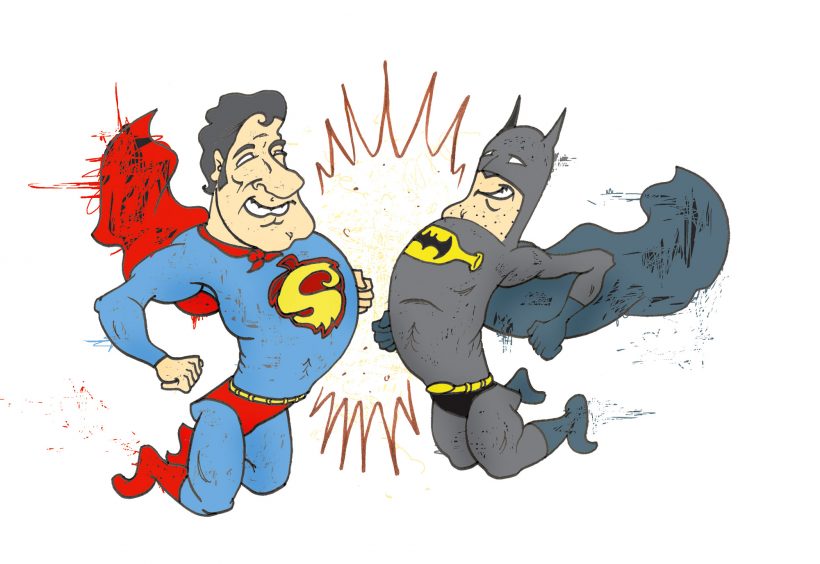 Illustration by Scott Murry
If you’ve ever seen any of Jonny Lieberman’s online photo essays and odes to brewing mayhem, you know he and I believe in the power of collaboration. Done right, the different brewers can express their own distinct personalities while bringing their focus to generating something new.
For us homebrewers, collaboration is easy and low risk. After all, if we don’t get it right, we lose 5, 10 gallons? Heck, if you’re lucky, you and your partner know enough suckers to drink free bad beer. To my great chagrin, I swear I’ve garnered way too much praise for beer I’ve just wanted to pour out.
The professional brewer has far more risk involved in collaborations. Even at the smallest commercial scale, you’re talking several thousands of dollars of real expense and profit. And yet, today more than ever, we’re seeing a never-ending stream of bold collaboration brews.
Many choose to push way out there with their experiments, jumping from their usual beers to triple-decocted, cassis-infused, hop monster, bourbon oak Imperial Stouts. They command high prices, fervent devotion and insane trade demands akin to a sweetheart four-way trade for (in their prime) Manny Ramirez, Pedro Martinez, Curt Schilling, a piano and 10 players to be named.
However, Garrett Oliver, brewmaster at Brooklyn Brewing and James Beard nominee, plays with a more traditional palate. Classically minded and influenced by the world of European brewing, both Oliver and Hans-Peter Drexler, the brewmaster of Weissbierbrauerei G. Schneider & Sohn, brought a different take to their transatlantic crossover, Brooklyner-Schneider Hopfen-Weisse and Schneider-Brooklyner Hopfen-Weisse. What? You thought they’d brew Stout at the world’s finest Weiss brewery?
The end result was a unique creation. Unlike Schneider’s wicked Aventinus Weizenbock and Brooklyn’s Weizenbock, the Hopfen is pale and hoppy. The concept flies in the face of conventional wisdom by combining Schneider’s bold hefe strain with a blast of aromatic hops. Cloves, bananas, bubble gum and hops together? This is just not done. Too much clashing! But the brewers intuited the magic would work.
Now wrap your head around this: Not only was the Germanic-rigid, traditional Schneider doing a pale, hoppy, non-decocted, dry-hopped beer; they were doing it with their first guest brewer in their 400-plus operating years. Of course, Oliver and company returned the favor shortly by asking Drexler to take the helm at the Brooklyn brew deck.
To add to the fun—and remember, for professional brewers, endlessly rebrewing their main line is fun stuff—the hop varieties were chosen by the non-native brewer from the local supply. Oliver chose the sweet and citrusy Hallertauer Saphir. At Brooklyn, Drexler, confronted with 15 different American varieties, chose Palisade and Amarillo from his samples. Each batch was built on 50/50 Weyermann Wheat malt and Pilsner malt that went through five steps of mashing to achieve a roughly 1.081 OG. Fermented with Schneider’s house yeast at 69°F, it was cold crashed and then raised back to 60°F for a week of dry hopping. And here’s my favorite difference: The Germans removed the spent hops via centrifuge. Brooklyn took the decidedly low-tech approach of hand filtering with cheesecloth!
On every step of this oceanic adventure, the two partners pushed themselves to take calculated risks. Thinking about brewing and collaborating, Oliver stated, “Brewing is like cooking—think about what flavors and aromas you think might work together. I also like for the beer to have a particular meaning for me.” The final beer thus ended up a unique German-American hybrid that clearly reflects both Oliver and Drexler, and their friendship. That same sort of spirit is what infuses those silly misadventures that Jonny and I get into. Look at things like the Gonzo Hemp Poppy Spirit Wine—is that really the work of one misfit?
Thanks to Oliver for collaborating with us on this article!
HOP-FEN WEISSE PALE WEIZENBOCK “INSPIRED CLONE THINGY”
For 5.5 gallons at 1.084, 4.5 SRM, 46 IBU, 90 minute boil, 8.2% ABV
Malt / Grain
8.0 lb. Weyermann Pilsner malt
8.0 lb. Weyermann wheat malt
Mash Schedule
Strike 99°F 20 minutes
Protein Rest 122°F 20 minutes
Beta Rest 146°F 20 minutes
Saccharification Rest 153°F 20 minutes
Mash Out 167°F 10 minutes
Hops (Pellets) – The German Version!
0.75 oz Magnum | 14.0% AA | 60 minutes
1.00 oz Hallertauer Saphir | 4.5% AA | 15 minutes
0.50 oz Hallertauer Saphir | 4.5% AA | 5 minutes
0.50 oz Hallertauer Saphir | 4.5% AA | dry hop
Hops (Pellets) – The American Version!
0.75 oz Magnum | 14.0% AA | 60 minutes
0.25 oz Amarillo | 8.1% AA | 15 minutes
0.25 oz Palisade | 8.0% AA | 15 minutes
0.25 oz Amarillo | 8.1% AA | 5 minutes
0.25 oz Palisade | 8.0% AA | 5 minutes
0.25 oz Amarillo | 8.1% AA | dry hop
0.25 oz Palisade | 8.0% AA | dry hop
Yeast
Wyeast 3638 Bavarian wheat yeast | White Labs WLP351 Bavarian Weizen yeast ■
 Previous: The Death of the British Pub
 Next: Al Marzi