
Blue Hills Brewery
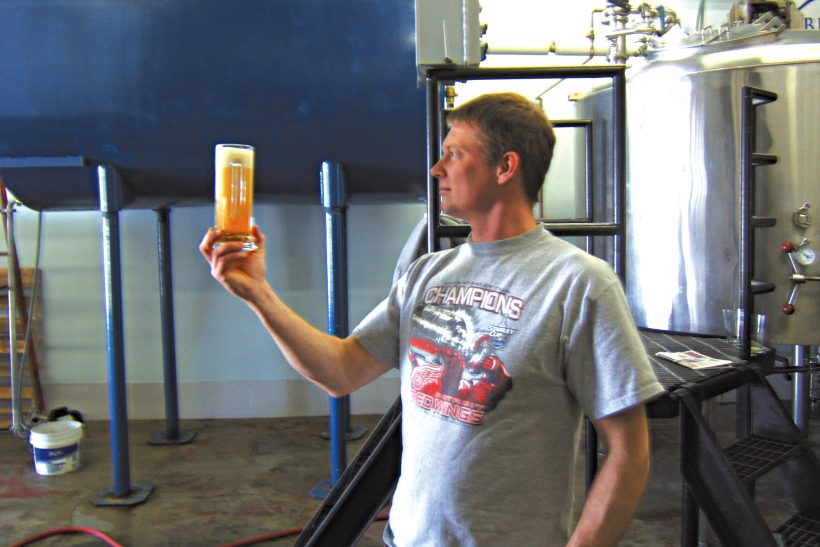
Beer talk in New England covers a myriad of topics. There is talk about East Coast breweries brewing West Coast-style beers; there’s talk about the perfect beer for the ever-changing seasons; and there’s talk about the merits of large and small breweries. One thing that doesn’t come up very often: Latvia.
But if Latvia had never joined the European Union in 2004, Massachusetts would be without one of its newest craft breweries. After joining the EU, property values in Latvia shot up and suddenly it was no longer economically feasible for Andris Veidis and Peter Augis to build the brewpub they’d imagined in Europe. Instead, Veidis began searching for space close to home, which is where he found a warehouse in Canton, Mass., and opened up Blue Hills Brewery in August 2008.
“Because I lived in Canton, I kind of focused my search around towns that had a decent industrial space,” said Veidis, who serves as Blue Hills’ head brewer and is a managing partner along with Augis. “Primarily, I searched up and down Route 1 in Massachusetts.”
Veidis, who, along with his partners, is of Latvian descent, got his first taste of brewing as a homebrewer, but didn’t break into the industry until 1994 when he worked as an intern at Harpoon. After cleaning kegs and learning the ropes, Veidis went to California to study at the American Brewers Guild. He returned to the East Coast and became an accomplished head brewer; he brewed at Beer Works in Boston and Salem, and began formulating his plan for a Latvian brewpub in 2004. He had to switch his plan around to work for the American market, and when he did, he found a location close to his home.
“In ’96, I took a trip with some buddies and we were talking, and I had done some, I won’t call it ‘soul searching’ because I’m not that Zen type of person, but I had done a lot of thinking about it and kind of came up in my own head with a 10-year plan,” Veidis said. “Basically, my five-year plan was to go to school for brewing and be a head brewer, an accomplished head brewer and a recognized brewer, and my 10-year plan was to be an owner/partner.”
After finding the space, the next step was building the brew house. Nobody was selling a complete brew house. So instead of waiting for one to come on the market or to fork over thousands of extra dollars on a new system, Veidis did his best Dr. Frankenstein impersonation and began to piece together a brew house from used parts from around the country.
By December, with parts from both coasts, Veidis had a steam-jacketed 20-barrel kettle, hot liquor tank and mash tun ready to brew. Blue Hills Brewery was born, and its first words were “Pale Ale.” More specifically, Blue Hills brews an India Pale Ale and an Xtra Pale Ale, and the first batches were fermenting away on New Year’s Eve 2008. A little over a week later, Veidis introduced the two beers at the Boston Beer Summit Winter Jubilee.
“It came out basically: Thursday I filtered, carbonated, and Friday morning I kegged up both batches,” Veidis said. “Friday afternoon, we loaded up the truck with four kegs and went to the summit. I thought it tasted great. And as it turns out, especially the first night of the summit, … there was already a small buzz about us, it was definitely a good kind of unveiling, especially within the industry.”
In its infancy, Blue Hills started with just two offerings—the IPA and XPA.
“I wanted to offer these two from the get-go because they’re kind of a couple of steps apart from each other,” Veidis explained. “I had a very good idea that I wanted to do an IPA because it’s one of the most popular styles of microbrews being sold right now, especially on the East Coast. We lack behind the West Coast a bit, so to get a creative, a good-tasting IPA into the market can kind of set your foundation as a microbrewer. If you go in with some kind of sissy beer—if we started off with a Blueberry Hefeweizen as our flagship beer—people would be like: ‘What’s going on? You’re making girly-girl beer.’”
Some may think to themselves that the last thing the craft beer world needs is another brewer taking a lot of malt and a lot of Cascade hops, and acting like it’s brand new; well, Veidis tends to agree. Instead of using the Cascades that have become synonymous with American IPAs, Blue Hills uses Summit and US Goldings hops for flavoring and bittering their IPA and XPA. The result is a smooth-tasting and well-balanced beer.
“I kind of wanted to veer away a little from that,” Veidis said. “That’s when basically, over the summer, I was doing all-grain homebrewing primarily to experiment [with] what type of hops we wanted to use. I find that the hops we do use, the Summit hops, give it a nice tangerine nose, a little citrusy nose, and a very mild bitterness to it. It’s fairly well palatable.”
Drinkability was also in Veidis’ mind when he formulated the XPA. On one hand, he wanted to create a beer that everyone could enjoy—especially in the rapidly approaching summer—and he wanted it to be something that was recognizably different from his IPA. He then had the arduous task of performing the research necessary to compare his brew to the lighter Pale ales already on the market.
“I went out and tried to pick up as many of the micros, the Golden Ales, the Blonde Ales that I could find, and after tasting them all, I noticed that they all had a residual sweetness,” Veidis said. “To differentiate my Xtra Pale from the Golden Ales and the Blonde Ales, I let it ferment out a little more. There’s less sweetness left over and you get a little more malt character to the palate. There’s a little dryer malt taste—hence the extra pale part, as opposed to calling it a Dry Blonde or something.”
What resulted was a crisp, Golden Ale that has emerged as the brewery’s biggest seller at sports bars and the like, with the IPA gaining popularity in the beer bars near Boston.
Blue Hills entered the market with just two offerings, but has plans to up the production this summer to four or possibly five beers. Plans are in the works for a Red Ale, and either a fruit beer or a Hefeweizen as summer seasonals. And although Blue Hills could be found on tap in about 30 locations in the middle of March, that number is steadily rising as more people begin asking for the beer by name. Augis put Blue Hills in touch with a distributor who could distribute into New Hampshire, and the brewery plans to invade liquor stores as well.
Almost as soon as they began brewing the beer, Veidis and Augis were working on setting up a contract brew at Mercury Brewing in Ipswich—which operates a bottling line and could open up a whole new market for Blue Hills. “When stuff like that starts popping, yeah, it’s only going to start expanding, only going to grow,” Veidis said.
Blue Hills Brewery
Opened: June 2008
Head Brewer: Andris Veidis
Assistants: Peter Augis
The Brewery: 20-barrel capacity, with two 20-barrel fermenting vessels, two conditioning tanks and one bright-beer tank. The brew house is a “Frankenstein” system that uses used parts from all over the country. Most of the tanks came from the West Coast, with the cooperage coming from New England. Other items came from New York and New Mexico.
Core Brands/Styles: India Pale Ale (made with Summit and US Goldings hops), Xtra Pale Ale (fermented dry with a light, malty backbone)
Seasonals: Red Ale in June; summertime releases of either a fruit beer, a Hefeweizen or both
Sold In: Greater Boston area bars and along the south coast of Massachusetts, with plans to distribute as far as New Hampshire ■

