
The Magic Craft: A Norwegian, an Arrogant Bastard and a Wizard Brew a Beer Together
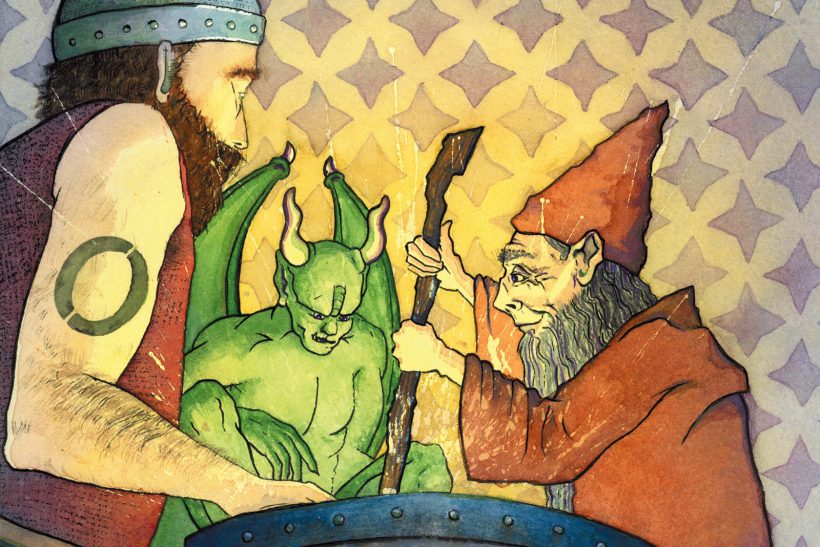 Illustration by Sarah Kim
It happened last fall in southern California—the place where Disneyland touched down and, if you buy the company line, the place where dreams come true. The epicenter of North American magic. Just about 80 miles down the 5 from the Magic Kingdom, Stone’s Mitch Steele (brewer of Arrogant Bastard), Jolly Pumpkin’s Ron Jeffries (the wizard) and Nøgne-Ø’s Kjetil Jikiun (the Norseman) came together to create a beer that bubbled with their respective sorceries.
It took 13 hours to brew, as Stone’s brewing equipment struggled to make sense of exactly what kind of foreign grist—rye, oats, chestnuts—these men from the East had dropped into the kettles. And then another 13 hours the next day. But, finally, the Holiday Ale took, hit markets and received, by all accounts, rave reviews.
“We couldn’t get the wort to lauter,” Steele said. “Our equipment is pretty new, and we’ve never had to deal with something like that.”
“Fortunately they have a lot of staff there,” Jeffries said with a laugh. “Mitch and Kjetil are coming out in April to brew the beer here. Hopefully, we won’t have as much trouble. There’s no one to take over second shift here.”
As the market for craft beer gets increasingly saturated with the bizarre, the odd and the semi-revolutionary, American brewers are finding more ways to innovate. An industry that derives its essential energy from flying on the fringe must, like all things that exist in extremes, push endlessly toward the edge. And it’s a testament to how far craft beer has come in America that not only are American brewers still brimming with creativity, but also with skills and flexibility that was virtually alien to this country a decade or two ago.
From barrel aging to Brettanomyces, from making Stouts that taste like peanut butter and jelly (Short’s, Michigan) to ales that taste just a bit like ham on rye (Three Floyd’s), traditional styles mean less than ever before. The trends in craft beer have gone from merely riffing on styles to crafting genre-shattering beers. And, finally—toward working together.
And that creativity, coupled with a growing ability to work, well, magic, together might make this period of beer history one of its finest. Just as importantly, it looks to keep craft beer’s profile sweeping forward.
“I just did the ‘25 random things about you’ on Facebook—my wife made me do it—and I commented on that,” Steele said. “I’ve been telling people that, for years, there’s been nothing like this ever in the brewing industry, and to be a brewer now is unbelievable. People 100 years from now, 200 years from now, they’ll look back and say that was a period of intense creativity and throwing out old restrictions.
“The only time that might compare to it is when they started brewing Pilsner beers in the 1840s and were just getting into pale malt and all these golden beers were coming out that were totally revolutionary.”
The resultant brew that came out of the summit at Stone was anything but pale. Intended to use indigenous ingredients from the three brewers’ locales, the three got close. The white sage came from the California farmer that supplies the Stone café with produce. Most of the chestnuts came from Michigan, where Jolly Pumpkin’s based. And while they couldn’t bring in juniper berries from Norway, they settled on bringing them in from Europe, and used Italian juniper. Then came the rye. And caraway.
In that cauldron, we see a microcosm of modern American brewing. We see risk. We see joy. We see a myriad components coming together from all around the globe to create a whole greater than any of its parts—a whole that hasn’t been done before. Ever.
“American brewers have stepped up to the plate to create things that they’ve never created before,” said Charlie Papazian, founder of the Brewers Association and author of The Complete Joy of Homebrewing, among other books. “No other place in the world do you have brewers that are willing to put it all out on the line and go up to bat and hit as many extra-base hits as possible.”
We see, most importantly, a rejection of the traditional. When craft beer was first re-learning to walk after the repeal of the laws barring homebrewing, a whole world opened up to Americans. So, American brewers started with the basics, Steele said—“it was like, ‘Let’s brew English ales because we didn’t have those.’” Now, after those first steps taken 30 years ago, the industry’s in a sprint to do something that hasn’t been done before, he said.
“Styles mean nothing to me,” said Dan Carey, brewmaster at New Glarus Brewing Company in Wisconsin. “Styles are a homebrewing development, an aberration. … You rarely hear a painter say, ‘I am trying to copy Rembrandt.’ If they do, they’re thought of in lesser terms. Or, a rock band saying, ‘I’m gonna get real famous, I’ll sound exactly like the Eagles.’
“I’m passionately against it and angry about it,” Carey continued. “It’s something being forced upon us by the AHA, for example, because it squelches creativity. They say, ‘What kind of beer is Spotted Cow?’ It’s my beer. I don’t give a shit, it’s my beer.”
So we see loose, inclusive terms, like “American Wild Ales,” used to describe the spontaneously fermenting elixirs of breweries like Jolly Pumpkin, Allagash and Short’s that have their roots in Belgium but their blooms in America. Or breweries like Vinnie Cilurzo’s at Russian River throwing “whatever we want” into a beer and calling it a Bier de Sonoma, riffing off the Bier de Garde.
Iconoclasts, craft brewers have become. But iconoclasts require one essential factor if they’re to be remembered as more than vandals: talent. Anyone can tear down a pillar. Few can improve on it. But, to borrow from President Obama’s inaugural address, artists—with brewers included in the bunch—must be remembered for what they create, not what they destroy. And the difference lies in the ability to rival and surpass the masters.
Jim Koch’s first brewmaster at Sam Adams was a carpenter. For comparison, Carey apprenticed in Germany, studied at Siebel in brewing technology and earned a master brewer certification from the Institute of Brewing and Distilling.
Above all, the beers have begun to speak for themselves. Take sour beers, a broad genre that has taken off in this country thanks to the efforts of companies like Jeffries’ and Allagash. By nature, sours make mass production and speed pretty much impossible. As craft brewing goes, they represent one of the most involved forms.
“The souring process and barrel aging is the most craft thing we do [as an industry],” said Jason Perkins, brewmaster at Allagash. “There’s a lot of feel to it, trial and error. You gotta get to know the bugs, cliché as it sounds. They’re living organisms, they do what they want and you gotta point them in the right direction.”
And not only are the beers complex. They’re good, at least as sales would dictate. As such, American brewers have landed, Carey said, at a crucial intersection. “What’s important is the Holy Grail,” he said. “To take complexity and marry it to drinkability.”
And now, a funny thing’s going on in craft beer—and it’s been gaining speed for quite some time. Something very American, yet at the same time, decidedly pre-modern. That is, simply, working together.
“I don’t even know if [collaboration] is a trend anymore,” said Cilurzo, co-owner of Russian River. “It’s amazing how many things have been done together. … It shows how unified our industry is. I remember Sam [Calagione, of Dogfish Head], in his keynote speech a few years ago at the Craft Brewers Convention, [said] that the industry is 99 percent asshole free. Companies getting together doing beers shows that.”
Back to that pre-modern idea. This country’s current economic infarction traces itself along lines of greed. Of exploitation. Collaboration rallies against that. It rejects the leapfrog notion of capitalism that’s led us to where we are now and embraces the cosmopolitanism of our national ideals, not our national practices.
Imagine Harley-Davidson splitting cylinders with Kawasaki. Or the tinny voice at the Burger King drive-thru rasping, “Do you want a McFlurry with that?” Breweries at this level are sharing more than ever, pooling their respective talents to push this industry forward into a greater future, one in which the edge will, once again, become the norm.
“I don’t feel [the market] is getting saturated because people are coming our way,” Carey said. “We have a long way to go and all of us together are chipping away.
“Not too long ago a successful beer was defined as a beer that had absence of off flavors—now it’s something defined as adventurous,” he continued. “Would you want friends or food or beer to have absence of eccentricities? Of course not. You want things that aren’t boring.” ■
 Previous: Blue Hills Brewery
 Next: Tampa