Jeff O’Neil
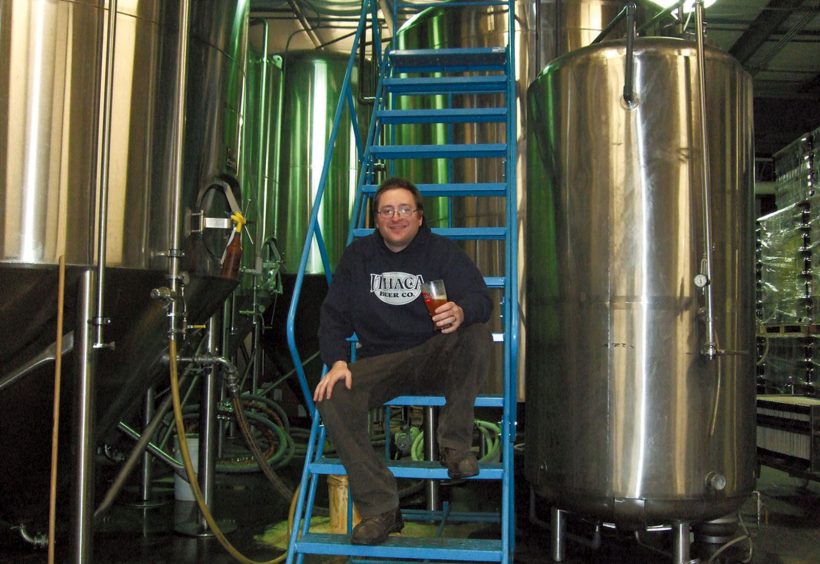
A decade ago, Jeff O’Neil was drinking Racer 5, growing hops in his backyard and sending résumés to every brewery in the Bay Area. Now he’s brewing West Coast-leaning ales out east, at the ever-expanding Ithaca Beer Company. There’s no secret to Ithaca’s growth, O’Neil says. It’s just sweat and passion. “Many times, I realize, I’ll be describing a beer as my baby. But I have an actual, literal baby. But I do think of beers as an extension of myself, and I spend a lot of time making sure they’re the best they can be.”
1. Sink those teeth in
Jeff O’Neil grew up in upstate New York, but fell in love with beer a decade ago, while he was living in San Francisco. He immersed himself in hoppy, flavor-forward brews from Sierra Nevada, Anchor, Bear Republic and the Twenty Tank brewpub. “I immediately latched onto hops as my favorite part about craft beer,” he says. “Every brewer has a particular part of beer they really sink their teeth into, and for me, it was hops.”
2. Dirty work begets glamorous titles
O’Neil learned the trade at Drake’s Brewing and the Jupiter brewpub before moving back east in 2002 and catching on at Ithaca. “We were so small then, it wasn’t even as an assistant brewer,” O’Neil recalls. “It was just a guy who did what needed to be done, working in the retail store, washing kegs, all the dirty work, without even the glamorous title.” He did the dirty work, moved up the ranks and eventually moved up to executive brewer. “I worked really hard for several years without really being able to put my own stamp on it, and it was really gratifying to actually be the one to say, ‘I’m in charge of the beer.’”
3. Push the wave forward
The Ithaca Beer Company’s offerings have evolved alongside the town they’re brewed in. “We’ve built a nice local beer scene here. When we moved back in 2002 from the Bay Area, craft beer was already part of the culture there, and we didn’t really have that here in upstate New York. Ithaca has become a great town to drink beer in. It might be a function of time—you can’t hold these great beers back for long. People are more receptive to them than ever. And the beer’s better than ever.”
4. Stay true
O’Neil describes his beers as “really clean and bright. Whichever style we’re putting in the glass, it’s a really true and clean representation of the style.” He has tweaked the brewery’s core recipes “to be more representative of the top end of the style guidelines for each style,” but, he argues, those top-end characteristics need boundaries. “There does have to be some restraint at some point for me to truly enjoy a beer. I’m not going to drink a beer just because it’s sour or just because it’s hoppy. There does need to be definition to the character, whatever the character is.”
5. Guideposts make for new beer geeks
Ithaca’s core brands are brewed to be style conscious. O’Neil says that’s not because he’s a style maven; he believes styles and sub-styles have proliferated to the point that “it’s almost like there aren’t any anymore.” Still, he argues, styles are important because they give new craft beer consumers important reference points. “I want the person on the other side of the experience to have an expectation, and have that expectation met.”
6. Befriend a monster
CascaZilla, the first beer O’Neil designed for Ithaca, was brewed because O’Neil couldn’t get his hands on any of the hopped-up Red Ales he’d fallen in love with out west. It features heavy floral doses of Amarillo and Cascade late in the boil and in the dry hop. In 2003, it was the hoppiest beer Ithaca had ever brewed, by far. Now, the frame of reference for Ithaca’s brewers—and consumers—has shifted greatly. “It’s not in your face [anymore], but it’s still a really, really nice expression of a hoppy beer.”
7. Stand out
Before it was retooled, Ithaca’s IPA was “a very standard British-style IPA,” O’Neil says. It was brewed with Victory and Munich malts, and hopped with restrained quantities of Goldings. “It didn’t stand out from many of the beers out there. It was a very nice and subtle beer, but in the marketplace now, to sell a beer a few hundred miles from your brewery, it’s got to stand out.” So O’Neil let the hops drive the thing.
8. Less is more
O’Neil’s reformulated IPA, Flower Power, uses 4 pounds of Simcoe, Centennial, Amarillo, Chinook and Columbus hops per barrel. Piles of dry hops led to an outrageously floral nose. But O’Neil says it wasn’t until he began subtracting from the recipe that it fell into place. “We kept trying to add more hops, more hops, and it still wasn’t getting there.” Then he read an article by Firestone Walker’s Matt Brynildson advising brewers to accentuate hop flavor by limiting specialty malt additions. Now O’Neil only uses base malt and one sack of Honey malt in Flower Power, “and that made the hops sing.”
9. Hands off the wheel
Brute, Ithaca’s world-class Wild Ale, is the result of equal parts sweat and faith. When O’Neil decided to brew a Belgian Golden Ale with Brettanomyces, he pored over piles of literature and consulted several peers. Then he dumped the beer in a tank, let it rot for the better part of a year and hoped for the best. “You’re trying to control the chaos, and then at some point, you have to let go,” he says. The beer, effervescent, tart and impossibly nuanced, turned out better the second year than it did the first, and O’Neil has even higher hopes for next summer’s batch. He compares the process to pushing an unmanned bike down a hill: “You do all that you can to make the right moves up to that point, and then hope that it lands safely in bushes.” ■