
Scott Smith of East End Brewing Company
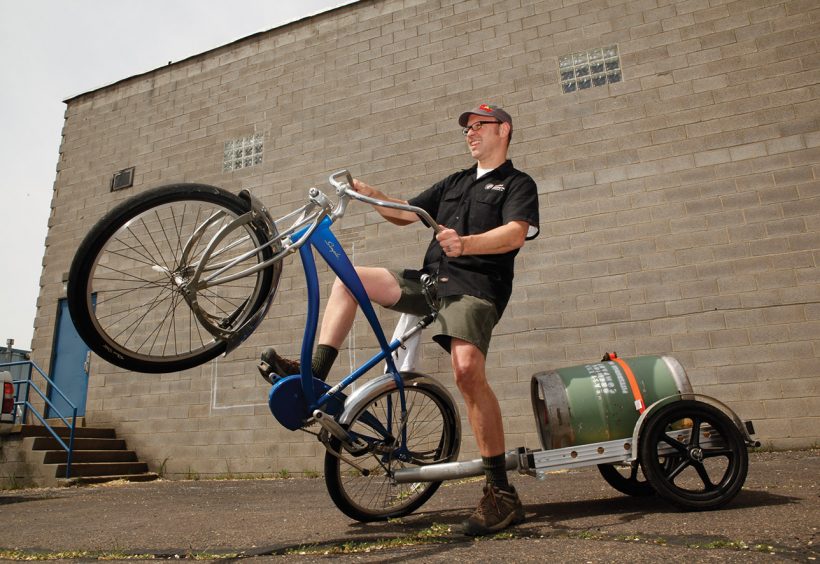 Photo by Heather Mull
Before he was a brewer, Scott Smith was a beer tourist. He traveled a lot for work, and he’d seek out local beers in cities where he had jobs. Drinking good beer led to brewing it at home, and making 5-gallon batches in the kitchen ended in Smith quitting his job, emptying his savings account and opening a production brewery in a dilapidated Pittsburgh warehouse. What began as a one-man, shoestring operation is now a proper facility that’s been growing, on average, about 40 percent every year. “When you look at it like that,” Smith says, “it explains a lot of pain and suffering you go through throughout the year.”
1. Listen to those voices
For almost a decade, Scott Smith was like any other homebrewer, making beer in his kitchen and chewing over idle dreams. “Anybody who’s ever brewed a batch of beer has that little voice in their head that says, hey, maybe I could do this for a living one day,” he says. Smith now brews beer for a living because, he jokes, he’s always been guilty of listening to the voices in his head. He spent 13 years working as a corporate engineer, but he could never shake that voice; when a job change took him home to Pittsburgh, he knew it was time to give in to it.
2. Work under pressure
Smith left the corporate world on gut instinct. “I quit before I had any real plan,” he says. “The notion of starting to write a business plan when you have that kind of pressure hanging over you can be very motivating. You have to find a way to make it work.” Smith sunk all the money he and his wife had saved into the brewery project, which he designed to be a one-man show that he could run on a tiny budget. Self-financing the project meant that Smith didn’t have to sell banks and investors on his vision; he just had to convince his wife, and himself, that they could make it work.
3. Don’t look up
Smith spent months building out East End’s brewing space. He did most of the work himself. The used brewhouse Smith bought had been “disassembled rather savagely,” and he spent countless hours trying to make sense of hacksawed piping and tangles of severed wires. “That process was pretty humbling,” he says now. Asked whether he ever had a moment when he questioned the wisdom of trading his family’s savings for an industrial space full of disassembled machinery, Smith says, “You can’t acknowledge those thoughts. You just have to keep your head down. The fear is, you stand up and look at what you’ve done and say, ‘What have I gotten myself into here?’ If you do that, you’re dead. That fear is paralyzing, and once it sets in, you can’t get out. If I got frustrated with the electrical, I’d go hang some drywall or think about a recipe. It all had to be done. But god forbid you stop doing something and look up.”
4. Let it fly
From the beginning, East End Brewing has been a seat-of-the-pants operation. That’s ironic, considering Smith’s background in corporate logistics and network optimization. East End doesn’t have any storage space, so production runs on a week-to-week basis, based on which recipes distributors are running low on; recipes go from bright tanks to kegs, to the back of the truck, in a single day. Smith jokes that settling into a portfolio of four year-round recipes and four seasonals was “the first structure we ever had to hang our hat on.”
5. Don’t predict, adapt
“You can do all the market research in the world, but you can’t predict the future, even if you can accurately predict the present,” Smith insists. It’s more important, he says, to be able to roll with what the market throws at you. When East End launched, Smith envisioned shipping most of his beers through distributors, and pouring growlers on-site as a side business. Instead, Smith is filling growlers at two locations (at the brewery, and at the Pittsburgh Public Market), with half his sales coming from those “Growler Hours.” He adapted to demand, and the brewery has thrived because of it.
6. Change it up
Heavy growler volume helps East End forge deeper relationships with customers. It helps educate new customers about craft beer. Most of all, a robust growler business keeps Smith and his crew from getting bored. East End uses its growler taps to push out about 20–25 experimental recipes a year, and to maintain a flexible portfolio that looks more like it would belong to a brewpub than a traditional production brewery. “It’s our laboratory,” Smith says. “We have so many beers we want to brew. Why limit yourself to a few beers if you don’t need to?”
7. Play small ball
A major component of East End’s specialty portfolio is a series of single-batch session ales. “It’s a series where there are no rules, and we can do whatever the hell we want,” Smith says. Beyond the strictures of brewing low-alcohol recipes, Smith says, “There’s not a whole lot of rigidity to it.” Smith has released a Gose, some Stouts and hoppy wheat beers, and a series of Milds and fruit-infused Rye beers, and he sometimes revisits his favorites. Fat Gary, a Nut Brown that tops out at 3.7-percent ABV, was a one-off session brew that graduated to year-round production. “There’s a bit of burnout with high-gravity beers,” Smith argues. “I’m an old fart, and I like to have a handful of beers, and if they’re lower alcohol, even better.”
8. Keep it fresh
That said, Smith sells more of his hop-forward IPA than anything else. Big Hop is a classically styled IPA, pairing Crystal and Munich malts with Centennial and Cascade hops. “I wanted that beer to be more about flavor than bitterness,” Smith says. “I wanted fresh, bright, interesting American hop notes, but not something that would cause palate burnout. The people who come into the brewery and say they don’t like hoppy beer, what they’re really objecting to is the bitterness.”
9. Bypass the bank
Smith hasn’t spent much time in the brewhouse over the past year. Instead, he’s been building out a new brewing facility that will quadruple East End’s square footage, and allow Smith to put popular session ales into more regular production. Smith financed the expansion with savings, beer sales and home equity. He also rolled out an investor program where loyal East End drinkers could buy $1,000 shares in the expansion, and receive store credit and brewery perks. So far, 100 people have signed on. “We have enough expenses as it is, without having to pay a bank every month,” Smith says. “The loyalty of our customers blows my mind. People are taking their hard-earned money and handing it to us so we can get to the next level. I can’t express what that means to us.” ■
 Previous: Trappeze Pub in Athens, Georgia
 Next: Dunbar Brewing Co.