Pitching Multicultural Slurries: How to Add Complexity and Save Money
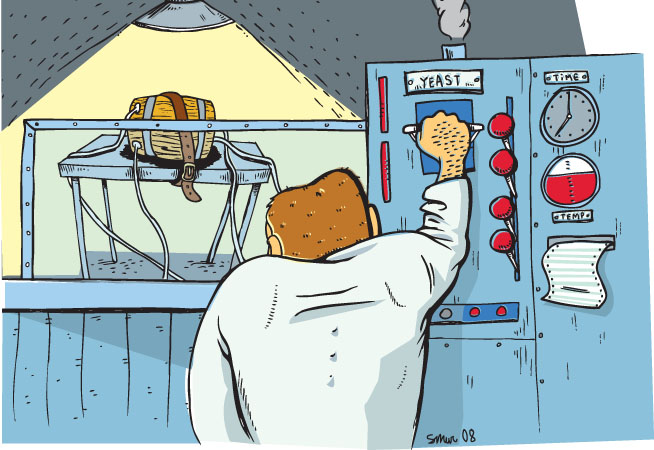 Illustration by Scott Murry
Ladies and gentlemen, I have some shocking news for you. The brewers and yeast culture companies of the world feed you lies! Why? They sell you wooden nickels as gold bullion! All this palaver about “pure yeast cultures as found in the world’s great beers” is pure bunk. All right, I’m mostly kidding, but we homebrewers do paint ourselves into a corner the way professionals wouldn’t (with a focus on single strain selection). So why fork over the extra dough for a second, third or fourth package of yeast? To find out, I asked two of the homebrewing world’s most yeast-knowledgeable folks.
Yeast guru and beer diva MB Raines, the woman responsible for proclaiming the gospel of good yeast and fermentation management, loves pitching multiple strains for her award-winning Belgian ales. Since she can reach into her yeast bank and fish out strains from any number of breweries, famous or obscure, her brews have sometimes contained five or more types. For instance, her design for the Falcons’ Anniversary Ale used Chimay, DeKonick, Unibroue, and Dupont. MB’s regimen begins with separate starters for each culture and includes varied pitching times to encourage different aroma and flavor contributions. Shows you how well she knows her fungi and her brewing! MB stresses that even with experience, biology is a fickle mistress. Your results will vary from batch to batch, but in wonderful ways. One of these days, we’ll talk Lambics, and I’ll spill all of the secrets I stole from her.
Dave Logsdon, the yeast mastermind, loves the added complexity from which virtually any style can benefit. He chooses two contrasting strains for his primary fermentation. You should look for contrasting ester profiles, attenuation levels and other patterns. The combination often emphasizes the desirable aspects of each strain. For instance, if you want to temper phenolic characters from wheat and Belgian strains, pitch a neutral ale strain and explore the subtle aromas cowering behind the big, bad clove. Mixing high and low flocculation yeast produces malty beers with dry finishes and fantastic clarity. Our recipe this month takes advantage of this with a stubborn, slow fermenter, like Saison, by using the Thames Valley Ale to push the gravity lower, faster. Interestingly, commercial breweries use a blend to encourage generational stability, but it takes experimentation to find the appropriate mix.
Now that the experts have had their say, this is how I go about mixing a Saccharomyces cocktail. With the various bits of gear I’ve picked up over the years, I can run three starters on stir plates. As vital as starters are usually, they become doubly so in a mixed world. Don’t skip, don’t skimp! Those adverse to buying multiple packs, plan ahead and grab yeast cakes from other batches. Remember, using the whole cake can be detrimental! I generally pitch equal amounts of slurry into each fermentor after oxygenation. As you grow confident about the yeast performance, start adjusting factors: size of starter, amount of slurry, timing and temperature.
With multiple starters on hand, you can crank the experimentation knob! Gather the brewing army and prepare a large batch of your target beer. Pitch a different starter into each and then blend the rest into your last carboy. If you have enough yeast, beer and gumption, pitch your strain blends at different rates. Label each vessel with pitching info and ferment together. Package and then hold a taste test. Blend the single culture beers together and compare to the full beer. What has changed? Does the complex fermentation make for a better final product?
Don’t stop with our usual critters in the primary. Yes, they cost twice as much as Saccharomyces, but their phenomenal impact is worth it. For my thoughts on using Brettanomyces, check the “Tempting Fate” article in the November 2007 issue. Incidentally, as I write this article, I’m sipping on a glass of the Fate and all I can say is, “Wow!”
The Recipe (and a History Lesson)
For four years of World War I, the town of Ieper (Ypres) in Flanders served as a meat grinder, an endless battle between the German and Allied forces. In memory of their sacrifice, the citizens of Ieper commemorate the missing Commonwealth soldiers by playing the Last Post at the memorial Menin Gate each night. The Last Post serves as a Commonwealth soldier’s final farewell, as Taps does for Americans. This heartfelt remembrance has continued since its inception in 1928. The German occupation of World War II halted the ceremony, but immediately upon liberation, the townsfolk resumed the tradition even as fighting continued in the streets surrounding the gate.
My good friend Brewgyver Fletch and I set up to brew an English Old Ale for the club’s monthly all-grain brewing lesson. While he stirred up a batch of Thames Valley, I racked off a cake of Saison yeast. Remembering the Last Post ceremony from an earlier trip through Ieper and our recent tasting of MB’s Hashell 10, we decided to blend the two strains together. The resulting beer was smooth, with a light fruity and peppery nose over a big caramel mid body that comes to a remarkably dry finish.
Written under the influence of “Tempting Fate” and Fu Manchu’s King of the Road.
LAST POST AT IEPER—OLD ALE SAISON
For 5.5 gallons, 1.086 OG, 13 SRM, 42 IBU
Malt
14.5 lb. Marris Otter malt
0.75 lb. Cara Munich malt
0.75 lb. flaked corn
0.25 lb. Carapils malt
0.25 lb. Special B malt
0.50 lb. Turbinado sugar
0.16 lb. Lyle’s Golden Syrup (1/4 can)
Mash
Saccharification rest at 151°F for 60 minutes (strike at 1.33 qt/lb).
Hops
1.0 oz Target (pellets) | 10.6% AA | 60 minutes
1.0 oz East Kent Goldings (pellets) | 5.5% AA | 15 minutes
0.5 oz Fuggle (pellets) | 5.1% AA | 3 minutes
0.5 oz Progress (pellets) | 8.0% AA | 3 minutes
Yeast
Wyeast 1275 Thames Valley Ale Yeast—1 qt starter, decanted
WLP565 Belgian Saison I—1 qt starter, decanted ■
 Previous: Erin-Go-Bud, Cinco De Miller