
Why I Hate Modern Fruit Beers
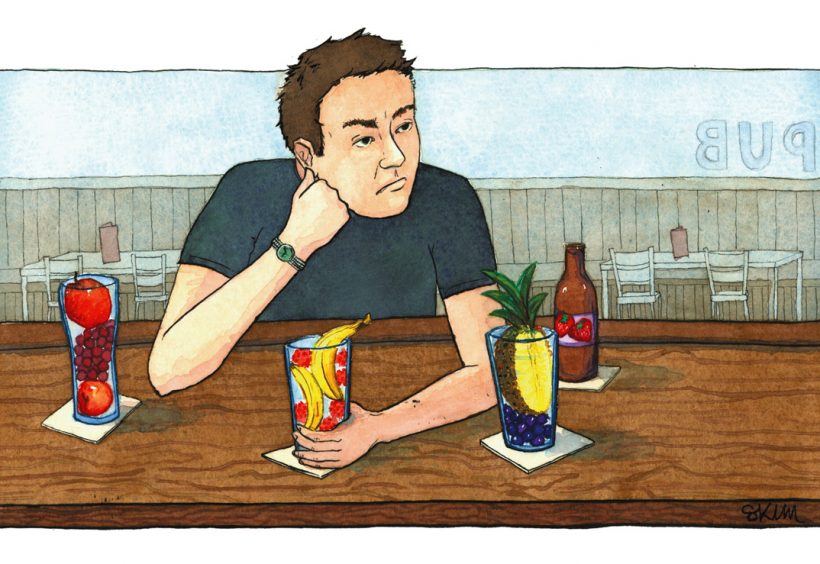 Illustration by Sarah Kim
I can suffer silently no longer. Something has happened that compels me to speak out. I write a book that forces me regularly to taste over 1,200 beers. Unthinking people say, “It’s a lousy job, but someone has to do it.”
As with any job, beer writers must learn to take the rough with the smooth. I get paid for drinking the finest beers on Earth. The downside is wading through all that supermarket shelfware. I bleat about it, though the real problem is finding new ways of saying, “Yet another PLB”—pointless light blonde.
Traditionally, even the worst Belgian beers were just, well, dull. But recently, it got dangerous. I am talking about “fruit beers.”
The principle goes like this. For four hundred years, traditional beer makers in northern Europe took large quantities of whole fruit—principally cherries, though raspberries would do—and steeped them in barrels of oak-aged ale or Lambic. The fruit adds color, aroma, great backtastes and a touch of sugar to spark more fermentation. The results can be magnificent. I applaud them.
For those who value image over content, it followed that adding fruit syrup to cheap ’n easy beer would also make something wonderful (or at least colorful). Since 2006, Belgium’s brewers have created over 70 of these things. A few are nice drinks, and some bear a distant relationship to beer. Others are foul beyond belief. Most are hideously sweet.
My problem is that if the Good Beer Guide Belgium is to remain comprehensive, I have to review them all—a ghastly prospect. I have friends whose tastes I trust, but when I asked them for help, their emails bounced back and letters returned, marked “Gone away.”
So, appreciating that these beers are aimed partly at a younger female audience, I enrolled my daughters. As teenagers, they need education in responsible drinking and always seem keen to be taught. Having taken well to table beers and the odd wheat beer, they were frankly thrilled to be asked to “help write the Guide.” I sat, dictating machine in hand, while they each sniffed and sipped assembled small glasses of these nectars. It went roughly like this.
First one: “We are not sure we would take to that.” Second: “Hmm. It’s better than the first one, but it’s not very good, is it?” Third: “Do you have any water?” Significantly, no sample was finished.
With a united front, they refused a fourth, mumbling something about phoning child welfare. Attempted bribery brought a threat never to drink beer again and to tell all their friends that wine was the way to go. I had lost.
At the Zythos Festival in 2006, a highly respected brewer was busy telling customers how fantastic and authentic their new fruit beer was when they spotted me in the queue. I felt genuinely honored to be taken aside and told, “Look, I am really sorry about this, but our financier insists we make them.”
Most of these new fruit beers make me nauseous. It’s probably the chemicals. To appreciate their rich unpleasantness, try them after six months’ cellaring.
I resolved my editorial problem with a flounce out. The new Good Beer Guide Belgium has declared these “non-beers.” They have been de-listed, downgraded to a passing mention. Brewers say they make them because some people like them. I point out that some people like thieving and reruns of The Waltons. So what?
Adding stuff to a nearly completed and rather shabby beer is a dangerous pastime that brand Belgian cannot afford. And neither can any other craft beer culture that wishes to be taken seriously. ■
 Previous: Craft Beer's Crazy Growth
 Next: Mix it Up