
Mix it Up
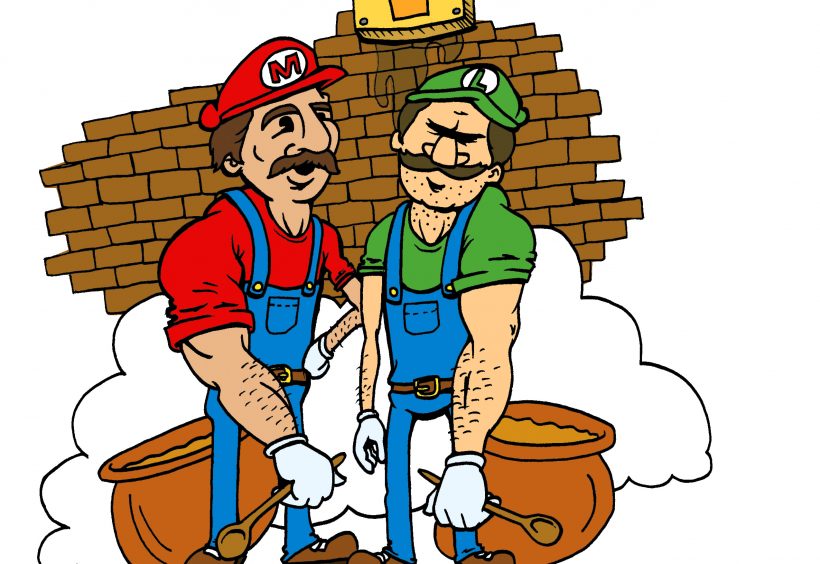 Illustration by Scott Murry
No sooner had the “March Madness” issue hit the mailboxes than I got a response from brewing partner and all around gadfly, Jonny Lieberman: “You lazy bastard! Look, it’s all well and good that you advocate beers like Märzens—but using melanoidan malt in place of a decoction? That’s like subbing tofu for a ribeye. It’s simply not as good as the real thing.” Isn’t it nice to know he’s equally grating online or off?
Well, he’s right—I’m lazy and have never made any bones about it. I prefer to lighten my load and spend my brewing days more enjoyably, but if you’re going to be mad traditional and German, then it’s time to grab a second kettle, a spoon/paddle and a brewing partner. It also helps to boost that stirring arm stamina. Take care, because we’re going to the land of boiling grain.
Decoction mashing dates back to the old days, when barley was bad, mash tuns were wooden and brewers hadn’t quite invented the thermometer yet. Without one, ice, blood and boiling serve as natural, reliable temperature points.
Decoctions take advantage of boiling grain to boost the mash through its multiple rests. A demystifying point about decoctions—really, all we’re talking about is a different way of infusing heat in a multistep mash. Depending on the recipe, you may be performing one to three decoctions to go from strike to mash out, and all points in between.
Sadly, it’s not as easy as grabbing a bunch of mash and bringing it to a boil, but it’s not that much harder. The basic decoction procedure: Grab a thick third (almost no water) of a thin mash (1.5 quarts per pound) and toss it into a kettle. Light the fire, and start stirring. Bring the mash to saccharification temperature (150s) and let it rest for 10 minutes. After the brief respite, bring back the fire and get to stirring. Once the grain gets boiling, start the timer and keep it going for 15-30 minutes. As you boil and stir, appreciate the tremendous malt olfactory experience. Just when you’re sure you’ll never stop stirring, return the boiling malt to the main mash. After a thorough mixing, the mash magically rises 20 or so degrees.
You’ve now successfully “pulled” a decoction! If you’ve got more rests to pull, just wait a few minutes and repeat. That and a bunch of stirring is all there is to it.
Why doesn’t boiling the grain destroy all the enzymes? In a fortunate stroke of luck, barley’s enzymes quickly dissolve into the mash liquor. Since you’re pulling mostly grain, the enzymes stay behind, hacking and cleaving their way like Viking marauders. The final pull is traditionally thinner, in part to help denature the enzymes.
Heloise’s helpful hint: If you’ve thought about going all-grain, but can’t afford a burner, use a decoction to perform any corrections or mashing steps.
So why pay the cost of all this extra sweat? Is it just stubbornness that makes people work more hours and turns a partner into a bona fide necessity? Beyond staunch traditionalism, some converts claim a near miraculously boosted malt flavor and aroma from extra boil-generated melanoidins. Others report a corresponding efficiency increase from malt kernels that explode while boiling. Still, some studies point toward any effect being subtle at best, and many award-winning brews have adopted the single-infusion mash approach.
March’s Märzen recipe replaced the über malt “effect” with a charge of melanoidin malt. This time, we’re skipping the shortcut and doing a double decoction. Get stirring!
LION TO LAMB MÄRZENBIER – THE SWEATY VERSION
For 5.5 gallons, 1.055, 21 IBU, 10 SRM, 75 minute boil, 5.5% ABV
Malt / Grain
5.5 lb. Weyermann Pilsner malt
5.5 lb. Weyermann Munich malt
Extract Version
Replace 5.0 lb. of Pilsner malt with 4.0 lb. of Pilsner/Pale LME and 5.0 lb. of Munich malt with 4.0 lb. of Munich LME.
Mash
128°F Dough in 30 minutes (Strike with 16.5 quarts)
150°F Saccharification rest 30 minutes (Thick Decoction, 20-minute boil)
168°F Mash out 10 minutes (Thin Decoction, 20-minute boil)
Hops
0.75 oz Tettnang Tettnanger (pellets) | 4.5% AA | first wort hop
0.3 oz Hallertauer Hersbrucker (pellets) | 4.5% AA | 40 minutes
0.5 oz Hallertauer Hersbrucker (pellets) | 4.5% AA | 20 minutes
Yeast
Wyeast 2308 Munich Lager / WLP820 Octoberfest-Märzen
Fermentation
Cool the beer and ferment at around 50°F for 2-3 weeks. Raise temperature to 60–65°F for 1–2 days. Crash cool back to 50°F, rack and then proceed to lower the temp by 1–2°F per day until resting at 34°F. Lager for 2–5 months before serving. ■
 Previous: Why I Hate Modern Fruit Beers
 Next: Martin Dickie