
Martin Dickie
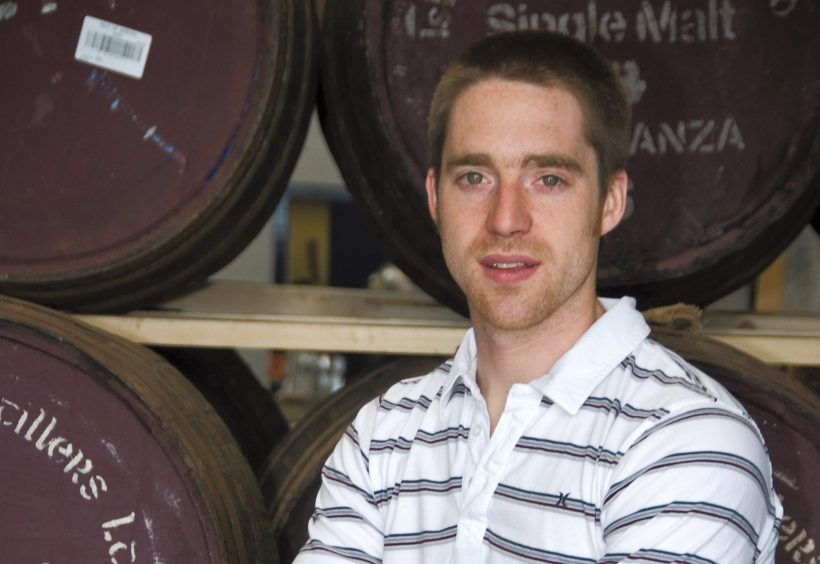
BrewDog Brewery commands a global audience from a tiny outpost on Scotland’s northeast coast. Its beers have inflamed critics and ignited a debate about what beer in the UK can and should be. And it’s done so while churning out a staggeringly wide portfolio. Not bad for a brewery that’s only been in production for two years now.
1. Impatience is a virtue
Martin Dickie grew up intrigued by alcohol, but he never figured he’d be working with beer. “When I was younger, I was always fascinated by distilling, rather than brewing,” he says. Dickie began studying distilling in Edinburgh, Scotland. The course was a joint exercise in distilling and brewing, and it wasn’t long before Dickie came around to the hoppy side. “You make any changes to the process in distilling, it takes 10, 12 years before you can fully appreciate the change to the process, whereas in brewing, it was a couple of months. For me, brewing was a lot more enjoyable. I like to experiment with things a lot.”
2. Break the mold
Dickie brewed in England for a bit, before returning to Scotland, teaming with longtime drinking buddy James Watt and founding BrewDog in late 2006. “In the mainstream British market, everything is so traditional,” Dickie says. “The variety of beers goes from a 3.5 percent bitter to a 4.5 bitter, using a mixture of Goldings hops and Fuggles—or, if they’re really outrageous, maybe a bit of Challenger. We spotted a big gap in the market to do something a bit exciting, different than everybody else, make it nontraditional, a bit edgy, a bit modern. A reflection of ourselves, and the beers we wanted to drink ourselves.”
3. To hell with everybody
BrewDog’s founding philosophy was simple. “We just decided we’d make the beers we wanted to drink ourselves, and to hell with everybody else. And if other people would come with us and drink the beer, then that would be fantastic.” BrewDog launched with an Imperial Stout, followed up by the hop-forward Punk IPA. How did that philosophy play out on the brewery’s home turf, Scotland’s rural north coast? “Not particularly well,” he confesses. “We were running out of money fairly quickly. We had to do something pretty radical to turn things around.”
4. Get wired
The choice facing Dickie and Watt was simple: either change their beers to placate their home market, or change where they sold. They chose the latter. They identified markets where consumers of their style of beer lived, and sent sample cases to influential beer bloggers. They got positive feedback, and used it to persuade importers and distributors that BrewDog could sell in their markets. Then, in the fall of 2007, BrewDog swept the top three prizes in a national competition sponsored by a UK supermarket giant—a win that came with national distribution. The brewery is now selling in major domestic retailers and in 14 countries.
5. Make it different, and enjoyable
Dickie’s beers are bold and flavor forward, but they’re also quite distinct from many of the American craft brews they draw inspiration from. Dickie is a fan of hops from New Zealand because they lend his ales unique flavor profiles. “Our beers range massively in style and origin,” Dickie says, though one thing is constant. “You can make extreme beers, but unless they’re enjoyable, I don’t really see the point. What we’re about is making the most interesting, the most flavorful beers we can, but making them accessible.”
6. Reclaim what’s yours
Britain birthed the IPA. And then, Dickie says, it bastardized it. He saw the average British IPA as “a fairly low-alcohol beer with moderate hops—nothing spectacular.” So he and Watt returned the style to its roots. They brewed their Atlantic IPA based on a traditional 200-year-old recipe, bunged it in oak casks and loaded the beer into a fishing boat that trawled the North Atlantic for two months. “To have it maturing it in the constant motion of being at sea, technically, it’s not 100 percent accurate, but it’s 85 percent accurate. It’s the most accurate version of that beer that anyone’s made in the last 150 years.”
7. Lighten up
Punk IPA, the brewery’s flagship, couldn’t just be an American knockoff. It had to stand out. Highly attenuating yeast dries out the finish, and New Zealand hops—all kettle-hopped, nothing in the dry hopper—throw off flavors of passion fruit and mango. “We wanted something American-esque, but with a twist,” he says. Dickie uses the lightest Maris Otter malt he can find, so the beer’s color is much lighter than a West Coast IPA. There’s no Cara malt in the recipe, to give the hops room to breathe. “Because it’s an IPA, for me, it’s all about hops.”
8. Let the smoke roll in
Sometimes, great beers come from mistakes. Take Storm, an 8 percent IPA aged in Islay whisky casks. The beer was born after Dickie was aging Stout in Speyside casks, and filled a couple with his IPA to see what would happen. “It felt a little sweet and sickly,” Dickie recalls. “The original one didn’t work out really well, but getting the contradictory flavors, we felt, why not go three steps further and throw it in the most outrageous cask we can find? That’s a beer that goes against what we’re trying to do most of the time. We have the fuity hoppiness of the IPA, why not try something completely insane, like the dark, peaty, smoky whisky cask of the Islay? There’s such confusion in your mouth—smoke, peat, pineapple.”
9. Beer is a populist drink
BrewDog is a punk brewery, which naturally puts it at odds with Britain’s beer establishment. That’s fine with them. “There’s a lot of snobbery,” Dickie says, arguing that Britain’s real ale guardians are “missing the point. They’re really excluding a lot of the public by having all this pomp and tradition, because not everybody wants to have a warm, flat beer served in a traditional pub. That keeps a lot of the public from trying these beers in the first instance. What we’re trying to do is just strip away all that crap. There are unlimited flavors to be found in beer. That’s what we’re trying to get across, and just excite people about beer again.” ■
 Previous: Mix it Up
