
Green Day
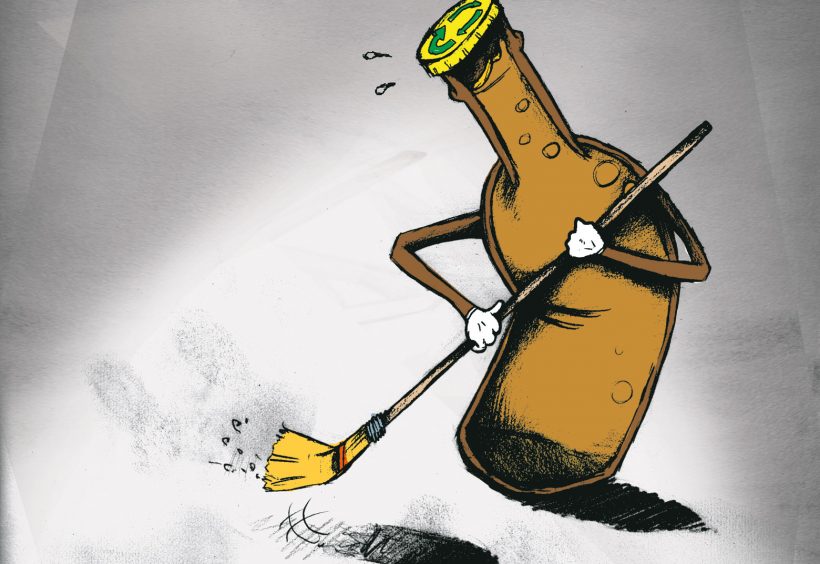 Illustration by Scott Murry
No matter what you think of Al Gore, Greenpeace and the growing hordes of hybrid drivers, there’s momentum to improving your ecological footprint. Even if you think global warming is a bunch of hooey, you can always satisfy your profit motive, saving some “green” by going green.
After all, the brewing industry uses green ideas where they can. On water alone, they use roughly 20 gallons of H2O for every pint of beer in your fridge. Toss in electricity, fuel for heating, sewage-effluent loads and the masses of spent malt, and you can see why sizable breweries are looking to cut back. The gargantuan brewery plants of Anheuser-Busch InBev capture heat from the boil and chilling to create hot cleaning liquor and strike/sparge water. For craft examples, look at Stone’s and New Belgium’s solar work or Sierra Nevada’s biofuel efforts.
Water Costs How Much?!?
When I first heard that 20-gallon water rate, it surprised me. Brewing’s not the worst offender; supposedly more than 1,500 gallons are used per pound of beef. But I’m not raising cattle on my back lawn, and I do have a water bill to pay, and living in a metropolis infamous for “importing” water from half the western US means a high rate to swallow.
Chilling and cleaning/sanitizing guzzle water faster than any other part of the brew process. If we want to boost green cred and reduce “green” wallet outflow, we need to focus there. And for the record, I’m a fan of full soaking. I only use spray bottles for spot sanitation.
To waste less while cleaning, do more at once. Clean multiple kegs and carboys together. OxiClean and P.B.W. work great. I don’t touch my kegs until there are at least four, and then I tackle them one after another. I chain them: Cleaner in one keg, soak and transfer to a second. Rinse the first keg, dry and soak with sanitizer, and transfer that to the second. On a brew day, I use one batch of chemicals to handle the chiller, fermenters and kegs. Any carboys left at day’s end soak overnight.
For the gadget minded, look online. Combining a cheapo ($20–$30) submersible pump and some plumbing parts creates a Clean In Place (CIP) rig to efficiently scrub gear with even less cleaner. To CIP sanitize, avoid using a foaming agent like Star San; use its cousin, Sani-Clean.
For chilling, think reuse and efficiency. The simplest thing to do is capture your output water and repurpose it. I use mine to water the veggies and fill the washing machine for a load. Brewing soon? Save it for the next batch.
All chilling works on temperature differential: The greater the difference between the wort and the water, the faster the chill and the less water used. Summer ground water in LA hits about 80˚F, so pre/post-chilling is critical. Counterflow users can flow into a copper coil submerged in ice to push faster and colder (pump needed!). Immersion chillers can either check out a “whirlpool” enhancement or chill with ground water until about 100˚F before switching to ice water circulated via a sump pump. These methods can drastically reduce water usage.
Wasted Grain to Fertilizer
After every all-grain brewday, you haul a giant steaming mess off to the trash. You know the living-hell stink that rotting mess causes when left in the tun. Sadly, unless you’re a brewing machine of massive volumes, you can’t take the pros’ route of handing your grain to farmers.
So what’s to do after making 90 loaves of spent-grain bread and dog biscuits for 200, and a metric ton remains? If you’ve grabbed hold of the rebirth of the modern “Victory Garden,” then it’s time to compost and feed your plants some great chow. Grab a composting bin (or make a compost pile). To encourage recycling and minimize polluted runoff water, some cities offer special composting classes and free equipment. Just remember to cool your grains and keep the pile well aerated to discourage anaerobic lactobacillus “death smell” activity. Oh, and don’t compost your hops; their antibacterial nature messes with the composting magic. ■
 Previous: And the Best Brewery in the World is...
 Next: Christian Ettinger