
Black Star Co-Op
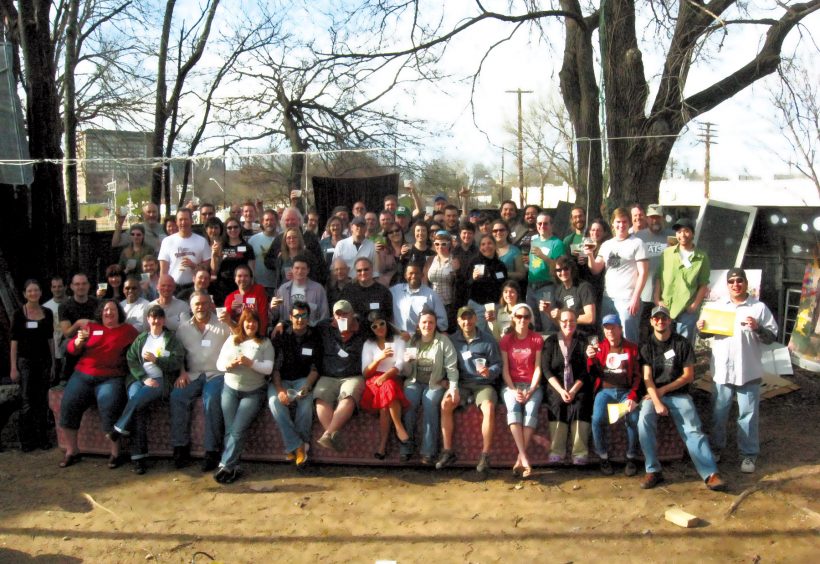
Three years ago, Therese Adams gave up homebrewing for the crowded pages of the Texas Alcoholic Beverage Code. She’d just been to a homebrew club meeting where an outsider spoke about opening a cooperatively owned pub in Austin, Texas. She loved the idea and asked the speaker, Steven Yarak, if she could get involved.
One of the ways she could help, Yarak told her, was by going through the code to make sure everything he was proposing was, well, legal. She volunteered immediately.
“That’s the kind of dork I am,” she said. “It made for interesting reading, and it quickly became clear I could offer a lot of other things. I realized I was a better drinker than a brewer.”
Three years later, she sits on the nine-member Board of Austin’s Black Star Co-Op, the organization that’s churning toward the establishment of America’s first fully cooperatively owned brewpub. Now over 1,000 members strong, Black Star—if it can secure a real estate deal by year’s end—looks to be fully operational by the fall of 2010, board member Debbie Cerda said. And when the kettles start humming, what’s brewing in Austin may provide a glimpse not only into the future of craft brewing, but into that of American cities.
“This is the perfect marriage between the cooperative business model and a community centered around beer,” said Adams, who also works as the human relations coordinator at Wheatsville, a local grocery co-op (Yarak, Black Star’s founder, is the lone full timer). “I want us to succeed because in so many communities, this would be perfect. It’d be a launching pad to improve the community as a whole—not just as one brewpub, but when you bring so many interesting people together, socializing, you get some really cool ideas.”
Without country-club membership fees—Black Star charges $100 to be an invested member—co-ops allow a roundabout means of ownership at a time when money spent opening a brewpub could be otherwise be spent putting a kid through Harvard with a fairly inclusive meal plan. And though members may differ in their day-to-day involvement, they share a central goal: to make sure—even if it takes sitting down and enduring a few pints several (or seven) nights a week—that the pub succeeds, Cerda said.
“What better idea is there to create your customer base as people who have a vested interest in [the company]?” she said. Consider brewing co-ops to be the next step in the craft beer revolution.
Revolutions—and craft beer’s uprising has often been called one—naturally trace a pyramid, passing from the minds of a few to the hands of many. For them to really work, and to effectively topple an old regime, that initial excitement must morph into action; the masses must take up arms. And co-op breweries, with their minimal costs, democratic involvement and intensely local feel, look a hell of a lot like craft beer’s militia. They represent a community no longer simply using its buying power to steer the market, but one empowering itself to join the fight.
“There are so many people excited about beer, people who want to open their own brewpubs,” said first-year board member Mark Wochner. “Maybe one guy can’t pull it off, but one really excited guy can pull people together to do it. And once we do this, it’ll make it easier for everyone else.”
That one man, 27-year-old Yarak, tells a story much like the rest of the residents of the craft beer world. Growing up drinking whatever he could get his hands on, he had an epiphany after spending time around better beer, he said. Of course, his revelation took place while on an exchange in Belgium, which is a bit like discovering paint in the Sistine Chapel.
“I grew up in College Station, [Texas],” he said. “It’s hospitable [to beer]—but only if you like Lone Star.”
He came back to Austin with an idea for a place that would run along the lines of the traditional (and now almost entirely extinct) English pub, where the publican owns and operates the business. It’d be something like that—just with a few hundred publicans, where the “community regulars” own the bar, he said.
“People gather together, they get shit-faced, there’s a college atmosphere—you have a community that naturally comes together [at bars],” Yarak said. “Why is it that the benefits of that business, they get funneled out? … You have absentee ownership, and the owners, if they even live in town, they don’t care too much about the business—it’s just a revenue stream.”
According to Yarak, more pubs present one of the means through which communities can remain communities. In an age of privatization—of iPods pounding, of computer screens screaming, of social networking serving as a surrogate for speaking—the essential glue that once bonded people together has begun to dissolve, he said.
As commuting rises, community thins. According to Robert Putnam’s Bowling Alone: The Collapse and Revival of American Community, each additional 10 minutes of commuting cuts “social capital”—club meetings, social outings, athletic participation and coaching—by 10 percent. Same goes for the workweek: Extra hours in the office mean fewer hours outside of it.
“You have somebody living in the suburbs, commuting all alone, isolated going to work, isolated in the cubicle—their number-one communication is email, and they repeat that every day,” Yarak said. “You don’t get enough time that people spend in the company of others, just talking about what’s going on, making new friends, talking about the ideas of the day, politics. Beer is the absolute ideal drink for a social lubricant.”
Yarak cited “new urbanism,” the architectural philosophy that stresses third spaces—places for members of a community to congregate when they’re outside their first two spaces of the home and the workplace—as part of his inspiration. A community needs those third spaces, from coffee shops to rec leagues to pubs, in order to thrive, he said.
“We consider ourselves in some ways to be a social agenda with a pub,” he explained.
Yarak took the idea to the local homebrewing club in early 2006. He talked about opening a Belgian-style café, one that would tie the community together around good beer, and one that local drinkers could say was truly theirs, as they leaned over a pint. A brewer—one who happened to also double as a board member for a local grocery co-op—stood up and said, in short, Why stop there?
They went over the legal ramifications for a cooperatively owned brewery—here’s where Adams would soon come in—and the idea of Black Star was hatched. For over three years—years that included dozens donating their time to speak, to plan for the future and to organize Black Star’s monthly beer socials, which bring in 500 people for beer education and co-op promotion—the idea grew. A member-elected board came into being. A brewer, Jeff Young, who has contributed 10 recipes and spent the first part of the year apprenticing at Founders Brewing Company, was selected. And money—a significant amount of it—was raised.
The start-up capital comes from membership fees, a stream that, Yarak said, is gradually gaining speed as awareness spreads. As of June 30th, the co-op counted 1,015 members, the majority of whom come from Austin, but a few coming from as far as Denmark and Singapore.
To become a “joining” member of the co-op, a share costs $85, payable over time (plus there’s a one-time $15 start-up fee). The majority of Black Star’s initial investors fall into that group. Then there are the member-investor shares, which pay dividends when the brewpub becomes profitable. Right around 70 of the members have purchased those shares.
All that capital, the business plan dictates, will go into buying a place of operations, Yarak said. From there, the co-op will leverage the property toward raising the rest of the money needed to purchase everything that will go inside the building, from brew kettles to barstools.
“We need to be in a property by the end of this year,” he said. “We’ve raised this army, but the army has no place to gather. So we need the Roman field of Mars.”
And here’s where Black Star has hit its first true wall, Yarak said. The co-op had a place lined up last last year, until negotiations fell through at the last minute. But momentum is still going, he said. One of the board’s responsibilities is to keep the members informed—to “make the membership feel like they own the place,” said Yarak, and to keep the enthusiasm rolling. To that end, the four said, the energy is still high—just waiting to be transformed into action.
“When I first joined three years ago, the idea was, ‘Well, this might happen,’” Wochner said. “Now, I really think this is gonna happen.”
“We have an advantage over any bar that’s opened in Austin—maybe ever—in that we’ve got this community that’s already dedicated to seeing us succeed,” Adams said. “They put forth money, time, spread the word themselves, so when they open, they’re not gonna say, ‘There’s that new place that opened—I have to check it out.’ Now it’s like, ‘This pub I own, it’s finally open, I’m gonna go drink!” ■
 Previous: Beer-be-cue'n
 Next: Cows Don't Eat Grapes