Drinking Imperial Stout in Summer
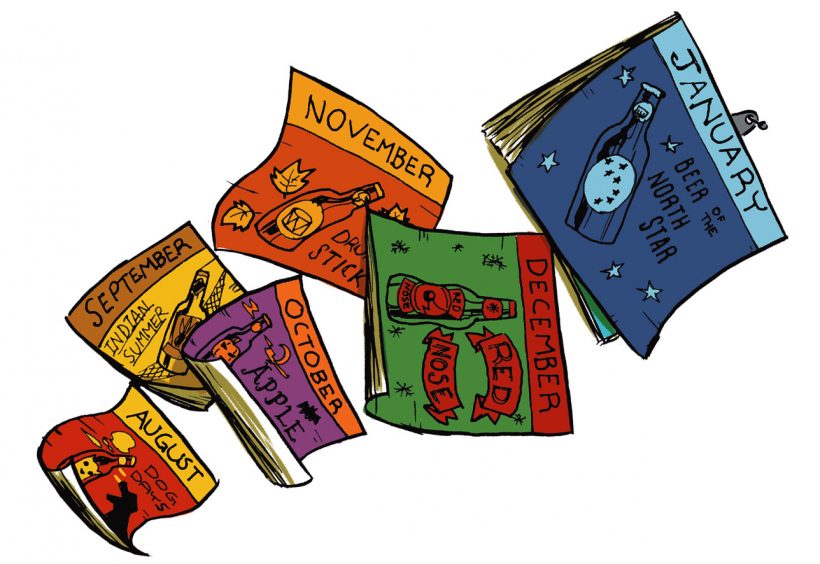 Illustration by Chi-Yun Lau
A few months back, I wrote a column bemoaning the creeping extension of seasonal beers into months of the year where they previously were unseen. I suggested that such stealthy seasonality might result in the lessening of the excitement that surrounds these timed-release offerings. I still believe that. But over recent months, I’ve spent some time contemplating seasonal beers and thought it time to address my other take on the issue: In the modern age, seasonal beers are just weird.
As the story has been told from beer historians, both professional and amateur, seasonal beers developed from both need (the lack of refrigeration) and practice (religious and political events). And while I can certainly appreciate the genesis of bock beer and Octoberfest styles, it’s a true curiosity that in the United States, a country largely divorced from these religious, historical and political traditions, that American brewers have chosen to adopt and preserve these ancient brewing rituals. And in the absence of technological obstacles, such as sufficient cooling resources, it’s more than a touch peculiar that we can’t enjoy year-round examples of many classic beer styles, some of which are lager beers.
Beyond this curiosity, I have personally experienced an unusual pattern of response to the changing of the seasons. As the weather turns chilly, I, like all good beer geeks, dash out and fill my fridge with a wide array of soul-soothing dark beers, ranging from Baltic Porters to Imperial Stouts. That’s when strange things start to happen. I find myself quietly sneaking out of the house to meet up with some old friends, including zesty German Pilsners, sharply hoppy India Pale Ales, and airy, fragrant Kölsch beers. Like long-neglected family members cast aside for the acquaintances of work, these beers quietly weep on the shelves of my fridge. The condition only gets more pronounced as the cold lingers, until finally I can’t even bring myself to consider opening a classic winter seasonal beer.
As the clouds pass and the snow gives way to the first sprouts of a green spring, the process repeats itself. I head out and buy the few bock beers and other seasonal releases I can find. With my stock full again, my mind quickly returns to those long-languishing dark beers. As spring develops, I think about their plight, having survived winter’s frigid temperatures, virtually abandoned and uncared for. It takes until about the first warm day in May for my interest to be piqued by what I missed the previous season and within a few weeks, these patient winter vessels are all emptied.
When this cycle repeats itself throughout the summer and fall, I begin to think that somehow my internal seasonal beer clock has become disrupted, in a kind of seasonal affective drinking disorder, but in reverse. And then I start to question the entire idea of seasonal beers and come to fully appreciate the pleas of ardent beer enthusiasts who want to sip cool Octoberfests in the budding warmth of June, Imperial Stouts in humid August, and Hefeweizens in chilly January. I also wonder about whether the seasonality of these products has adversely impacted the development of many lager styles in the United States, as the few examples of such seasonal beers are only available in limited quantities and restricted times during the year. And while I fully understand and appreciate how important seasonal beers have become to craft brewers in a business sense, I think that the further we get away from the origins and traditions giving rise to the creation of such timed offerings, the more I question the absence of a good Märzen when I want one. ■
 Previous: Beer News