Indigo Imp Brewery
There’s something wild going on in Cleveland. Just a couple of blocks away from the shores of Lake Erie is a hint of devilishness in the air—and it is finding its way into the beer. With open windows and open fermentation tanks, Indigo Imp Brewery doesn’t mind some input from Ohio’s natural flora and fauna. In fact, brewmaster and co-owner Matt Chappel welcomes whatever the wind brings into his small-batch craft brewery.
“I just like to think that an imp is a mysterious little devil, and maybe that’s what our brewery is, compared to some of the giant breweries out there,” he said. “We’re using some mischievous brewing techniques.”
The Mother of Invention
Matt, who owns and operates the brewery along with his wife, Kathy, didn’t necessarily know that he wanted to start a brewery that would incorporate open fermentation to create unique flavor profiles; all he knew was that he wanted to do something different. After all, Cleveland is loaded with brewpubs and bigger breweries that turn out fantastic beers. If Indigo Imp was to have any success, it would have to find its own niche.
“I didn’t want to make just a great IPA or Stout. Hopefully, I would have my own twist on it,” Matt said. “We looked at open fermentation and thought that it would add something a little different to the flavor. … We’re not trying to be a Belgian brewery exactly, but it’s a little like that, and it’s a little like the Old English style as well.”
And, of course, as with any start-up business, cost played a major factor. As Matt began exploring options for fermentation vessels, he was less than enthusiastic about the cost of conical fermentors. When the time came to decide between building a typical brewery with typical brewery equipment, and building a one-of-a-kind brewery with equipment from wherever he could get it, Matt and Kathy chose the “mischievous” latter option. And as he openly admits, “It helped that dairy tanks were cheaper than brewery equipment.”
With a hodgepodge brewhouse, Indigo Imp eschewed both steam-jacketing and direct-flame heating for its brew kettle. Instead, Matt uses three 24-kilowatt electric immersion heaters to bring the runoff extracted from the mash tun, which they also built themselves, to a boil in about 20 minutes. By December of 2008, the brewery was fully constructed and Indigo Imp was turning out craft beer, one 7-barrel batch at a time. Last year, Matt brewed about 280 barrels, with almost all of it heading to bottles.
“The Brewmaster’s Master”
When Indigo Imp was little more than a mischievous look in its owners’ eyes, friends and associates were warning Matt about the perils of teaming up with a spouse to start a business. Having a business relationship turn sour has its own negative effects, but when business problems and marriage problems become one and the same, the results can be ugly. Fortunately for Matt and Kathy, there have been no such problems. Kathy serves as the president of the company, with Matt acting as the vice president and brewmaster. And when it came time to make the business cards, Kathy found a playful way to make sure Matt knew who was boss.
“I wanted to put ‘brewmaster’ on my card instead of ‘vice president,’ and she wanted something better on her card, so she put ‘brewmaster’s master,’” Matt said. The one-upsmanship was in jest, but helps put this couple’s impish sense of humor into focus. Ultimately, the pair works together well, and Matt acknowledges that having his wife around on bottling and brew days has proven to be a great resource. “It’s actually nicer [to be working with her] than to be working with an employee who may, or may not, be as motivated to work as I am,” he said.
Although Matt has been homebrewing for well over a decade, beer was little more than a hobby for the Chappels until 2006. While Kathy worked as an IT professional, Matt stayed at home to take care of their two children until they were old enough to begin school. That’s when the husband-and-wife team decided that their dream of owning their own brewery would always be just a dream unless they went for it. So that’s exactly what they did.
“After a couple years of research, or dragging my feet, I’m not sure [which] it was, we said ‘Give it a shot.’ If it works out, great. If not, then at least we can say that we tried it,” Matt said.
Nudging the Envelope
Maybe Indigo Imp’s beers aren’t extreme, but they aren’t exactly traditional either. Matt has nothing against brewing “to style,” he just prefers to experiment with his creations.
“My approach is that I like to think of a style that I like and see how it will come out with some wild yeast in there or warmer temperature,” he said. “I guess my philosophy is pushing the envelope. Maybe not craziness and fermenting with fruit, but with pushing the yeast to get flavors that people maybe aren’t used to.”
This would be where open fermentation comes into play. Each batch gets a sufficient dose of yeast pitched into the cooled wort, but little is done to discourage wild yeast from floating in the windows or the open doors of the fermentation rooms. It isn’t exactly spontaneous fermentation, but it’s not the tightly controlled fermentation found in more typical breweries. To add to the wild mix, the yeast is harvested at the end of the cycle and pitched into the next batch, which allows any wild bugs that were able to dig out a foothold to continue to make their mark in the beer. The result is slight variation from batch to batch, as well as some unique flavors in otherwise traditional ales.
“It actually comes out a little fruity,” Matt explained. “Sometimes we get some tartness or citric acid taste in there. It depends a little on the season. Whatever we brew in the summer has some of that citrusy flavor in there, and things that we’re brewing right now seem to be cleaner tasting and closer to what the actual style is, but they still get in there because we’re propagating the yeast as we go.”
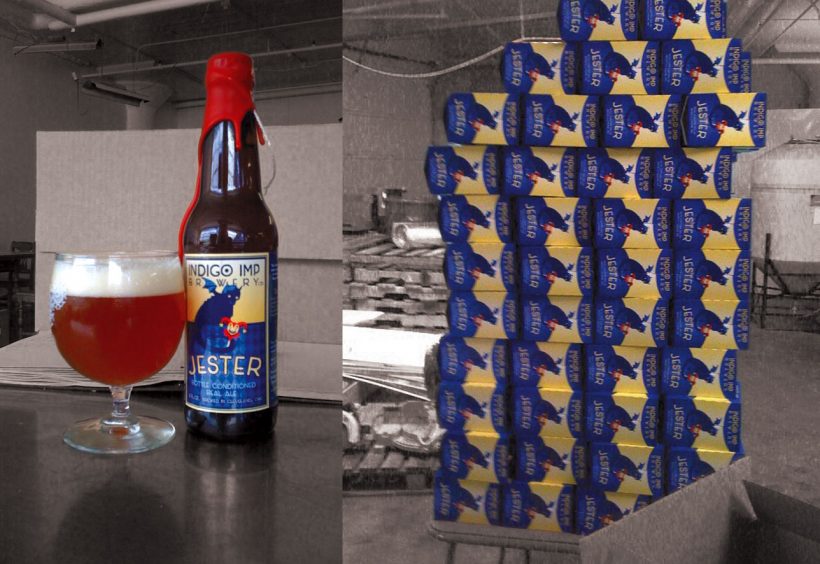
Indigo Imp currently brews four beers: Blonde Bombshell, a citrusy pale beer that emphasizes malt character over hops; Winter Solstice, an amber seasonal brewed with all Cascade hops as well as subtle amounts of sweet orange peel and cinnamon; Jester, a Belgian-style Pale Ale that seems to thrive in Indigo Imp’s atypical fermentation vessels; and Gatekeeper[/beer], a robust Porter loaded with black malt that is reminiscent of traditional Porters thanks to slightly sour notes that stem from the presence of wild yeast. The Chappels are also considering releasing a series of one-off beers for a summer variety pack that would capitalize on the brewery’s small batches and creative freedom.
Regardless of whether it’s a one-off brew or one of Indigo Imp’s signature beers, it will have Matt and Kathy’s mark all over it. It can’t be helped, as everything from stirring the mash to filling the bottles is done by their hands. As Matt said, “We put a lot of sweat into this, and we try not to drip it in the mash tun.”
BREWHOUSE
The brewhouse was assembled from used, unlabeled, stainless steel, 400-gallon food-processing tanks. It is heated by three 24-kilowatt custom-made electric immersion heaters built by Heatrex.
Fermentation equipment:
4 7-barrel Sunset brand bulk milk tanks
2 7-barrel cono-cylindrical conditioning tanks
What’s on Tap:
Blonde Bombshell: A Golden Ale, but at 6.2 percent ABV, it’s not a light ale.
Winter Solstice: Winter Amber lightly spiced with sweet orange peel and cinnamon.
Gatekeeper: A robust Porter along the lines of traditional English Porters.
Jester: Belgian-style Pale Ale hopped entirely with Cascade hops.
Imp Bottle:
If you happen to live in northern Ohio and have seen a six-pack of Indigo Imp in stores, you have probably asked yourself, “What’s the deal with the wax-covered bottle?” One beer in every sixer is dipped in wax to cover the cap and neck, which serves two purposes: First, it helps differentiate between styles, as each style is dipped in a different color wax and the labels look similar; and second, the wax serves as an additional barrier to light and oxygen, which allows the Imp Bottle to last longer for those who like to age their beers. ■