
Is A-B Inbev Going West?
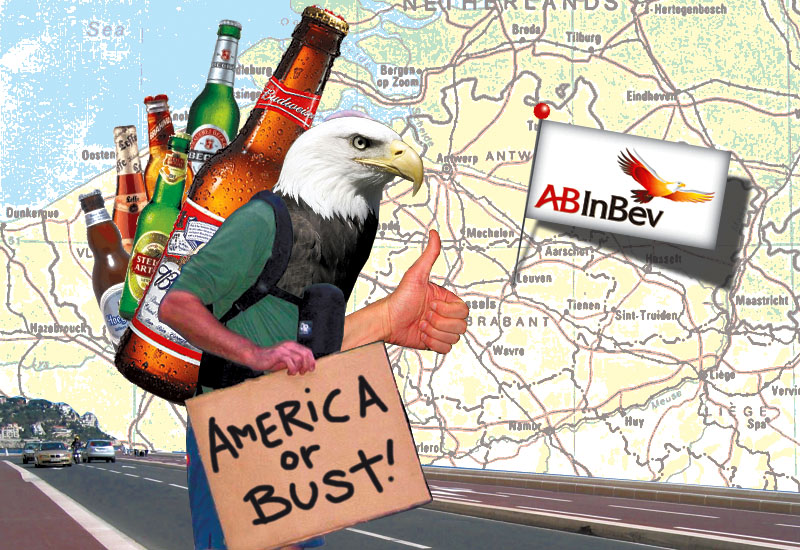
There is a rumor making the rounds of European beer consumer groups that A-B InBev, the world’s largest brewing utility, may take its operational headquarters out of Belgium and move stateside instead.
But that’s not the funny part. The bosses are said to be getting fed up of working in an awkward environment.
A series of public relations blunders in their Belgian operations in recent years, such as the closure and reopening of the Hoegaarden brewery and attempts to sack other brewery staff, has led to the kind of poll ratings that make politicians choke. I can see where the story might have come from.
But as a seasoned observer, I ask how anyone could know this is true. On two occasions in my CAMRA (Campaign For Real Ale) days, senior execs were calling me to suggest meeting for a beer in some quiet country pub so they could spill the beans about their numbskull CEO’s latest madcap project.
I doubt that happens nowadays. Other than in photo shoots, most board members would not be caught dead drinking the stuff they are vaguely involved in creating. This story sounds like wishful thinking to me. Though it did get me wondering.
Mass-production beer making is a world apart from craft brewing, and it could safely be ignored if its proponents had not nearly destroyed the world’s beer culture barely a generation ago.
While thousands of microbreweries have been founded and many have flourished, the big boys have gotten even bigger. Four companies—A-B InBev (producing 350 million hectoliters in 2009), SAB Miller (250), Heineken (200) and Carlsberg (125)—now supply over half the world’s beer.
Their goals are brand familiarity, technical flawlessness and market domination, all achieved through massive spending, often financed by huge borrowings. In their latest annual report, A-B InBev cited that its current debt is $45.2 billion, with a net debt to EBITDA (Earnings Before Interest, Taxes, Depreciation and Amortization) ratio of 3.7.
For global companies, achieving greater efficiency and lowering overhead costs have always depended on upscaling many operations, to the extent that in many parts of their empires, they can no longer produce anything entertaining because they do not make or handle smaller-volume products.
Perpetual expansion is an essential prerequisite of many old business theories, but this hits the buffers once the world’s markets are filled. And it is not too fond of the idea of finite renewable resources either.
For global brewers, the foe used to be the other guys who wanted market domination. The new enemies are more difficult to nail—consumer resistance to being a simple brand user, greater knowledge of more interesting alternatives and a growing awareness of the advantages to buying local produce.
To function, this large of a company needs to be fleet of foot. Brewing interests in Eastern Europe and elsewhere (clever buys a few years back) are sold off to service the debt. So much for becoming a top-two producer in every market served.
Fortunately for A-B InBev, the market for discarded beer factories remains buoyant. So for now, they get to stay in the grand game of musical chairs, watching and waiting for others who lose their seat when the music stops.
But if A-B InBev’s predecessor, Interbrew, which once produced over 70 percent of Belgian-made beer (and still makes over half), was finding that life in old Belgium was too tough, is the US beer scene really a better place to grow a bulk beer producer? That is not my impression.
The irony, of course, is that if A-B InBev does downsize, it would be the best thing to hit Belgian craft brewing for a century. It is an odd world we have created. ■
 Previous: Objectively Better Beer
 Next: Maintenance Engineering