
The Beer Language Dilemma
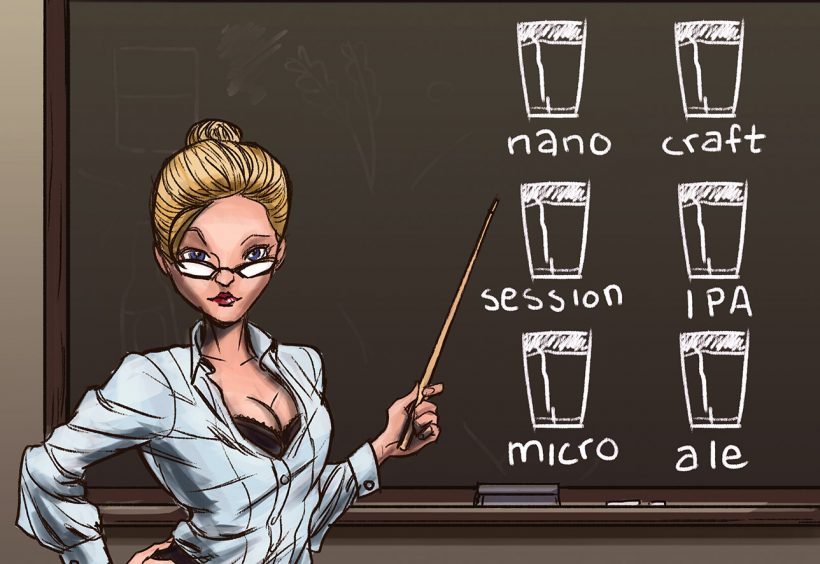 Illustration by Chi-Yun Lau
We have a language problem in the world of beer. I’m not talking about our overuse of four-letter words or an inability to speak after too many pints. We lack a cohesive and agreed upon set of terms for discussing our shared art of passion.
Let’s start with the term whose popularity continues to grow every day—“craft beer.” Brewers, distributors, writers and industry insiders have been engaged in an ongoing battle over what to call the flavorful, colorful, characterful beers we all enjoy. As with defining pornography, we know it when we see it; or, in the case of beer, also taste it. But we still don’t quite know what to call it. Do we define what constitutes a craft beer or just a craft brewer? Can a big brewer (macro? Behemoth? International conglomerate?) make a craft beer? In terms of flavor, is Blue Moon by Coors so different from dozens of other average Witbiers made by smaller brewers? Should we instead use the term “better beer,” and if so, better than what? Anything brewed by the big brewers? Nowadays, even the Boston Beer Company is derided by many beer geeks as being too big, so that hardly seems appropriate.
Having grown up with the term “microbrew,” many seem loathe to let go of this iconic word and the related imagery of beer made in tiny, handcrafted batches. While many small breweries still operate at least in part by hand, the days of handcrafted beer belong to a different, quickly disappearing era, having been supplanted by much-welcomed automation and greater control. And with many once-small breweries now producing tens or hundreds of thousands of barrels per year and distributing beer from Denmark to Japan, the “micro” designation is an anachronism, if not a myth.
Beyond these big-picture terms, the creativity of brewers also leads to new issues and areas of confusion. In the last two years, beer geeks and brewers from coast to coast have waged a nerdy battle over what to call dark beers that display strong hop characters without the bite and flavor of roasted malts. Depending upon which viewpoint you subscribe to, you might call such a beer a “Black IPA,” an “India Black Ale” or “Cascadian Dark Ale.” With a somewhat murky history, either having first been made by the late Greg Noonan at the Vermont Pub & Brewery, or somewhere in the Pacific Northwest or Britain, there is no agreement over what such beers should be called. It does, however, seem a bit ridiculous to call a dark beer with no connection to the subcontinent an “India” or “pale” ale.
Perhaps the most troubling (and most recent) example of our parlance problems comes with the American use of the British-based “session beer” moniker. As I discussed in issue #53 of BA, beer cultures are largely not transferable between countries, and that’s a good thing. You shouldn’t expect to find a vibrant Belgian beer culture in Cleveland, just as San Diego’s thriving beer scene can’t be re-created in Tokyo. And while pursuing the goal of lower-alcohol yet flavorful beers is a very worthwhile goal, trying to cross-apply the “session” label just doesn’t work in the States.
Even the otherwise appropriately named nanobreweries have come under some scrutiny. Just how small does a brewery have to be to qualify as a nano? I’ve recently started seeing the term “pico-brewery” pop up, denoting something even smaller than a nano, if that’s possible. I’m not sure if this involves beer made by boiling the mash in a microwave, but it boggles the mind.
As a beer writer, I’ve been struggling with these semantic issues for a long time, usually with little to no results to show for it. While we generally agree on what we’re discussing, defining these beer-related concepts remains a difficult task. Maybe you’ll figure out the whole craft beer language debate over your next pint.
Then we can get started on gastropubs. ■
 Previous: Beer News
 Next: Reinheitsgebot Pays Off