
Hopleaf in Chicago, Illinois
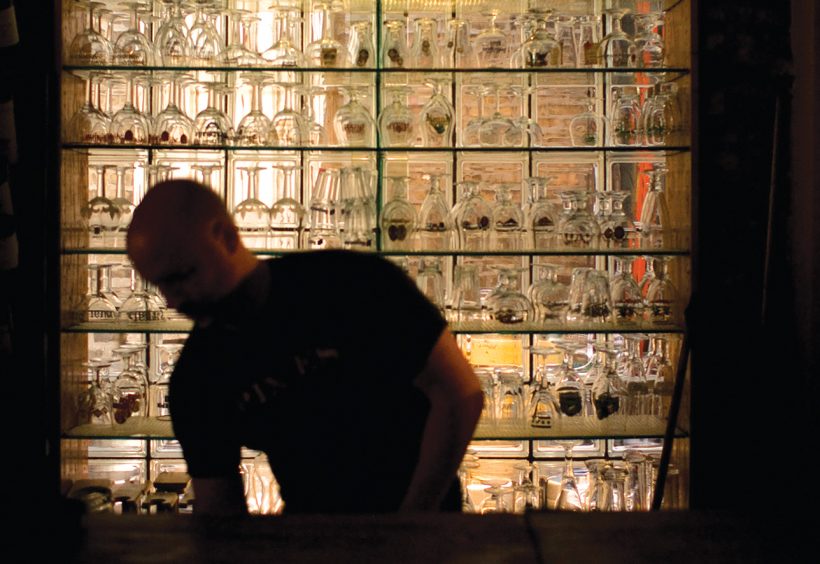 Photo by Grant Kessler
It would take Michael Roper a few tries to get it right. The first place he opened, The New Miami, was located in Detroit’s Cass Corridor—patrons would bring their car batteries into the establishment to avoid getting them stolen, Roper found bodies in the alley or on the sidewalk on more than one occasion, and when a group of hoodlums “poured gas into the building through an exhaust vent and lit it on fire,” the damages were too much to cover. After a stint at a downtown punk-rock club, Roper left the Motor City for the Windy City with his then-girlfriend in 1982. “[In Detroit], I was in a bit of a tailspin with drinking, drugs and women,” he says. “Chicago worked. Our relationship did not.”
In the early ’90s, Roper purchased Clark-Foster Liquors in Andersonville, a Swedish neighborhood on Chicago’s North Side. The transition from dive to destination was slow, but steady. “We served a lot of old-timers with liver spots and worn faces, peppered with neighborhood pioneers,” says Meghan Fiore, Hopleaf bartender of 18 years. “Lots of young folks, artists. It was fun. You just felt like you were a part of something new and exciting.”
With time, a new clientele emerged. “I put some custom-made neons in the window advertising Bell’s, Golden Prairie, Sierra Nevada,” Roper says. “People heading past on the bus pulled the cord and made a bee-line in.”
The craft beer scene in Chicago “was a bit behind in 1992,” Roper says. But with a bar like Hopleaf and emerging craft brewers popping up, things began to turn around. “Goose Island broke the curse by combining good beer and good business sense,” Roper says.
The once-humble tavern now has 65 draft lines and 400 bottles, featuring a lengthy list of Belgians and Chicago’s up-and-coming brewers, like Revolution, Half Acre and Five Rabbit—not to mention a full-service kitchen serving up mouth-watering options like a duck reuben and Hopleaf’s legendary mussels, plus eight lines of draft wine. Meanwhile, the significant recent expansion has increased the kitchen size by five times, and the capacity to 280 year-round, with an inviting patio in the summer and cozy fireplace in the winter.
And, as it turns out, that Goose Island love is reciprocal, too. “Before Hopleaf, Belgian beers were hard to find in stores, almost impossible to find in bars,” former Goose Island brewmaster and Virtue Cider founder Greg Hall says. Hall has been and still is a Hopleaf regular. “Hopleaf sets the tone for the rest of Chicago’s beer bars. Michael deserves a ton of credit. He’s turned a lot of drinkers into beer experts.” ■

