
Argentinean Empanadas
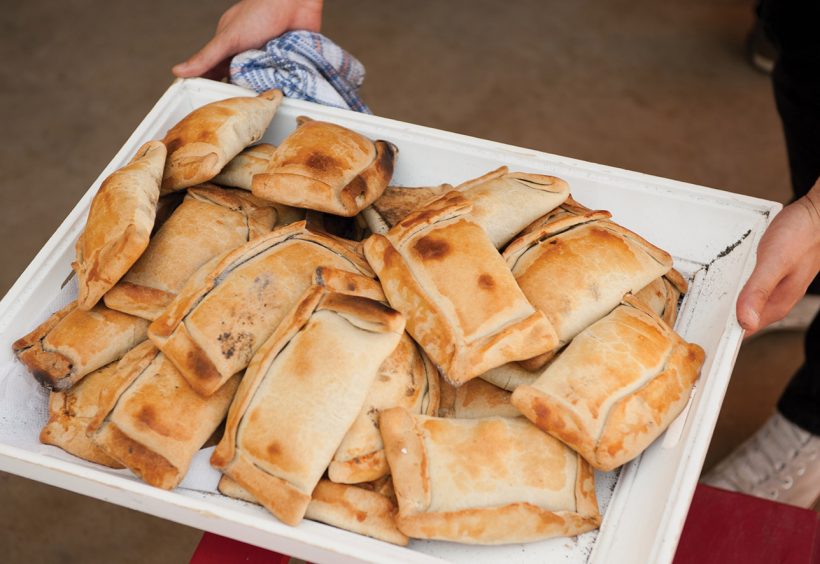 Photo by Sean Z. Paxton
While traveling in Argentina in May, I tasted the most incredible empanadas, and since my return, I have been in search of a great empanada—with minimal luck. So in true homebrew chef form, I went to work re-creating what is locked in my memory as some of the best empanadas I’ve ever had, with a cuisine à la bière enhancement. So, what is an empanada? Think of a turnover-like pastry, a flaky, golden crust stuffed with a savory filling, that, when combined into one bite, makes pure bliss.
Empanadas can be found all over the globe, but what makes the Argentinean empanada version different is the small wedge of a boiled egg and a single olive placed on top of the meat pie. The variations are endless with empanadas, so make a few fillings, have some friends and family over, and put them to work.
Empanada Dough
While Latin markets usually carry a premade dough for empanadas, a homemade dough leaves room for the chef of the house to be a little more creative. To bring out more richness in the dough, which will add balance to the filling ingredients, use a malt-forward beer style (Bock, Brown Ale, Scotch Ale or Märzen). Or go with a beer that is roastier (Porter, Stout, Smoked Porter) to give more color to the dough, while also bringing out more astringent elements in the filling. This combination makes an incredible crust that is more tender and flaky than any frozen, premade dough could ever be.
Makes: about 10 6-inch rounds or 18 3-1/2-inch rounds
Dough Ingredients:
1 each egg, jumbo (or two large eggs)
1/2 cup beer, cold
1 tbsp malt vinegar
1 1/2 tsp kosher salt
2 cups all-purpose, unbleached flour, preferably organic
3/4 cup flour, barley or whole wheat, stone ground
1/2 cup unsalted butter, cold, or vegetable shortening cut into 1/2-inch cubes
Dough Directions:
In a small bowl, crack an egg and lightly whisk until it is frothy, about 30 seconds. Add in the beer of choice, malt vinegar and salt; mix until combined. Set aside.
In the bowl of a food processor, pulse together the all-purpose flour with the barley or whole-wheat flour (to add a touch of extra texture and light grit to the finished bite) until well blended. Next, add the cut-up, ice-cold butter to the flour mixture and cut the fat into the flour, until the mixture resembles a coarse-sand consistency (don’t overprocess or it will become a paste). Add in the egg/beer mixture and pulse several times, until the mixture forms a ball. Remove the dough to a lightly floured surface and fold it over onto itself a few times to knead any smaller bits of dough into the large ball. Wrap the dough with plastic wrap and refrigerate for at least an hour. The dough can sit up to a day in advance. While the dough is chilling, prepare the filling for the empanada. The filling will need to be chilled before combining with the dough in order to avoid melting the butter in the dough.
Egg Wash Ingredients:
1 each egg, jumbo or extra large
3 tbsp beer, the leftover from the dough
Egg Wash Directions:
In a small bowl, crack the egg and whisk it to a frothy consistency. Add the beer, and whisk again. Set aside, and have a pastry brush ready to go.
Rolling Out Directions:
Have a clean, large surface to work on, a rolling pin, and two pieces of wax paper that have been cut to 10-inch squares. Lightly flour the surface and the pin. Divide the dough into either 10 pingpong-size balls (to make a 6-inch round) or 18 balls (to make a 3-1/2-inch-round, appetizer-size pastry). Lightly coat a ball of dough in flour. Place it between the two sheets of wax paper and center it. Lightly press the dough down with a cold 22-ounce bottle of beer, rolling pin or pint glass to make a thin dough, about an 1/8-inch thick with a diameter the size you want the final round to be. Tear away one corner of the top wax paper, leaving behind the finished round. Using a fine sieve filled with a little flour, lightly dust the surface of the wrapper. Remove from the bottom wax paper and set the round, dusted side down, on a clear work surface. Repeat with the remaining dough; if it is cool, then roll out all the rounds, but if warm, only do about a third. The finished rounds will warm faster, making them harder to form with the extra heat from your fingers.
At this point, the filling should already be made (recipe below). Use a very small ice cream scoop or a tablespoon to portion out the filling. Remember, a little goes a long way for making any stuffed pastry. Place a small mound of the chilled filling in the center of the dough round. Add a wedge of hard-boiled egg and single olive to make a traditional Argentinean empanada. Lightly brush the edge with the egg wash. Next, fold over the dough to make a half-moon shape.
There are several options for sealing the empanada that add decoration, and can help identify the different fillings if multiple are used in one setting.
- Forked: Using the tongs of a fork, start at the corner closest to you, press to seal the dough together, but not so strong as to cut through both layers of dough.
- Fold: This is easier, but not as elegant looking. Lightly pull the bottom layer of dough over the top layer, fold it over itself to seal the dough, and pinch together.
- Dumpling Maker: Asian or Latin markets usually carry dumpling presses, which are plastic and fold over to seal a dumpling. If using this method, remember to roll out the dough to the size of your mold. Center the dough round onto the press. Portion the filling in the center, and press and seal.
- Roll & Crimp: This is very similar to making a pie-crust edge and the hardest to master. Starting at the point closest to you, at the fold, using your thumb, roll the dough up over your index finger and lightly pinch together to create a small ridge, and repeat. When a well-trained and seasoned grandmother does this, it is true art.
Place the finished empanadas onto a sheet tray fitted with a piece of parchment paper or a Silpat, and arrange so that no two empanadas are touching. Next, lightly brush the top of each empanada with the remaining egg wash, leaving an even coating to create a golden-brown crust. Sprinkling a large-flake salt, a salt/herb blend or a smoked salt on the top gives a little extra dimension to the empanada. These salt crystals work like the salt on the outside of a pretzel, boosting the flavor in each bite.
Baking Directions:
Preheat the oven to 400°F, convection if your oven has this option. Place the sheet tray in the center of the oven and bake until golden brown, usually about 25–30 minutes, depending on the size of the empanada. Since the filling is already cooked, the focus of this step is to make sure that the dough is fully cooked.
Serve the empanadas right out of the oven or at room temperature. I like to pair my empanadas with a complimentary beer, something with darker malts, to access the melanoidin flavors that mimic the Maillard reaction in the crust and the caramelized onions in the filling. Or pair with a Caipirinha, a South American beverage with cut limes muddled with sugar and mixed with Cachaça, a sugar cane liquor, to provide a little contrast. Another good option is to pour a citrus-forward IPA or Pale Ale over ice in a pint glass with a few slices of lime, lemon, orange or tangerine.
Steak, Onion, Porcini Mushroom and Imperial Stout Filling
This is a classic filling found all over Buenos Aires. The addition of a Stout gives extra depth and enhances the natural umami of the mushroom.
Makes: enough filling for 2 batches of empanada dough
Ingredients:
12 oz Imperial Stout, such as Dogfish Head World Wide Stout
2 oz dried mushrooms, preferably porcini or morel
3 tbsp olive or vegetable oil
1 lb. beef, top sirloin, cut into 1/2-inch cubes
2 each yellow onions, peeled and sliced
2 each bay leaves, preferably fresh, or 3 dried
4–5 each garlic cloves, roasted
2 each eggs, hard boiled, shelled and cut into eighths (optional)
20 each olives, cured and pitted (optional)
Directions:
Start by rehydrating the dried mushrooms in the Imperial Stout, letting both sit in a small bath for 20–30 minutes. In a skillet or Dutch oven, over medium-high heat, add the oil and brown off the cubed beef, seasoning lightly with salt. Once browned on all sides, remove with a slotted spoon to a bowl and let sit. Next, add the sliced onions and bay leaves, seasoning lightly with salt and dropping the heat to medium. Slowly caramelize the onions to a dark brown color, about 12 minutes. When the onions begin to turn golden brown, add in the chopped roasted garlic and the cooked meat. Dice the mushrooms, add the fungus with the Imperial Stout to the pot, and turn down the heat to cook on low, until the mixture forms a stew-like consistency. This will take about 30 minutes on the stove, stirring occasionally. Or set in the oven at 325°F covered with a tight-fitting lid for an hour. The finished filling will be still moist, but more of a gravy consistency. Chill the filling down to room temperature, then place into a container and refrigerate until cold. This mixture can be made in advance and will get better the second day, like a good stew.
Variations: Using lamb or venison will add extra richness and gaminess to the filling while using a Smoked Porter or Rauchbier instead of an Imperial Stout will increase the umami flavors even more. For a vegetarian option, substitute the beef with Portobello mushrooms, scraping out the gills and sautéing them lightly; add to the onions, and follow the rest of the directions. ■
 Previous: Short Beer
