
First Among Equals
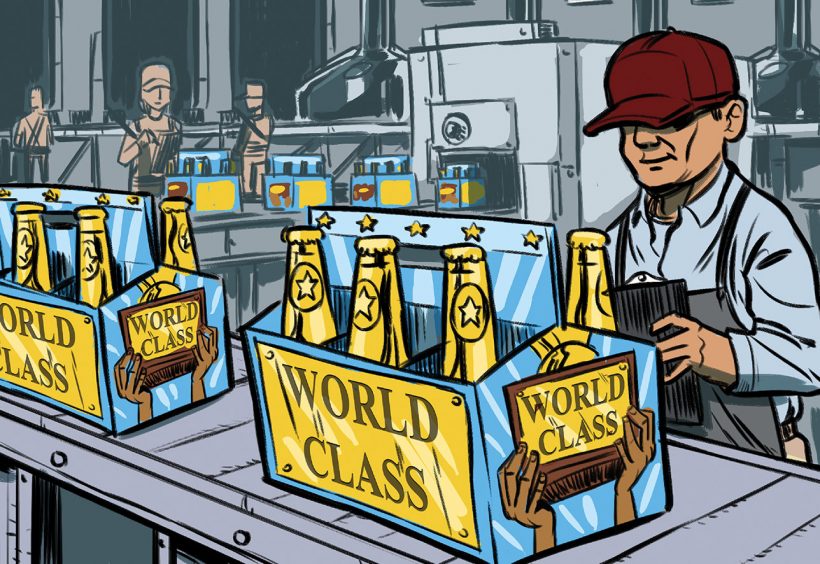 Illustration by Chi-Yun Lau
In last month’s column, we explored what it meant to be world-class in the early days of craft brewing. This month, we look to the present and the future.
Despite radical changes in the face and scope of the American craft beer industry, some elements of what constitutes world-class beer remain timeless. While it’s a testament to the evolution of craft brewing that many new brewers believe themselves capable of making the world’s best beer, the likelihood that they will make good beer, let alone world-class beer, in their earliest efforts is exceedingly low. Brewing is a developed talent requiring a delicate balance and fine-tuning of skills. It requires understanding the mechanics and physical properties of brewing, mastering the underlying chemistry, investigating how each element fits into the overall profile, and takes time, dedication, and some measure of good fortune. I have yet to meet a brewing savant or wunderkind that nailed every batch from the very beginning.
World-class brewing also demands consistency, not in simple flavor terms but as a method of demonstrating skill. If as a brewer you can routinely hit a defined target, especially where consumers have a reference point and can judge your efforts, that’s no small feat. It’s a mental and technological triumph that’s rarely celebrated in today’s beer marketplace. Moving beyond process and technical proficiency, creativity requires careful honing and boundaries. Simply lashing out wildly with hops, malts and other ingredients results in a tattered, confused canvas of flavors and ideas, even if the occasional marvel results. Such chaotic efforts do not make a world-class brewer.
It also remains difficult to define “tomorrow’s classics,” as Michael Jackson put it, in an age where beer styles have exploded in number and commingled, resulting in bastardized and often unrecognizable offspring. Does the laurel of world-class maintain any true meaning in a time of Black IPA, Black Kölsch, and Black Saison? Jackson proved prophetic in his talk of the next age of brewing—ironic when brewers often don’t know his name or body of work, let alone that of their brewing forefathers.
Brewing conformity, whether towards one style, a subset of that style, or a dominant flavor and aromatic palette, further complicates the ability to determine the talent and contributions of an individual brewer. In his Pocket Guide to Beer, Jackson wrote that “[t]he world’s classic pastries, cheeses and wines were each born in a particular place as a result of local materials, circumstances and the ideas of the creator.”
While beer tends to take its ingredients from around the globe—which should offer a near endless number of aroma and flavor permutations—we’re beginning to see an unprecedented level of brewing recipe groupthink. With the rise of IPA and its dominance in the marketplace, enterprising brewers are gravitating toward constructing essential clones of a handful of the most successful and elusive versions. Built on the back of a simple, unobtrusive, and often hard to locate malt base, these super-IPAs are loaded with some mélange of Amarillo, Mosaic, Simcoe, Tomahawk and Warrior hops. The resulting beers possess bright, juicy aromatics, light bitterness and a sameness of flavor. Basically inbred derivatives of some long-lost West Coast-style IPA godfather, they are difficult to differentiate and possess little to no individualized character. Their resulting popularity with beer reviewers, however, ensures their continued existence.
The concept of world-class itself remains a throwback to a different era, one that no longer maintains relevance in our diffuse and disparate time. With no slowdown in sight, the growth of craft beer likely requires a wholesale rethinking of what it means to be world-class. And it may just be too early to know where that debate will end. ■
 Previous: Hopworks Urban Brewery: 5 Essentials
 Next: Alphabet Soup