
The Belgian Highlands
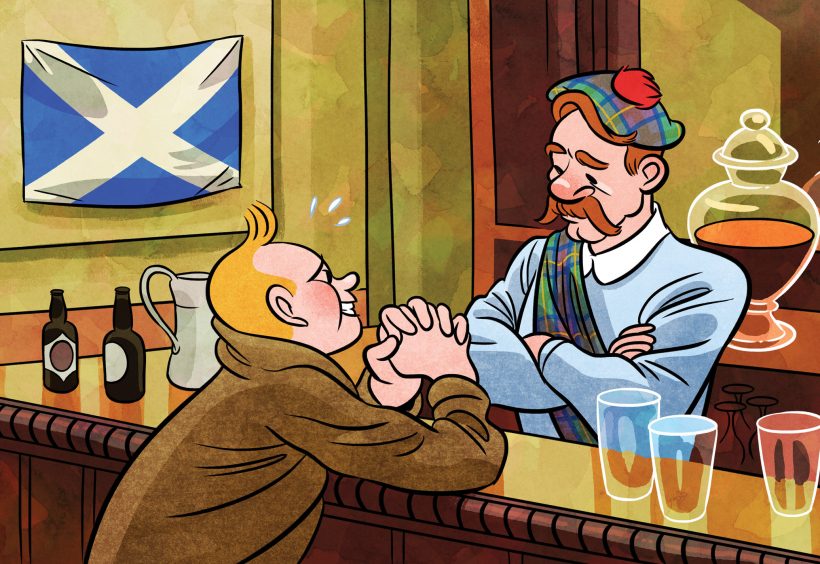 Illustration by Ellen Crenshaw
Belgium was wrecked after WWI. The inhuman grind of newly modern warfare denuded the land, destroyed resources and stripped breweries of metal to feed the machine. It was enough to drive citizens to drink, but in 1919 the Belgian government passed the Vandervelde Act banning the sale of distilled spirits.
Combine the ban with peacetime recovery pressure and you have the conditions for making strong beer. The bar stool story is that Belgian brewers turned to the Scots for their expertise in brewing strong beers, but I can’t vouch for that tale.
I do know Brouwerij Moortgat’s Alfred Moortgat went to Scotland to gain strong beer knowledge and, legend has it, a yeast culture from McEwan’s. That trip inspired “Victory Ale,” a potent, dark 8.5 percent beer that drinkers nicknamed “The Devil” or Duvel in Flemish. In time it transformed into today’s pale gold beer.
Alfred wasn’t the only brewer to seek Scottish inspiration. I can think of at least three others: Caledonian’s Gordon Highland, Scotch De Silly and McChouffe. Each displays a different interpretation of the style. Gordon is the familiar Wee Heavy, McChouffe is thinner and more Belgian-like, while the Silly beer lies between the two with a decidedly Belgian flair—my preference. I also highly recommend Gordon’s amazing thistle glass for the drinking experience.
VICTORY BELGIAN SCOTTISH ALE
For 5.5 gallons at 1.083 OG, 27 IBU, 17 SRM, 9.0% ABV
Malt/Grain/Sugar
15 lb. Belgian (or Scottish/English) Pale malt
0.5 lb. Special B malt
2.0 oz Carafa II Special
1.0 lb. brown sugar
Mash
Rest for 60 minutes at 152°F.
Hops
0.5 oz Magnum (pellets) | 14% AA | 60 minutes
Yeast
Wyeast 1388 Belgian Strong Ale, WLP570 Belgian Golden Ale, Wyeast 3522 Belgian Ardennes, or WLP550 Belgian Ale Yeast
Notes
Take the first half gallon of runnings and boil down to 1 pint of syrupy goodness. Add back into the kettle. Next, add the brown sugar in the last 5–10 minutes of the boil. Finally, ferment cool in the lower 60s to deemphasize the Belgian character of the brew. ■
 Previous: American Styles of the 1930s
