
Kjetil Jikiun
How to go from being you to bringing a flavor to an entire nation in 9 tasty steps
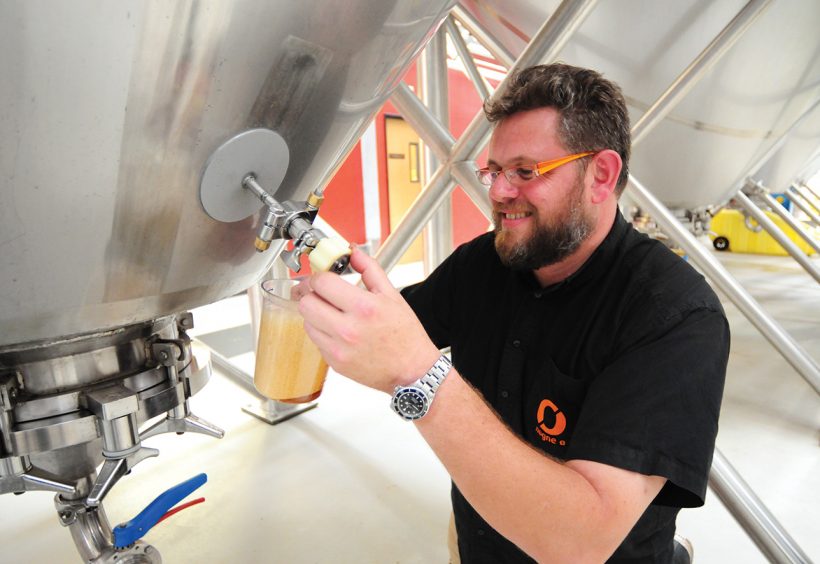 Photo by Douglas Gates
Kjetil Jikiun once found inspiration in American craft brewers’ powerfully flavored ales. Now, his brews are a global sensation. But there’s a better line on his résumé: When he founded Nøgne Ø, he brought flavor to Norway.
1. Bring it on home
Kjetil Jikiun found great beer thousands of miles away from his native Norway. He’s an airline pilot, and he’d often fly long hauls to the United States. “I didn’t fly to Europe at all,” he says, “and I ended up being very inspired by the US brewing scene.” He fell in love with big, assertive American beers, began homebrewing, and since the Norwegian homebrew community was virtually nonexistent, he would end up flying back with homebrewing books, yeast, hops and “50-pound bags of malt in [his] suitcase.”
2. Flavor makes life worth living
Homebrewing “became an obsession.” Norway was awash in awful light lagers, and, Jikiun says, “I felt that somebody would have to take the responsibility to bring diversity into beers in Norway.” He founded Nøgne Ø with a fellow homebrewer in 2002. The pair wanted to “provoke” their countrymen with full-flavored beers. “I just thought it was so horrible to live in a country where all these good beers were not available. We brought about the first IPA, the first Brown Ale, the first Porter, the first of many styles. We felt we needed to do something to make people pay attention.”
3. Work hard, and find a patient wife
Nøgne Ø had no financing and no obvious market. “We couldn’t afford to buy a proper brewhouse or proper fermenters,” Jikiun recalls, “so we got in touch with a guy who could weld for us, and who trusted that he would be paid later, and we found lots of scrap metal, dairy tanks.” They welded a Frankenstein brewhouse, and brewed and bottled around their full-time jobs. “For the first two years, we were just about to go bankrupt every second month or so. Nobody believed in us, nobody believed in our idea. I think the only reason I’m still married is, my wife is very forgiving.”
4. Seize your opening
One day, Jikiun got a call from a prestigious wine and cognac importer in Oslo. The importer gave them a distribution network and access to Norway’s government-run alcohol outlets. More importantly, he gave them credibility with the press, which introduced them to the drinking public. “That’s the turning point. We have not earned much money on this brewery, and it will never make us rich, but I think we have changed Norwegian beer culture. We have been able to make a change in how people regard craft beer.”
5. Show them
Nøgne Ø brews #100, a brutal hop bomb that lives halfway between a Double IPA and a Barleywine; Dark Horizon, a midnight-black, 16-percent ABV Stout brewed with coffee, sugars and wine yeast; and an Imperial Brown. They’re huge, unabashedly flavor-forward beers. What’s with the aggression? Jikiun tells a story about his homebrewing days. “I did my best IPA ever, and I submitted it to a contest, and it came out as the second lowest score. The judges’ reaction was, it was too much hops. That provoked me very much—I felt that, OK, if this is how it’s going to be, I need to prove that my IPA is good in a different way.”
6. Evolve
Yet Jikiun has been veering away from big, West Coast-inspired beers lately. “The first two years, I think I was too heavy-handed with the hops, and this is probably a reaction to what I grew up with,” he says. Now, Nøgne Ø is “moving more in the direction of harmony and balance.” Jikiun is now experimenting with local hops and barley, with lingonberries and spruce shoots. “What I see this shifting into is more a focus on our own identity, the Nordic identity.”
7. Take notes
Jikiun traded his sizable Frankenstein brewhouse for a 38-barrel system. He hasn’t brewed at home since he founded Nøgne Ø. And he’s never had a pilot system. So, when he brews, there’s little room for error. Jikiun works new recipes out on paper. He’ll carry that paper with him for weeks, or “as much as half a year,” dwelling on it, making corrections. Or, he’ll post the recipe in the brewery office and invite his brewers to have at it. The end result: When he’s ready to brew, he’s ready.
8. The goal: small world, big identity
Americans are brewing Belgian beers. Belgians are using West Coast hops. Jikiun, a Norwegian, became a brewer because he fell in love with beers from California and Colorado—which had been cribbed from the British. Nøgne Ø was founded for a domestic audience, but it exports the bulk of its product. Its brewer calls the globalization of beer flavors and markets “a wonderful thing” for consumers and brewers. And after all that, Jikiun still insists that brewers should strive to create local flavors with local ingredients—beers that “people have a relationship with,” he says.
9. Keep your friends close
Nøgne Ø exists today because, when Jikiun was flying to the States, he’d bring his homebrews with him. American brewers would give him notes on his work. He singles out Elysian’s Dick Cantwell as being especially “important in giving me the right input for me to believe in doing this.” Now, Jikiun is advancing that spirit of cooperation. He’s done collaboration brews with Swedish, Danish, Finnish and Japanese brewers. In October, he flew to San Diego and brewed a Spiced Winter Ale with Stone and Jolly Pumpkin. “We learn from each other, we exchange ideas,” he says. “There’s no point in sending Nøgne to the US if we could brew it there.” ■

 Next: Beer Wares