Laying the Groundwork
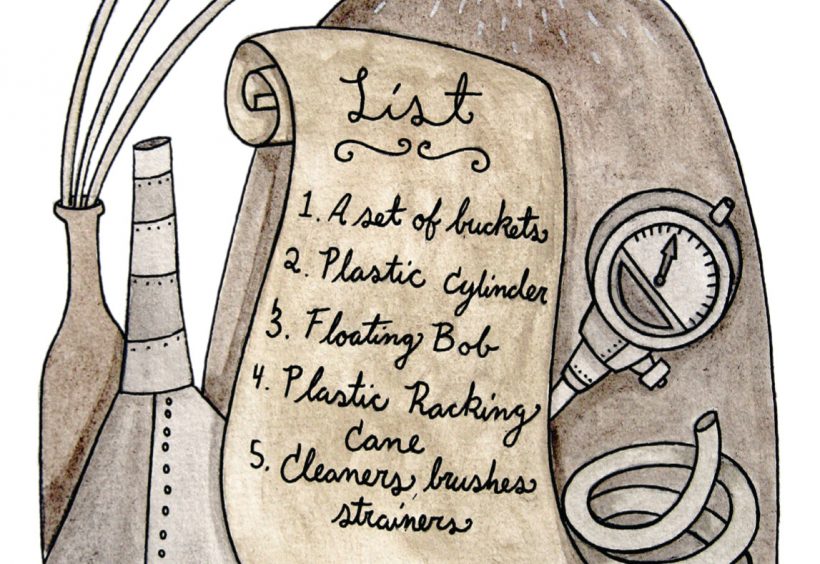 Illustration by Evan B. Harris
Our first article sold you on the virtues of homebrewing: it’s fun, it builds community and, obviously, it yields beer. Yet you’re still hesitant. Is it messy? Will there be bottles exploding everywhere? What if my batch turns out like Granddad’s awful crock of homebrewed foulness that practically tore my family apart?
Relax, it ain’t rocket science. It’s beer. And this month we’re going to get you started by walking, step by step, through the process of setting up your own homebrew shop. Once you get everything in place, you’ll be closer than ever to brewing your own beer.
The Shop
To pull it all off, you’ll need special tools and ingredients.
Most places have a homebrew retailer within driving distance. BeerFly on BeerAdvocate.com can help you find your options. A good local shop has a wide selection of equipment, fresh ingredients and a knowledgeable staff. Look for a sponsored homebrew club—an invaluable resource.
Stuck in Podunk? Reputable online merchants (morebeer.com, northernbrewer.com) can meet your needs. Online stores can save you time and money, provided you plan ahead. Look for a supplier who answers questions promptly and offers quick, free shipping.
Equipment
Every homebrew emporium has a magic beginners’ kit. Kits are an easy way to start and offer a bewildering array of gadgets. A set of buckets or glass bottles (called carboys) comprise the bulk of the equipment. Treat them right and magical fermentation will occur here. A plastic cylinder with a floating bob serves as an airlock and protects the fermenting beer. Included in most kits is a long, curved, plastic racking cane and tubing to siphon beer to different containers. You’ll also receive bottling supplies. Kits may also include books, cleaners, sanitizers, brushes, strainers and more.
All of this gear can be yours for a measly $100 investment. Many shops will even throw in ingredients for your first batch. Their sample recipes will cover a gamut of beer styles. Choose something simple, read their instructions and have fun. If you’re stuck, ask for help at your store or BeerAdvocate.com.
Inevitably, some parts aren’t included. Chief among them is a 20-quart (or larger) pot made of stainless steel or aluminum. And despite receiving bottling equipment, you need to supply your own non-twist-off beer bottles. The simplest solution: Get a couple cases, call over a few friends and by morning you’ll be golden.
Ingredients
A good homebrew shop has a seemingly endless collection of fresh ingredients. Like any other form of cooking, freshness is key for brewing. If a shop has improperly stored ingredients (i.e. warm hops) or terrifyingly old ingredients, slowly back out of the joint. Never go back. There’s no reason to waste time using inferior ingredients.
Water constitutes over 90 percent of your beer, so choose your source wisely. Your city or town probably provides safe, clean water, but it’s treated with chlorine or chloramine. Both react and create nasty metallic and medicinal flavors and aromas in beer.
To avoid this, either use charcoal-filtered or bottled drinking water.
To get your first beers started, use concentrated malt extracts as a shortcut, instead of mashing a mess of grain. Malt extract comes in syrup (LME) or spray-dried powder (DME) forms. Unless you like stale flavors in your beer, choose the freshest extract you can find. DME stores better, while fresh LME provides better grain flavor. To boost the beer’s fresh taste, add a small amount of crushed barley malt.
Providing the bitter, contrasting edge to a beer are doses of hops. These green flowers of a bine are usually crushed into pellets for easy storage and use. Choose hops that are still green and aggressively aromatic. If they’re brown and cheesy, run.
Lastly, Yeast
The magic fungus that makes beer. There’s a lot to know about these bugs, but for now you’ll use dried, active brewer’s yeast or a package of liquid yeast. Don’t use bread yeast or health-supplement brewer’s yeast, unless you want to be like dear old Granddad.
You’re now set for next month’s column, when we start in on a Guinness-inspired Dry Irish Stout. ■