
In All Things, Simplicity
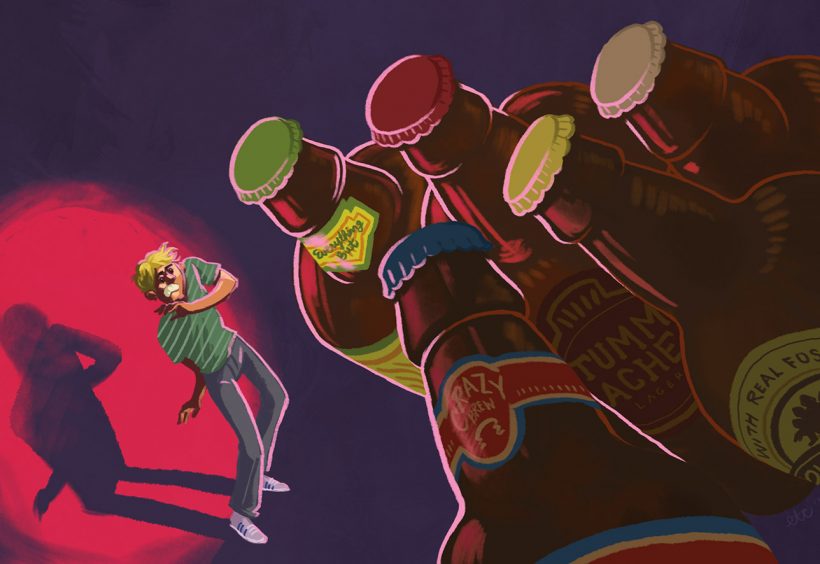 Illustration by Ellen Crenshaw
As we approach the upcoming holiday season, a constant blare of marketing horns drives everyone to “bigger, better and more.” Well, actually, this is the super-concentrated apex of a nonstop campaign pushing us to the newer and more complex. Even the top-rated beers seem to be giant fuel-air bombs. It’s death by keeping up with the Joneses and their new Quadraphonic stereo cabinet. I’d prefer, in my head, if not in reality, to live like Marcus Aurelius—“Make thyself all simplicity.”
While over-complication is rife in life, I don’t think we can solve the problem in a mere 600 words, so let’s stick to the beer. I realize there’s a certain amount of irony for the guy who made a name for himself via monstrosities like the Gonzo Hemp Poppy Spirit Wine standing here on his monthly soapbox and commanding the tide from the shore, but bear with me.
One of the most telling signs of the depth of a homebrewer’s experience is his or her recipes. Though the presence of extract is leading, it really tells you nothing. I’ve mentioned in previous columns the top-notch beers of my veteran extract-brewing friends. Nope, the single biggest revealing factor is the malt bill. More than a pound of Crystal malts, and it’s probably a rookie’s, for instance. Stacks of malt also reveal the truth. If you’ve complicated your recipe with 20 different malts, you’ve probably failed. Instead of a pint sounding a clear clarion call of malt, it will “brrrapp” with the muddled, muted off-tone of a trumpeter at their first recital.
Hops also suffer from heavy-handedness. “I’ve added 30 different varieties at 30 different points,” has been a favorite bragging point I’ve heard over the years. Fortunately, the hop crisis shocked people’s wallets (and senses) away from mixing clashing flavor profiles for boasting sake. The popularity of the SMaSH concept (“Single Malt and Single Hop”) among homebrewers may have had a hand in this change as well. (Admittedly, though, my tinkerer’s heart wants to gussy up that SMaSHed horse.)
A prime example of simple complexity is the vaunted Westvleteren 12. This beer that inspires legendary lust is born of monkish purity. The internet shows recipes with 6 or 12 malts containing layers of dark crystals to futilely duplicate the dark gold. Recent research, most notably by Chuck Cook in Celebrator and the blog Brew Like a Monk, lends credence to the rumor that Westy 12 is simply a mix of Pilsner and Pale malts with dark candi syrup added for strength and color. Toss in a simple hop addition and some White Labs WLP530 or Wyeast 3787, and you’ve made magic.
Before you go thinking my snobbery is restricted to recipes, note that I’m talking about simplicity in equipment as well. It’s all well and good to have glycol-jacketed conicals and electronically controlled brew rigs, but good beer flows from the brewer, not the equipment. Covet if you must, but don’t think you need all that crap to succeed.
Now, I’m the first person to admit that, well, every rule has exceptions. I’ve made plenty of beers that violate the simplicity concept. Some would even argue that I’ve made a career as a breaker of the rule, but it’s taken time to gain the necessary know-how to produce “good complicated” over “bad complicated.” An easy way to achieve complexity is to look at blending yeast strains, for example. Often, you’ll get amazing flavor production that gives extra oomph without the mess.
There’s a saying, supposedly from Picasso, that one shouldn’t try to paint a cubist painting until you can paint a perfect still life. In other words, don’t rush into making “Mega Imperial Stout with Chocolate Espresso Cherries and Szechuan Peppercorns” before you understand your surroundings. You and your beer will be better for it.
SIMPLICITY AT NOON
For 5.5 gallons at 1.091, 28 SRM, 41 IBU, 11% ABV
Malt / Grain / Sugar
11.0 lb. Belgian Pilsner malt
5.0 lb. Belgian pale malt
2.0 lb. Candi Syrup D-180 (or Dark Candi D2)
Mash
Mash in at 150ºF for 60 minutes.
Hops
0.75 oz Magnum (pellets) | 14.0% AA | 60 minutes
Yeast
WLP535 Abbey Ale or Wyeast 3787 Trappist High Gravity ■
 Previous: Books
