
Buh-Bye, Chalkboard Beer List
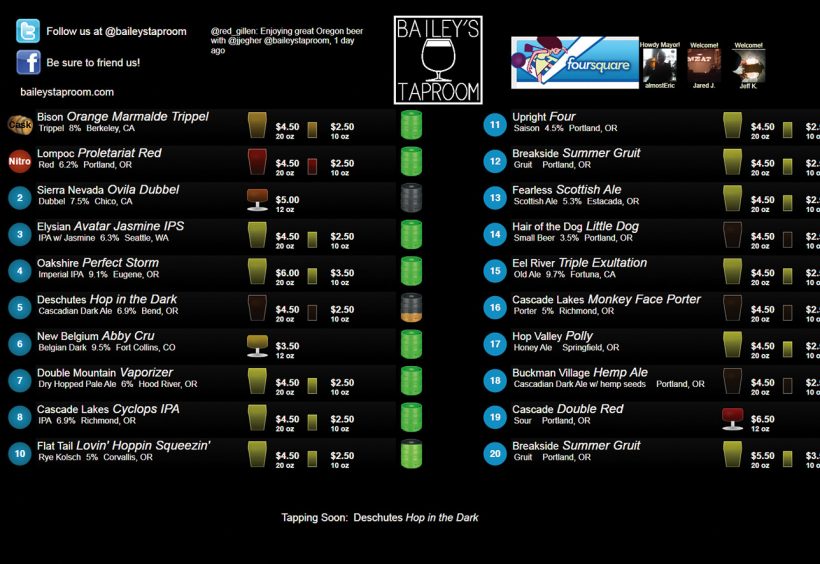
From chalkboards with stunning works of art to scribbled-upon dry-erase boards, the way in which a tap list is presented can speak volumes about how much the establishment respects beer. Now, thanks to a self-proclaimed “computer nerd,” the tap list board has become a lot more high tech—and can not only tell the customer what’s being poured, but can help give the pub owner insight into his or her clients’ beer preferences.
Eric Sterling is a computer programmer who loves beer. So it would follow that he’d start toying around with the idea of a computer-generated beer tap list for his favorite watering hole, Bailey’s Taproom, in Portland, Ore.
“This started as a labor of love for a place I like to hang out at and a chance to play with some new technologies,” Sterling says. “I do a lot of developing on my laptop at Bailey’s—there’s good beer, free WiFi and lots of power outlets. A year ago, I thought about how [Bailey’s owner Geoff Phillips] could use a TV that wasn’t being used, and did a prototype.”
That prototype turned out to be a computer-generated tap list that makes HAL in 2001: A Space Odyssey look like a boat anchor. Connected to an easy-to-read flat-screen TV, Sterling’s creation tells customers everything they need to know to make an informed choice (or several) from the beer taps; it’s also designed to help Phillips make better business decisions.
The board is so new that it hasn’t even been given a proper name, although Sterling is asking for suggestions. On the “public side,” customers see the tap’s name (at Bailey’s, the taps are simply numbered 1-20). The brewery is listed beside the number, then the name of the beer. Directly under that first line, customers find information about the beer: style, ABV and the brewery’s home city and state. The information gets even more detailed from there.
“Next, are the beer glasses,” Sterling says. “There is a representation of a 20-ounce pint, a 12-ounce snifter and 10-ounce glass. Different beers are available in different sizes, so only the appropriate glassware is shown [for each beer].” The color of the glass represents the color of the beer.
Additionally, Sterling has made it so that newly tapped beers get a “Just Tapped!” message displayed next to them; the message slowly fades away over the first 24 hours. And for folks who want to make sure they get those specialty beers before they’re gone, the amount left in each keg is represented by a small keg icon that shows how much beer is available.
“The bar graph [inside the keg icon] gets shorter and turns from green to red as the amount reduces,” Sterling says. “[In the program], I query the point-of-sale system for what has been sold on a given tap. Since I know when a keg went on, and Geoff enters the size of the keg when he puts it into the system, I can just subtract the total amount sold since the items are identified. This does make the assumption that a 20-ounce beer sold means 20 ounces has been taken out of the keg, which is not perfectly accurate. Also, things like samples and overpours are not tracked, so it is just an approximation. But so far, it has been pretty close, and I added a fudge-factor variable that we can adjust over time to make it a bit more accurate.”
In addition, there are spaces on the board for social media—Twitter feeds, Foursquare check-ins and such—plus a list of upcoming beers and a spot for event listings. The board has only been in operation at Bailey’s since August 1st, but Sterling says already, he and Phillips are finding out some interesting behind-the-scenes information collected from the system.
“The whole menu is driven by a database, so now, Geoff has a history of every beer and how much time it spent on a tap,” he says. “From that, we should be able to do different kinds of analysis to see what kinds of beer do well and when, etc. Should be interesting.”
So, drink up: Big brother might not be watching, but the Big Board at Bailey’s is. ■
 Previous: Autumnation by Sixpoint
 Next: Mexican Oktoberfest