Transforming Vietnamese Pho with Dark Ale
 Photo by Sean Z. Paxton
Pho (pronounced “fuh,” not “faux”) is a traditional Vietnamese soup made with beef broth and rice noodles. A rich, heavily seasoned broth is poured over tender rice noodles and served alongside a platter of vegetables and some hot sauce that, when combined, feeds the soul. That’s the classic preparation. But mixing in beer adds more complexity and rounds out the flavors. This recipe is a base that can be used as described here, or transformed using pork or lamb meat/bones for the broth to create a variation of the original pho.
Vietnamese-Inspired Beef BrothMakes: 6–8 quarts of broth, about 16 servings
Ingredients:
6 lb. bones, beef soup (marrow and knuckle bones)
2 each yellow onions, medium
2 each shallots
4 oz fresh ginger root
8 each star anise pods
8 each whole cloves
1 each cinnamon stick, about 3 inches long
2 tbsp fennel seeds
2 tbsp coriander seeds, whole
2 tbsp mixed peppercorns (red, green, black & white)
1 lb. beef, either chuck, rump or brisket
5 tbsp fish sauce, preferably Red Boat or 3 Crabs brand
2 tbsp kosher salt
2 tbsp malt, Caravienne or Crystal
1 tsp malt, cherrywood smoked
12 oz beer per 8 cups of stock. (see “Transforming the Broth” below)
* When shopping for ingredients, be sure to take a special trip to your local butcher. I have a great relationship with my meat man. When I told him my plans for pho, he tipped me off to a shipment of grass-fed beef from up north that was arriving the next day. When I stopped by, there was 6 pounds of marrow and hip bones ready for me.
Directions:
Soaking the Bones and Making the Broth
Since pho broth is one of the most important elements of the dish, take your time with it. It’s important to remove as many impurities as possible from the bones, by first washing them under cold water and then removing any bits of fat and blood. Place the cleaned bones into a large container that can fit in your refrigerator; cover with cold water, seal with a lid and store for at least 24 hours in the cold box. The water will extract any remaining blood from the bones and marrow, making for a better stock, with less skimming during the boiling process. Change the water every 8 hours for optimum extraction.
Once the bones have soaked, drain them one last time and add them to a large stock pot, at least 3 gallons in size. Add a gallon of cold water to cover the bones, and place over high heat. Bring the water to a hard rolling boil for 3 minutes, then immediately turn off the heat and strain the bones into a colander to stop the cooking. Rinse the bones with cold water, using a sprayer in your sink, cleaning the bones and removing any residue. Set the bones aside and wash out the inside of the stock pot. Transfer the bones back into the stock pot, and cover with 2 gallons of fresh cold water.
On high heat, bring the bones to a boil, then simmer. Set a timer for 60 minutes. As the bones boil, they will release some of their marrow and other impurities. Using a ladle and a steady hand, skim the top of the liquid to remove as much of the foam and scum that floats to the surface, leaving behind the clear broth. Skim as much as possible. The sooner the scum is removed, the less of a chance it has to infuse into the finished broth, potentially creating a cloudy broth. The goal with all these steps is to create a clear, amber-colored broth.
Flavoring the Broth
While the broth is simmering, prepare the vegetables and spices. If you have a gas burner, turn the heat to medium. If you do not have flame in your kitchen, start a grill. Place the whole onions, shallots and ginger over the direct heat to roast the vegetables. Turn the vegetables every few minutes to cook evenly, so they cook all the way through, while caramelizing the outside. It should take about 13–16 minutes. This process will develop lots of flavor and add color to the finished broth. Remove from heat and let cool for 15 minutes, until easy to handle. Chop the onions and shallots into quarters. Slice the ginger on the bias into quarter-inch-thick pieces.
In a cold sauté pan or skillet, add the star anise, cloves, cinnamon stick, fennel seeds, coriander seeds and peppercorns. Over medium heat, stir the spices to slowly to toast, releasing their oils. Once the coriander starts to pop, about 5–6 minutes, and the kitchen starts to become very aromatic, transfer the spices to top the prepared vegetables.
After the timer goes off (60 minutes), add the prepared onions, shallots, and ginger, along with the toasted spices, to the broth, and reset the timer for another hour. After an hour, add the whole piece of beef (nestling into the bones to keep submerged), fish sauce and salt to the broth. Measure out the malts into a mortar & pestle, and crush to open the husk. If malt isn’t available, 2 tablespoons of rock candy (yellow is traditional and available at most Asian markets) or brown sugar can be substituted. Set the timer for 90 minutes (1 1/2 hours), adjust the heat to continue a gentle simmer and skim any foam or scum that comes to the surface.
When the timer goes off, using tongs, remove the piece of beef and set aside into a container. Pour a few tablespoons of the broth over the beef, and allow to cool to room temperature. Turn off the heat and let the broth cool for 20 minutes, allowing any sediment to settle on the bottom of the pot. Using a clean ladle, skim the surface again. Then ladle the broth into a large container topped with a fine strainer (for best results, line the strainer with several layers of cheese cloth to capture any particles), leaving behind any bones, vegetables or spices. The finished volume should be about 6 quarts.
The bones still have more flavor and gelatin, so note that you can do a second boil, adding 2 gallons of cold water and boiling the bone mixture for 4 hours to create another 2–3 quarts of broth. This will use all that the bones have to offer and give more volume to the stock without any additional cost.
The broth is ready to be used at this point. However, if you want to continue with the steps outlined in “Transforming the Broth,” you can chill the broth by placing the container into a plugged sink filled with cold water and ice, and stirring periodically until the temperature comes down to around 40°F. Cover the container with a lid and refrigerate to allow any fat to congeal and set on top of the broth. This can later be removed, producing a less greasy broth and finished bowl of pho. The broth will last 4–5 days refrigerated and can be frozen for later use.
Transforming the Broth
Place 8 cups (a half-gallon) of the prepared broth into a pot. At this point, think of it as a mother broth. Select a beer style that will enhance, complement or contrast this mother broth. Using a Porter will bring more roast, a touch of astringency and body to the broth. A Smoked Porter will lend more umami. A Stout will add coffee, chocolate and espresso, while a toasty Brown will add more melanoidin components to enhance the star anise and fennel. A Belgian Dubbel will release more complex, dried fruit flavors that will meld with the spices, really transforming the broth.
Warm the broth and the beer to a simmer. Flavor to tase with salt, fish sauce, or sugar. The goal is to have a flavorful, strongly seasoned broth, as all the remaining ingredients are not salted or seasoned. The transformed broth is ready to use. Cover with a lid to prevent any further evaporation, and keep warm over low heat.
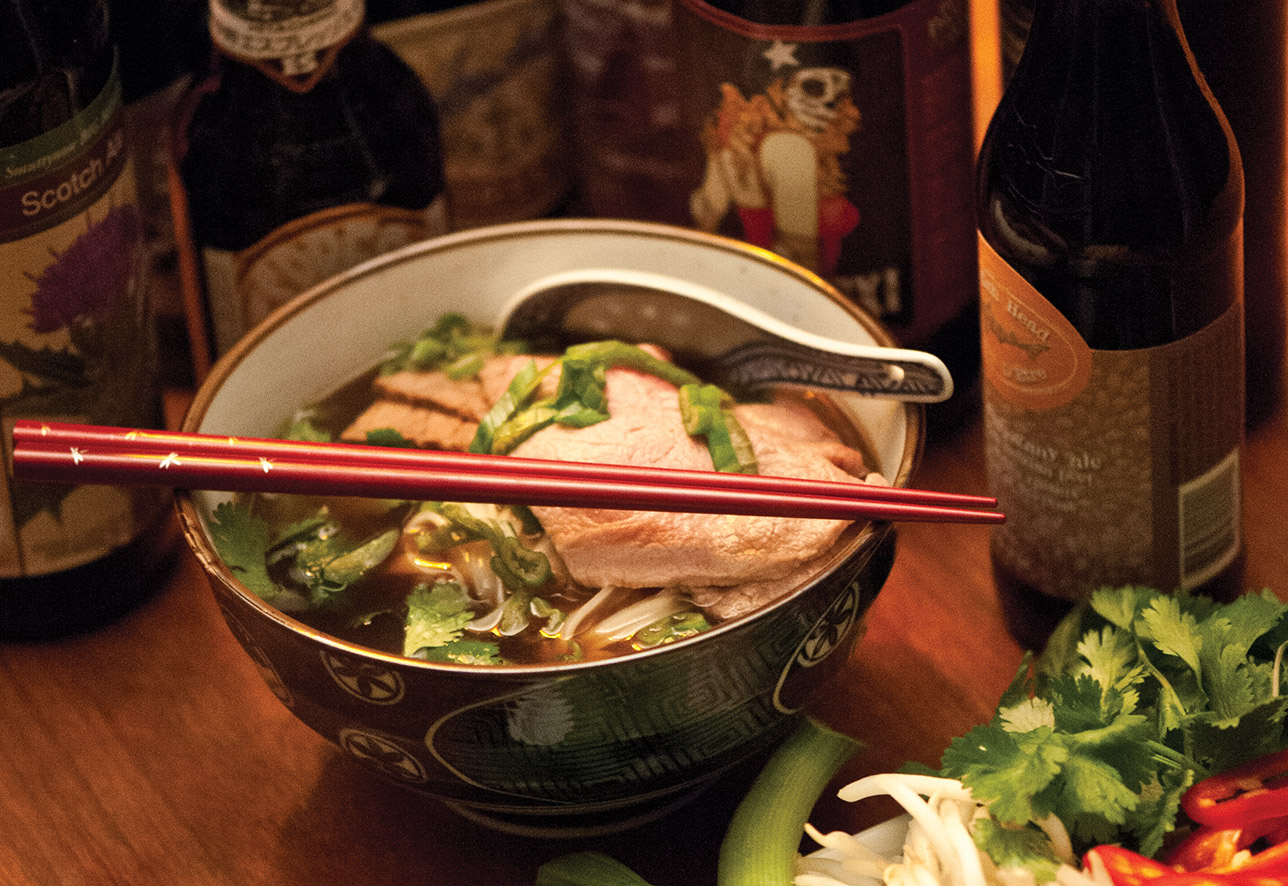
Photo by Sean Z. Paxton
Ingredients:
1 bunch Thai basil, leaves & sprigs, remove thicker stems
1 bunch mint/spearmint, leaves & sprigs, remove thicker stems
1/2 bunch cilantro, leaves & sprigs, remove thicker stems
3/4 pound fresh bean sprouts
2–3 each red-hot chilies, such as bird’s eye or dragon, thinly sliced
2 each limes, cut into six wedges
2 each bok choy, washed, leaves removed and lightly blanched (optional)
1 each lotus root, peeled and lightly blanched (optional)
1 handful pea shoots (optional)
1 bottle Sriracha sauce or other Asian hot sauce
1 bottle fish sauce (try Red Boat or 3 Crabs brands)
Buffet Directions:
Remove the tough bottom stem from the basil, doing the same with the mint and cilantro, and place into mounds. Wash and dry the bean sprouts and, on a large platter, arrange the chilies, quarters of limes, bok choy, lotus root and pea shoots, if you want to go outside the traditional vegetable offerings. Serve with the hot sauce and fish sauce on the side.
Bowl Ingredients:
1 lb. rice noodles, dried, or fresh banh pho noodles (“rice sticks’’)
1 each yellow onion, medium, sliced paper thin
1/2 lb. beef, raw eye of round, sirloin or tri-tip steak
4 each green onions, scallions or spring onions, green part only
1/2 cup cilantro leaves, lightly chopped
ground black pepper
Bowl Directions:
Place the dried rice noodles into a pitcher and cover with hot tap water. Let sit to rehydrate for 30 minutes while the rest of the ingredients are being prepared.
Bring a pot of water to a boil. Place the peeled and thinly sliced onion into a bowl, cover with ice water and let sit for 30 minutes to remove any harsh onion flavor and mellow the bulb.
Place the beef in the freezer for about 20 minutes to make it easier to slice. With a sharp knife (a slicer if available), slice the partially frozen beef against the grain, into very thin slices. Set aside. Using a clean cutting board, slice the reserved piece of cooked beef from the stock.
Blanch the soaked rice noodles for 2–3 minutes (looking for the noodles to just wilt, but not overcook) and portion them among the bowls. The 8 cups of beer broth will serve 4 people. Top each mound of noodles with a few slices of the raw beef, a few pieces of the cooked beef, some sliced onions, green onions, cilantro leaves and a few cracks of pepper from a pepper mill. Just before the bowls are brought to the table, ladle the boiling beer broth over the top of the meat (cooking it in the bowl) to fill the bowl. Serve immediately. ■
 Previous: ThaiPA