900 Steps to Beerdom
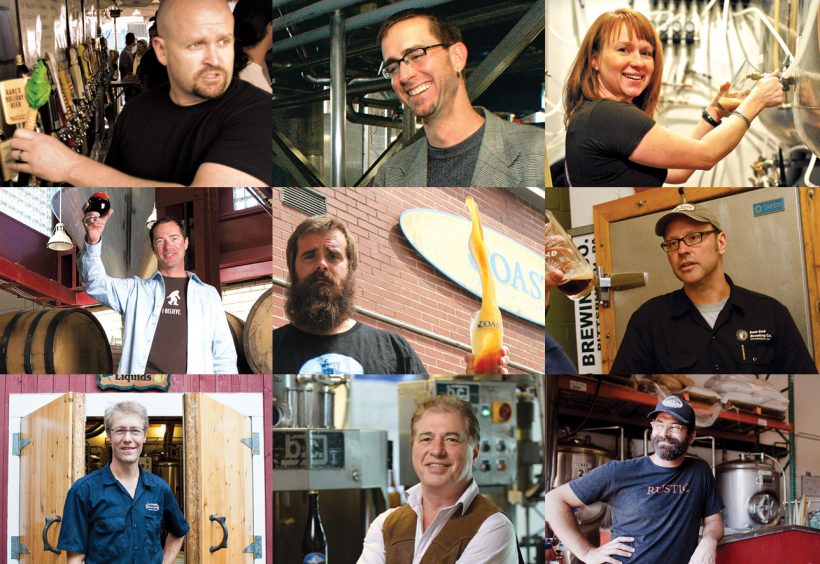
For this column I’ve interviewed 99 brewers over the past eight years. The setup hasn’t changed much: Why beer? Why brewing? Why do you do what you do? Those few questions spin off in many directions. But the common theme, from Oregon to Kansas to the Carolinas, is the way that a passion for beer builds and rolls forward on its own momentum. Countless pro brewers have told the same story: A pint of Samuel Adams or Sierra Nevada turns into a cautious dance with a homebrew kit, which becomes a basement full of homebrew.
This is the beauty of craft beer. Every beer drinker starts off as a novice; the novices who have gone pro are now evangelists who look to grow their ranks; they’ll take all comers, and their enthusiasm is infectious. What follows is a sampling from conversations with scores of talented brewers like Adam Avery, Vinnie Cilurzo, Nick Floyd, Kjetil Jikiun, Tod Mott, Patrick Rue, Alan Sprints, Carol Stoudt and Rob Tod. That list speaks to the depth of talent working in the industry right now. Here’s to a hundred more.
1. Don’t fear the swill
When asked about liquid guilty pleasures, Tomme Arthur, director of brewing operations at Port Brewing and The Lost Abbey, didn’t flinch. “I’ve been known to mow the lawn with a Coors Light in my hand. People ask why. As a brewer, sometimes you just want to turn that switch off—you don’t want a beer in your hand that you have to think about. You don’t want a beer that challenges you to stop and find wonderment in it.” [Issue #1]
2. Honesty’s the only policy
Greg Koch, co-founder of Stone Brewing Company, is famous for railing against fizzy yellow beer. Much of it stems from macro beers’ fuzzy marketing. “Things that I find offensive are misleading statements like, ‘The taste of a true Pilsner,’ when it’s not, and nobody has any misgivings that it is or could be,” he said. “Or, ‘This beer comes from this geographic location,’ when it doesn’t. … Why are you trying to make me believe something that is not categorically true?” [Issue #4]
3. Challenge people, including Tomme
After winning small brewpub of the year at the 2008 World Beer Cup for her work at the Bend Brewing Company, Tonya Cornett noted that what kept her energized was creating one new recipe after another. “That’s the focus of this pub—putting new styles in front of my regular customers, and constantly challenging them and the staff.” She added, “I was talking to Tomme Arthur the other day, and he said, ‘Will you stop telling these reporters that you love to do recipe development?’ He said he’s getting tired of reading it, that it makes me sound like that’s all I do. It’s not all I do!” [Issue #24]
4. Make the market come to you
When Brian Dunn launched Great Divide Brewing Company with two recipes straight from his stovetop, both crashed and burned. “We kind of brewed the first few beers to meet market expectations,” he said. “I thought we had to have an Amber and a Wheat for volume. We have neither now, and our best-selling beer is a 7-percent IPA with a ton of American hops. As the business got bigger and more sustainable, we started brewing styles that I really wanted to drink.” [Issue #26]
5. Suck it up
For years, COAST Brewing Company founders David Merritt and Jaime Tenny had been running the numbers and hunting for equipment unsuccessfully. Then things broke their way. Making COAST stand on its own, though, wasn’t easy. For several long months, Merritt worked his full-time job and got COAST rolling on nights, weekends and days off. “It sucked,” Merritt recalled. “It was horrible. I did it because I knew I had to do it. But, man, if you can make a living with one job or no jobs, just go ahead and do that. It’s a lot easier.” [Issue #44]
6. Don’t look down
Scott Smith, founder of Pittsburgh’s East End Brewing Company, bought a used brewhouse that had been “disassembled rather savagely,” and spent countless hours trying to make sense of hacksawed piping and tangles of severed wires. “That process was pretty humbling,” he recalled. Asked whether he ever had doubts, Smith replied, “You can’t acknowledge those thoughts. You just have to keep your head down. The fear is … ‘What have I gotten myself into here?’ That fear is paralyzing, and once it sets in, you can’t get out. If I got frustrated with the electrical, I’d go hang some drywall or think about a recipe.” [Issue #64]
7. Stay hands-on
Although Sean Lawson of Lawson’s Finest Liquids upgraded from his original 1-barrel brewhouse, the brewery retains its DIY feel. Lawson’s wife helps out part-time, but he is the only employee, brewing in a tiny 280-square-foot shed and handling each beer start to finish. “Making the beer myself is the part of the process I love the most, so I have no plans to grow the brewery in the near term,” he explained. “At this point in my life, I’m not very interested in managing employees and running a company. I love the process. I get excited about getting into the brewhouse and making great beer myself.” [Issue #72]
8. Embrace change
As founder of Wyeast Laboratories, David Logsdon had a unique window into consumers’ changing beer tastes. First came a wave of hop-friendly American ale yeast, then a wave of interest in Brettanomyces and sour lactic bacteria. Logsdon called the beer industry’s embrace of funk and sours a natural, inevitable evolution. “Consumers have more of an eye toward quality food, and beer is just one component,” he reasoned. “You’re seeing it in coffee, bread, wine, cider, kombucha, charcuterie—it’s all different than the Wonder Bread world I grew up in.” [Issue #80]
9. Focus on flavor
Sante Adairius Rustic Ales’ industrial warehouse near the Pacific Ocean is a long way from Belgium, but the brewery’s co-founder, Tim Clifford, brews in the rustic Belgian tradition. He sees a farmhouse influence on beers that fall into American styles. “There’s a whimsy to the Belgian tradition,” he argued. “It’s about the quality of the flavor, and not so much the process. Our beers are rustic. … They’re not intended to be perfect. As a homebrewer, you learn that you can make great beer in plastic buckets, and it doesn’t matter, as long as what’s in the glass is great.” [Issue #86] ■