Brian Dunn
How to go from being you to brewing for you in nine great steps
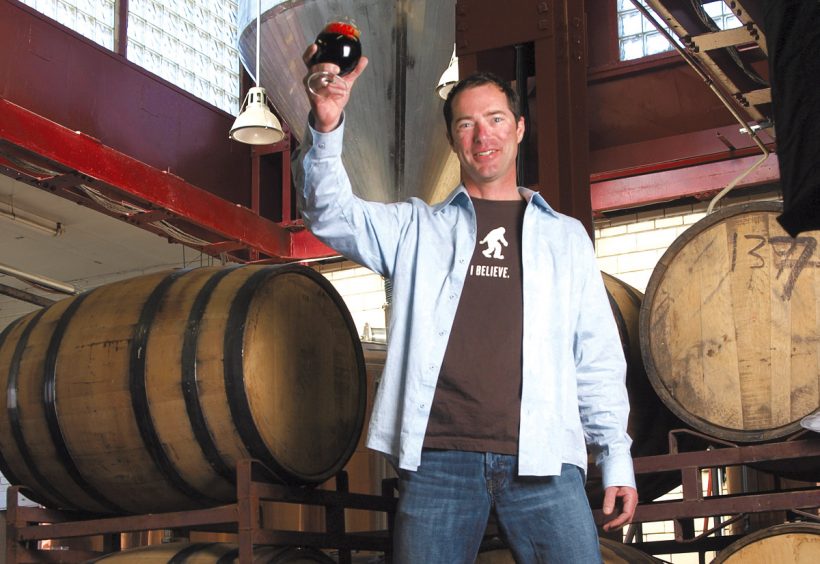 Photo by Mark Manger
Brian Dunn founded Great Divide Brewing Company to work with something he loved, and to work for himself. In the beginning, he brewed normal beers for the mass market. And then he figured out that beer drinkers were craving massive, adventurous, flavor-forward beers. They’re more fun to brew—and a lot more fun to drink. That leap has been rewarded with a rabid fan base and a wall full of medals.
1. Chase quality
Brian Dunn grew up on quality food and drink. There was always good beer and wine on the family dinner table. When he was in college, he was the guy who always had a fridge full of Guinness. After school, when he was living abroad, he was charged with making intercontinental beer runs. “One of my jobs would be to go up to France with the Range Rover and just load it full of good cheese and beer,” he says. “I was buying trunks full of Belgian beer and bringing it back to Algeria.”
2. Go your own way
Dunn worked abroad for a few years, building large farms in the third world. He returned to get his graduate degree in environmental policy at the University of Denver. That’s when he took up homebrewing. It was just a hobby—until it came time to put his degree to work. “I was on an airplane going to California for a job interview,” he recalls. “I spent more time writing a business plan for a brewery than I did paying attention to the interview. I did get the offer, but I decided pretty much on the way back that I was going to start a brewery.”
3. Your passion will conquer your illiquidity
It was 1993, and “I thought we might be a little bit late,” Dunn confesses. He surveyed local bars, got some positive feedback, raised money, and 14 months after committing to the brewery, he had his first beer. “I was nervous about it,” he says. “But I was going to do something I wanted to do, instead of working for somebody doing something I didn’t want to do. It helped get this company through some very tough spots. The first couple years it was just out-of-control growth. It was hairy. We ran out of money right away. But it’s OK. We’re here. We made it.”
4. Brew for yourself, not the market
Great Divide launched with two recipes straight from Dunn’s stovetop. “We kind of brewed the first few beers to meet market expectations,” he says. “I thought we had to have an Amber and a Wheat for volume. We have neither now, and our best-selling beer is a 7-percent IPA with a ton of American hops. As the business got bigger and more sustainable, we started brewing styles that I really wanted to drink. It’s great. We’re having a fun time brewing those, and every time we come out with new beers, they tend to be a little further out in the spectrum.”
5. Never stand still
“This market is still very much a Wheat and Amber market,” Dunn says. “For us to be who we are, we needed to do something different.” Being different has meant bold, fearless beers. Dunn’s staples are massive: A Double IPA, Barleywine, Imperial Stout and Old Ale. “People are looking for some more challenging beers,” he insists. And Dunn is more than willing to provide that challenge. In 2009, Great Divide will roll out eight new beers, including a Belgian IPA, Saison, Double Wit, a Yeti Stout brewed with espresso, and an Imperial Stout and a Barleywine, both aged in bourbon barrels. “That’s why people work here—to have fun on the job.”
6. Know when to step aside
For much of Great Divide’s history, Dunn was the sole recipe guy, and recipes would move immediately from paper to production. That’s all changing. “We’re getting more organized and we’re test-batching beers now. We’re playing around with hops, different yeast strains, doing a lot more R & D.” Recipe development has become a collaborative effort, with brewers dashing to the brewery’s pilot system on their off days. “Now, there’s people that have more experience in it than I do, and it’s time for them to be involved. Everybody needs to have input. And all our new beers are turning out great.”
7. Make taste relative
Dunn enjoys playing with ingredients and techniques that influence beer drinkers’ perceptions of taste. Hercules Double IPA, for instance, is much more bitter than Titan IPA (85 IBU, versus 65), but, since Hercules has twice the malt bill that Titan has, “people don’t perceive that. They think that Titan is hoppier.” The same is true of Old Ruffian Barleywine—it clocks in at 90 IBU, but it’s balanced by “a ton of malt.” When Yeti, an Imperial Stout loaded with American hops, is oaked, “the oak rounds out the rough edges of the beer. It’s big, roasty, very hoppy, and it becomes very round and smooth. The difference is so great.”
8. Create something extraordinary
Great Divide’s base malt comes from right down the road—the malting plant at Coors. In a broad sense, the beer that Dunn makes, and the beer that Coors makes, is the same stuff: It’s just water, malt, yeast and hops. “We’re brewing totally different beers,” he says, “and these beers are all made, largely, with the same ingredients.” He even does one beer with rice: His Samurai Ale is unfiltered, “but very light and fruity. It’s very different than a lager brewed with rice.”
9. If you can’t sell it fresh, don’t bother
Dunn’s distribution has been scaled down, leaving several states in recent years. He’s fine with that. “We’d like to grow, but we’re not obsessed with growth,” he says. What’s more important is representing his product right, in a way that wins over new craft beer converts. “When people are tasting beer that’s out of date, it’s not a good representation of what the beer really is. If we’re all about quality and flavor, and then the beer’s old, I think we’ve missed it.” ■
 Previous: March Madness