Foster’s: Australian for Electricity?
Drunk scientists play with fuel cells and biogas
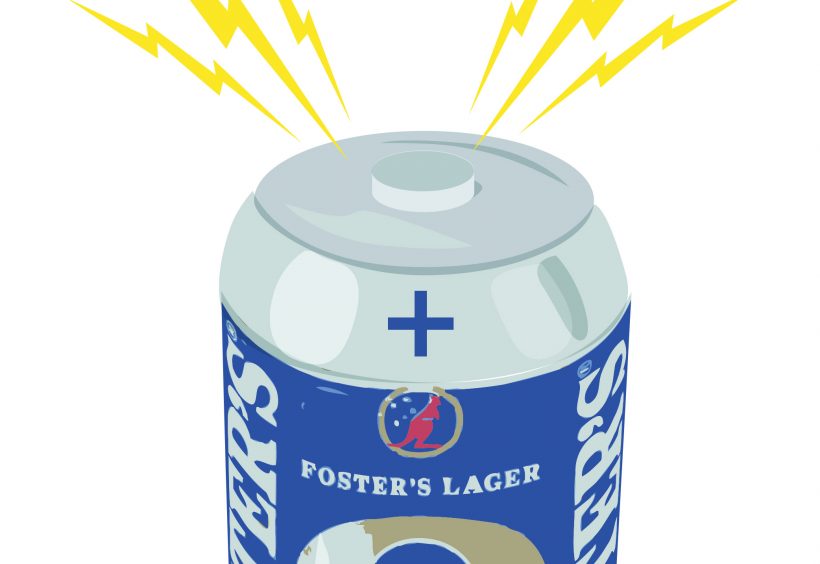 Illustration by Martin Pavlinic
According to research by Kirin, the average Australian consumes about 109.9 liters of beer a year—the fourth highest beer consumption in the world, and way ahead of US beer drinkers, who down a mere 81.6 liters a year.
It comes as no surprise that they’re also forging ahead of us in figuring out how to get clean, green energy from beer. This May, researchers from the University of Queensland, led by Professor Jurg Keller, announced a pilot project to get electricity out of wastewater from the Foster’s brewery near Brisbane. The project was slated to begin generating power in September.
The technology Keller’s team is using is the microbial fuel cell—a biological battery, full of bacteria that can digest the sugar, starch and alcohol in the wastewater. The process of digestion releases electrons, which the fuel cell harnesses to create an electrical current.
Fuel cells are hardly the only good idea for what to do with brewery leftovers. The process of making beer yields all kinds of interesting and useful goop: spent mash that can be fed to pigs and cattle, brewery sludge that can be composted and spread on farmers’s fields, methane-rich “biogas” that can be burned to heat the brewery. Biogas, in particular, is a proven way for breweries to save both money and the environment at the same time; Anheuser-Busch has been using it since 1985.
But while biogas works great for giant breweries, it’s not very useful for small operations, because of the large cost of building the system. Microbial fuel cells, on the other hand, are well suited to small-to-medium-scale breweries. While biogas reactors can be made bigger just by increasing the size of the tank, Keller says fuel cells don’t function well beyond a certain volume.
“The microbial fuel cell system is made up of a number of modules similar to microfiltration filters. The bigger you go, the more of these tubes you need, so you’re not getting a lot of extra cost savings by it,” he says.
The fuel cells at Foster’s won’t generate much electricity—about one or two kilowatts, a little less than the power needed to run an average household. The real genius of using fuel cells is that they make useful stuff out of a waste product that breweries typically have to pay big bucks to have taken away.
The water that comes out of the fuel cells at Foster’s is clean enough that it can be filtered and reused for brewing. Being able to get clean water out of reeking effluent—cheaply, efficiently and with a little extra electric current thrown in as a bonus—is especially important in Australia, which is in the throes of the worst drought in decades. But it would be a boon to any brewery that has to pay for wastewater treatment, which can be no small cost. Just this August, City Brewery in La Crosse, Wisconsin announced that they were building a $7 million treatment plant to handle their wastewater.
If microbial fuel cells prove their mettle in the Foster’s pilot test, there’s no reason to confine this kind of technology to beer. “Wineries or fruit juice makers, quite a lot of food manufacturers, have similar wastewater that would be just as useful,” says Keller. “We’ve got a good relationship with the Foster’s brewery.”
Of course, their choice of project sites couldn’t have anything to do with Aussie scientists being inveterate beer drinkers.
“That’s not why we did it,” Keller laughs. Sure it isn’t. ■
 Previous: Beer Wares