Beer News
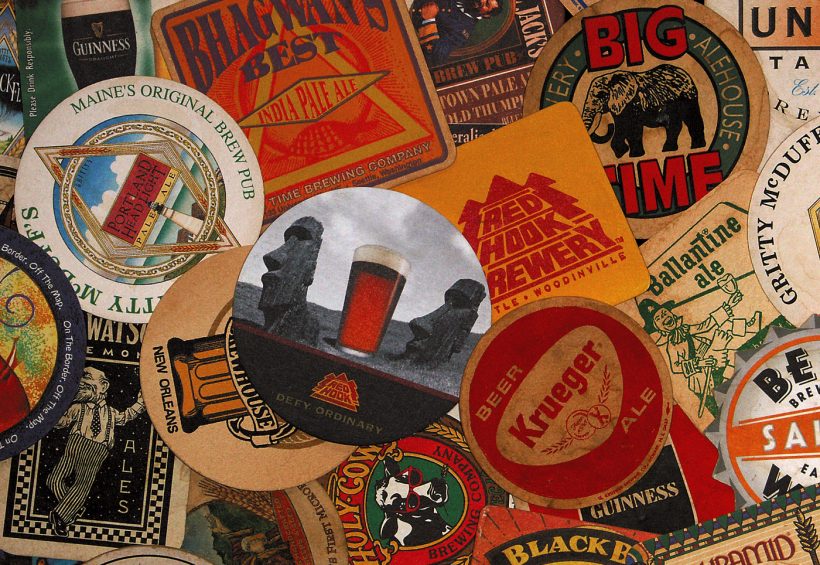 Photo by Leo Kenney
Is This the End of Cardboard Beer Coasters?
Throughout the world, people celebrate them. They hold throwing competitions, build towers of them, collect and trade them, but mostly, people just put drinks on them. Despite all these practical uses, the cardboard beer coaster may be facing imminent extinction.
The Katz Group, the German company responsible for manufacturing 97 percent of America’s (and two-thirds of Europe’s) cardboard coasters, filed for bankruptcy on April 14th. Garry Hobson, CEO of Katz, cited decreasing pub attendance and multiple big-beer mergers as reasons why demand has been falling since 2007. Katz was originally founded as a sawmill in 1716, but didn’t get into the coaster game until almost 200 years later, in 1903.
The cardboard beer coaster has been in existence since 1880. Another German print company, Friedrich Horn, created the original cardboard mats with printed messages. They were a hit with bar owners because not only were they provided free of charge by companies that advertised on them, but they protected their tables.
Atlantic Brewing Co. Shores Up Offerings by Acquiring Bar Harbor Brewing Co.
Two Maine breweries that have been competing for 18 years have just become unified, with Atlantic Brewing Co.’s recent acquisition of Bar Harbor Brewing Co. Bar Harbor Brewing was sold once before, in January 2008, to an out-of-state ad executive and developer. Doug Maffucci, owner of Atlantic Brewing, learned BHB was for sale again, and didn’t want to see it fall victim to someone who didn’t understand the legacy left by BHB’s founders, Tod and Suzi Foster.
Despite the (former) competition, there is nothing but respect for the acquired company. Atlantic plans to continue producing BHB’s three flagship beers—Cadillac Mountain Stout, Thunder Hole Ale and Harbor Lighthouse Ale—under the Bar Harbor Brewing brand.
Maffucci told the Bangor Daily News, “It’s good beer. It’s great beer. I was afraid the brand was going to die, which would have been silly.” He also explained he wasn’t sure how the rest of the company would feel about keeping a competing brand alive, but his brewers were eager to learn the new brand, quickly alleviating any fears. “They were super excited about it, they’re totally into it.”
Atlantic Brewing hopes to have the first batch of Bar Harbor beers available in early May as both bottle and draft, which the brewery’s previous owners had never tried.
Grumblings for a Growler to Go in Maine
Those who enjoy vacationing in Maine can add one more item to their souvenir shopping list—a growler (or three) of their favorite brewpub’s beer. The measure, sponsored by Rep. Nancy Smith, would allow bartenders to fill (and refill) 64-ounce growlers for off-site consumption. However, only pubs that brew on-premises would be able to sell them, and not past 10 p.m.
The 10 p.m. stipulation was added to the bill to help defuse concerns from the Department of Public Safety. According to the Sun Journal, Maine State Police Lt. David Bowler told lawmakers, “Our concern is that you can lug these out at 11 or 12 o’clock. … Yes, they could go buy some beer at a convenience store, but if they are going to do that, then make them work to do it.”
Under current law, breweries can sell beer for off-site consumption with one permit, while restaurants need another to sell beer for on-site drinking. This ruling would eliminate the cumbersome requirement of a brewpub having to obtain both permits in addition to establishing a separate storefront area to sell their bottled beer.
Kirin Seeks to Acquire Lion Nathan’s in $2.5 Billion Deal
On April 27th, Japanese brew titan Kirin made a formal offer of $2.5 billion (3.5 billion Australian dollars) to acquire Australia’s second-largest brewer, Lion Nathan’s. Over the last few years, Kirin has seen a drop in demand in their Japanese market. With the acquisition, Kirin seeks to significantly increase foreign-market sales, from the 18 percent they had in 2006 up to 30 percent in 2015.
Kirin would be paying Lion shareholders a premium—47 percent higher than what the stock is worth for the remaining 54 percent of the company. According to the New York Times, Lion chairman Geoff Rickets said the board would unanimously recommended that the shareholders accept the offer, as long as no higher bids come in.
The Australian beer market is particularly attractive to Kirin, because its two “big beer” companies, Lion and Foster’s, both enjoy high profit margins due to a lack of competition. The final sale is still pending regulatory approval, but if it goes through, Kirin would add Lion to its other Australian holdings, which include the Dairy Farmers milk cooperative and milk and dairy corporation National Foods.
 Beer: A Real Economic Stimulus
Every time you buy a beer—be it a lone tallboy or a case—you’re stimulating the economy in a number of ways. According to an economic impact study conducted by New York City’s John Dunham & Associates, the beer industry pumped over $198 billion into America’s economy in 2008. The industry also supported nearly 1.9 million jobs and generated almost $62 billion in wages and benefits.
Money spent supports every nook and cranny of the beer industry, from liquor and grocery stores to brewers and wholesale distributors. In addition, the brewers and wholesalers work with several state agencies to promote campaigns fighting alcohol abuse and advocating individual responsibility.
Jeff Becker, president of the Beer Institute, said in a press statement, “These numbers demonstrate that our industry is essential to several sectors of the US economy, particularly as the nation struggles to regain its footing in this uncertain climate. For this reason, it is important that state and federal officials consider equitable tax policies that do not unduly harm an industry that provides so many domestic jobs and so much economic growth.”
Dogfish Head Begins Three-Phase Expansion to be Completed in 2010
Even as the economy declines, Dogfish Head’s popularity has increased steadily enough to warrant a $2.5 million, three-part expansion project. When it’s complete, there could be up to 40 jobs created by the expansion.
The first phase is to install six new 20,000-gallon tanks. This will increase the brewery’s production capacity by 30 percent, (hopefully) satisfying customer demand for now. Brewery owner and founder Sam Calagione tells BA, “The market is very thirsty for the product. Literally.”
Phase two of the project will increase the office and tour areas, and is scheduled to be finished in late summer. Sam adds, “We average around 700 visitors per week from all over the country, and … more than half are from out of state. Of that group, more than half said they came to Delaware to see our brewery.”
The final phase will add a small brewpub on brewery premises. Similar to the existing Dogfish Head Brewings & Eats in downtown Rehoboth Beach, Del., the brewpub would offer food and a variety of Dogfish brews on tap, including special pub-exclusives. The new restaurant is targeted to open in spring of 2010.
Calgione feels his continued success is thanks in part to the affordable luxury craft beer provides. “Whereas a world-class bottle of wine can cost a few hundred dollars,” Calagione told BA, “you can buy a world class six-pack of beer for less than $10.”
 Red Stripe to Begin Canned Production
Jamaican lager Red Stripe is well known for its distinctive, stubby glass bottles, but now they want people to notice their new cans. Thanks to a partnership with Canadian company Moosehead Brewery, Red Stripe will be able to brew and can in Moosehead’s facilities.
The new Canadian brewing and canning process will be closely monitored to ensure consistency. International marketing director for Red Stripe, Grace Silvera, said in a press statement, “In order to guarantee … quality is maintained, the quality-control team in Jamaica is intimately involved. Since we do not have a canning line in Jamaica, the partnership with Moosehead is also the most cost-effective way of enabling us to ensure that Red Stripe is competitively priced.”
After the beer is produced, it will be shipped to Diageo USA for distribution throughout America. Red Stripe hopes to reach new market segments, such as stadiums, beaches and other events where glass bottles are prohibited. In addition, canned beers are more environmentally friendly because of easy recyclability and reduced shipping weight. ■
 Previous: Reclaiming "Craft"