
The Brewery at the Border
Alpine Brewing Company, Oroville, Washington
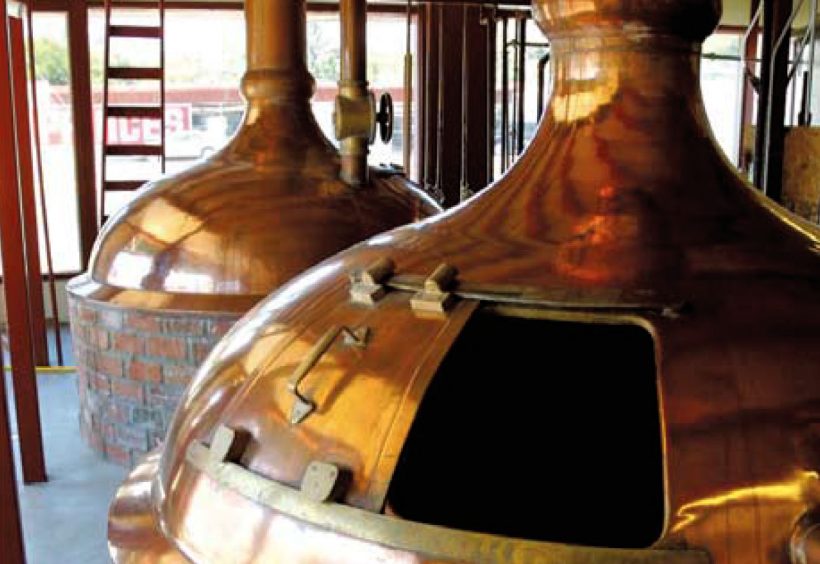 Photo by Red Diamond
Though it’s the northernmost brewery in the contiguous 48 states, you’d think Alpine Brewing Company was 5 miles from Bavaria, not Canada. The German-owned, German-built brewery brews Bavarian-style beers exclusively—all in accordance with the Bavarian Purity Law of 1516 known as the Reinheitsgebot. Owner Bart Traubeck prefers it that way.
“Why not?” he says. “Our beers don’t call for extra ingredients. Not even finings. Beer should be as pure and natural as possible.”
Traubeck’s cultivated instinct for brewing owes much to his personal history. A German national, he was born in Munich in 1954 and educated at the prestigious Weihenstephan school of brewing at the Technical University of Munich. There, he became an accredited master brewer in the German tradition.
With his degree from Weihenstephan, Traubeck launched his beer career as a project manager for a German firm called Steinecker, now a subsidiary of the Krones group. For the next 17 years, he designed, manufactured and installed breweries across Europe, the Caribbean, Asia and the US. Each brewery was custom designed by Traubeck in accordance with the specific needs of his clients, among them Red Stripe in Jamaica, Tsingtao in China and Wolfgang Puck in California.
Traubeck’s Alpine trajectory began when he arrived in the Pacific Northwest in the late 1980s to design Redhook’s historic trolley house brewery in the Fremont neighborhood of Seattle. A friend of his from Redhook would later consult him on designing a small craft brewery in the frontier town of Oroville, Wash. When this brewery dissolved in financial disarray during the craft beer contraction of the 1990s, Traubeck acquired it. He renamed it Alpine in recognition of his Bavarian heritage and in reference to Oroville’s proximity to Washington’s Cascade Mountain range—aka the American Alps.
There are good reasons to build a brewery in Oroville. And there are good reasons not to. On the plus side, it’s more economically feasible to transform a 1919 Model T car dealership into a brewery in a remote agricultural town than it is in the big city. Seattle real estate during the dot-com boom years of the ’90s was astronomical compared to that of a quiet border town surrounded by apple orchards. It’s not much different today.
But a better reason by far is the water. The Okanogan River is fed by waters from the foothills of the Canadian Rockies and slips across the border into Oroville with an ideal measure of suspended minerals. In comparison to the waters of his native Bavaria, Traubeck describes the Okanogan water supply without speculation. “It’s identical,” he says. “It has exactly the same hardness as Munich. It’s ideal water for lagers.”
But Alpine’s isolation has its drawbacks. Though bars just 10 minutes from the brewery would eagerly carry Alpine’s exquisite Märzen or seasonal Weizenbock, those bars are in Canada. Canada’s complex and stringent rules for the importation of alcohol would require Alpine to transport their beer hundreds of miles out of their way to a bonded warehouse in Vancouver, stretching that 10-minute delivery to 10 hours.
Another impediment to Alpine’s potential is that the local culture is still steeped in flavor-deprived macros and is less responsive to more authentic Bavarian-style craft beers. Doppelbocks are a hard sell in Oroville, and the surrounding communities are small, distant and similarly oriented. For this reason, Alpine “exports” most of its beer some 300 mountain-highway miles to the greater Seattle area.
Alpine Brewing has a brick-lined brewpub with a bar, a small commercial kitchen and a fenced beer garden with a hand-painted mural. Unfortunately, they’ve all been shuttered for years. Hard times at the turn of the new century forced the pub to close. But Traubeck is optimistic that recent growth in the region, combined with the surging popularity of craft beer, will allow him to revive it.
Helping him segue toward an optimistic future is Jerry King. “Jerry came by the tasting room to drink every day,” says Traubeck. He’s now the assistant brewer.
A member of the Oneida Tribe of Wisconsin, King claims to be America’s only Native American brewer. He works 12- to 14-hour days brewing double batches of lager in Alpine’s 40 hectoliter (34-barrel) mash and lauter tuns. The kettles look like twin sisters sitting resolutely in Alpine’s front window. They originally came from Freudenstadt in the Black Forest region of southern Germany. Now their Old World charm and functional artistry delight visitors and are a source of local pride.
“They were hand pounded with leather mallets,” King says of the gleaming copper kettles. “They’re also the only source of heat in here.”
Having a source of heat is no small consideration in a region where temperatures frequently dip below zero in the dead of winter. “When we’re not brewing, I’ve got to drain water out of every single pipe and hose in the house,” says King. “Sometimes the natural cold of the place helps chill our beers. Other times, we use our cooling system to prevent our beers from getting too cold.”
With the exception of their Hefeweizen, all Alpine beers are cold-fermented lagers. Malts receive a stepped-infusion mash with four rests to maximize enzyme potential. Imported Tettnang and Perle hops contribute bittering and nuanced hop character. After boiling and cooling, the wort is pumped to one of three 87-hectoliter (74-barrel) fermentors, where they’ll eventually lager at 28°F before racking to bright tanks. Most beers are cold-conditioned for six weeks. Alpine’s Pilsner gets lagered for eight weeks, the Oktoberfest for 12.
Lagers are what Traubeck does best. “They’re what I grew up with,” he says. “They’re what I know.”’
But the refined subtleties of cold-fermented beers lead to the adage that there’s no place to hide in a lager. “They’re so transparent,” he adds. “There’s no room for off flavors.”
Alpine’s beers are distributed almost exclusively in Washington, where Alpine reigns as the state’s oldest lager brewery. Though craft breweries typically favor ales over lagers, the recent Great American Beer Festival triumph at neighboring Chuckanut Brewery suggests lagers are slowly gaining favor among regional craft brewers. Chuckanut became the only GABF “Small Brewpub of the Year” winner to claim that title with an exclusive sweep of medals gained from lagers. The man from Munich concurs with the merits of their victory. “They’re excellent,” Traubeck says of his neighbor’s beers.
Craft beer aficionados from California may recognize Alpine in a slightly different context. A couple years after Traubeck founded the Alpine Brewing Company, a brewery in San Diego County opened called the Alpine Beer Company. Though the two breweries are unaffiliated and share nearly identical names, they’ve coexisted amicably for more than seven years. “It’s never been a problem,” says Traubeck of their shared brand, dismissing any potential rivalry between the two.
At a time when aggressive corporate entities defend even remote trademark overlaps with monstrous zeal, Traubeck upholds a more traditional “relax, don’t worry” ethic in which two regional breweries with nearly identical names can coexist with no small measure of friendship—even with solidarity: “We’re both small businesses and there’s no real competition between us,” he says.
To celebrate this uncommon harmony, you may wish to navigate the arid terrain of the Okanogan Valley and hoist a resplendently clear Alpine lager at the brewery. King and Traubeck are happy to give tours and pour samples. The crisp Pilsner and auburn-hued Märzen are brewed year-round. Other beers are subject to availability—as are Traubeck and King. Call ahead and bring your growler.
ALPINE BREWING COMPANY
Owner / Master Brewer: Bart Traubeck
Brew System: 40 hectoliter (34-bbl) copper mash and lauter built in Germany, 1955
Annual Production: 1,000 barrels
Best-Selling Beer: Alpine Pilsner
Profile: Draft-only production brewery with dormant pub. Tasting room open by appointment or luck.
Of Interest: Northernmost brewery in contiguous 48 states. ■
 Previous: Thanksgiving South of the Border
 Next: Back to Basics: Part Two