
The Changing Face of Homebrewing
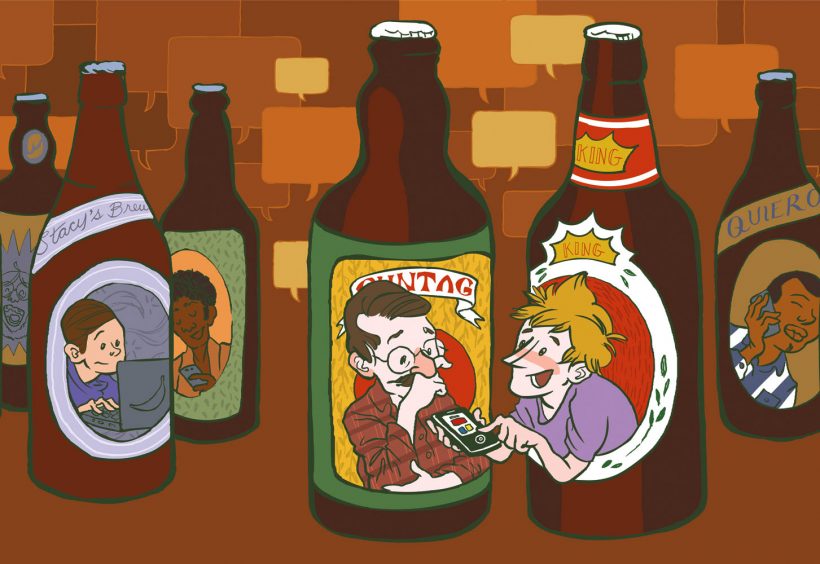 Illustration by Ellen Crenshaw
I swear to you on everything I hold dear in this mixed-up world of yours that I’m really not an old guy, but looking around my local homebrew club meetings these days, I feel like it. Just what is happening? You’d have to be blind not to notice that the average homebrewer is getting younger and younger, and the hobby’s growing.
Eleven years back, my 25-year-old noob brewing self was an anomaly. The average homebrewer was a semi-geeky guy in his late 30s, early 40s or older. Many had families, mortgages and retirement funds to worry about. But a number of us young Turks were at the cutting edge of a change that has accelerated to Mach 5, the younger brewer and beer enthusiast. What does the rise of the “millennial” generation mean for the hobby?
Facilitating the Passion
Since I’m a computer geek, every problem looks like it can be solved with a computer program and the internet, but here I think it can help us understand and anticipate the changes coming. Why? Well, if you’re younger than me and in the new growth segment of homebrewing, your life is likely bound by gobs and gobs of zeroes and ones.
As much as I’m online (seriously, email me at 3 a.m. PST, you’re bound to get an answer shortly), younger brewers are there unceasingly. Between Twitter, Facebook, blogs and other social media, life for this new brewing generation has developed with an eye to public sharing. (Watch the news—people are forgetting the internet isn’t private, much to their chagrin.)
From a practical point of view, this means bringing a club’s resources to bear. Take the time and pain to upgrade your website. Allow your members to provide photos, stories, articles, recipes, etc. Get them excited about changes. A vibrant, busy website means a vibrant club. Use Twitter and Facebook (and tool websites like Hoot Suite) to promote your events beyond your own circle.
The goal, online and offline, in marketing terms, is “engagement.” Make your audience feel connected, personally involved. By facilitating their passion, by letting your members—young and old—feel like a local rockstar, you not only build a stronger, more youthful culture, you create a better experience for all of your members. In my case, when I joined in the creaky early internet days, I got engaged in the club by becoming the young punk webmaster.
All of This has Happened Before and it will Happen Again
I don’t typically put a lot of stock in the philosophy of eternal return, but the enthusiasm for this hobby does seem to run in cycles. The last boost occurred before my time in 1996. For the Falcons, the club membership jumped from around 150 to 300 in the course of a year. The American Homebrewers’ Association hit a high watermark of 24,000 members in 1996 and now approaches that same number.
Do we have a crash coming in our future? The mid-’90s saw a sudden collapse after the peak that mimicked the microbrewery crash. Overnight, the hobby shrank, taking numerous suppliers with it. This time, though, we’re in the midst of a multiyear-long gradual growth of craft beer, even in a down economy. Hopefully, this slower growth pattern bodes well for long-term stability. A better portent: Today’s new drinker was born in 1989. They were born during the first boom of craft brewing, and for them, better beer has never been in question. ■
 Previous: Festivals of Life and Beer
