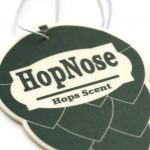
You know those ubiquitous tree-shaped auto air fresheners? HopNose is similar, only it looks like a giant hop cone and smells like Chinook hops—still piney, but with a more resinous hop smell than Christmas trees.
Don’t let the names confuse you. Aroma compounds are being engineered into your beers, so think about them the next time you smell a hop bomb. Does your nose detect anything besides that hop character?
A decade ago, typecasting IPAs was easy. And as of 2014, the mild-mannered East Coast IPA was old news, a relic of an earlier era of craft brewing. But a funny thing happened on the style’s trip to the graveyard.
For the first time, the US hop industry has grown more hops for aroma than for the commoditized bittering acid. The biggest driver of this change has been a 40-percent increase in Cascade acreage from 2012 to 2013; over 2,000 acres in the Pacific Northwest have been converted to Cascade.
Tasting panels are trained by smelling the chemical aroma standards responsible for each flavor—as beer geeks know, banana flavor is isoamyl acetate and butter is diacetyl—in decreasing dilutions. They taste the isolated chemicals added to polyethylene glycol until small amounts can be detected.
With its distinctive shape, the Offero line of glassware makes it easy to capture the aromas of beer while also making a statement at any table or place setting.
In addition to their bittering, flavor, and aroma properties, hops help stabilize beer foam, kill unwanted bacteria, and, according to some studies, impart body-boosting antioxidants. Future breeds might bring an entire revolution to the brewing industry.