On Falling Off
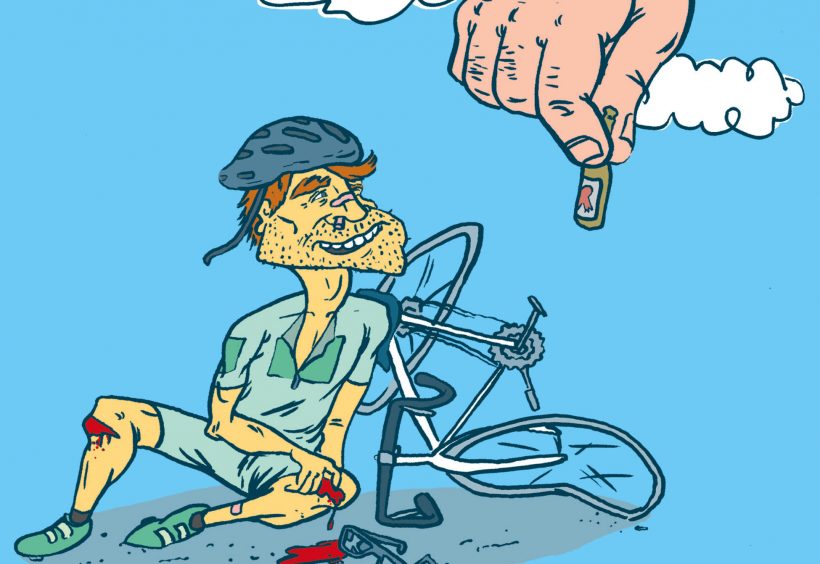 Illustration by Scott Murry
“Fifty-five-year-old cyclist traveling Lands End to John O’Groats fell off bike, admitted to Carlisle Hospital, sustained fractures left olecranon (open), two ribs, nose; periorbital haematoma; multiple abrasions.”
Some of us suffer for our art more than others. I had gotten halfway from the southwestern tip of England to the northernmost island of Scotland before I fell off my bike.
On a long, straight road, illuminated from behind by perfect dusk light, with little traffic, I lost control of a bike in perfect working order and booked five free nights’ accommodation in the trauma unit of the rather impressive Cumbria infirmary, no more than an artillery shell’s trajectory from the Scottish border.
I either hit an invisible stone, or it was the hand of God. Why would He want to stop me? Does He prefer wine? Has A-B InBev, newly impressed by the tediousness of soccer, swapped its sponsorship to the Holy Trinity? I prefer a more positive interpretation.
I hope and believe that He wanted me to contemplate what I had learned so far. So here are my three main lessons.
First up—without a strong import culture, a nation’s tastes in beer suffocate from lack of innovation. In sharp contrast to my travels as a youth through the land of my birth, this trip was peppered with pubs serving delicate ales made by small, local companies, with even the most popular brands coming from independent producers—a live testimony to the success of “real ale” campaigners.
But then that was it. It was not until I reached Liverpool, a third of the way along my route, that I encountered a single draft beer that fell outside a taste spectrum covering no more than 5 percent of potential beer flavors. Thus far it appeared, the UK beer revolution has simply nudged drinkers from one narrow corridor to another, albeit with more interesting paintwork.
Second—while beer in UK pubs has improved, few inroads have been made elsewhere. OK, I did come across possibly the only cycle repair shop in the world to commission and sell its own ale, but this was the exception to the rule.
In general, the only beers found in most UK hotels, restaurants and other non-pub premises are exceedingly dull. Is this because British beer geeks are not from hotel-staying, restaurant-dining classes?
It is time we Brits learn a lesson from North America and continental Europe. If you want to improve standards, you have to improve beer everywhere, not just in your favorite places.
Finally, and with feeling—beer lovers need legal protection from other people’s music. Live acts are fine. If they are that bad, you can always boo or chuck beer at them. This does not work for recordings.
It is excruciatingly difficult to enjoy any beer properly while some ’70s, ’80s, or ’90s hit is trying to insert itself into your senses, gnawing at the discriminatory functions like a bow saw carrying herpes.
It is not the repetitive, familiar tunes that cause the problem—it is the words. We speak in order to be heard. I assume singers wish this also, and so, if only out of politeness, I listen.
But frankly, I have no idea what “Three Times a Lady” is supposed to look like. I don’t care whether or not you might as well “Jump.” And I would have thought those problems with “Puppy Love” were long resolved, given how close the singer is to pensionable age.
The solution? Bar owners, the world over, should be banned from playing any music with words.
Or is that the pain talking? ■
 Previous: The Great Zoigl Quest