
Riding Out the Storm
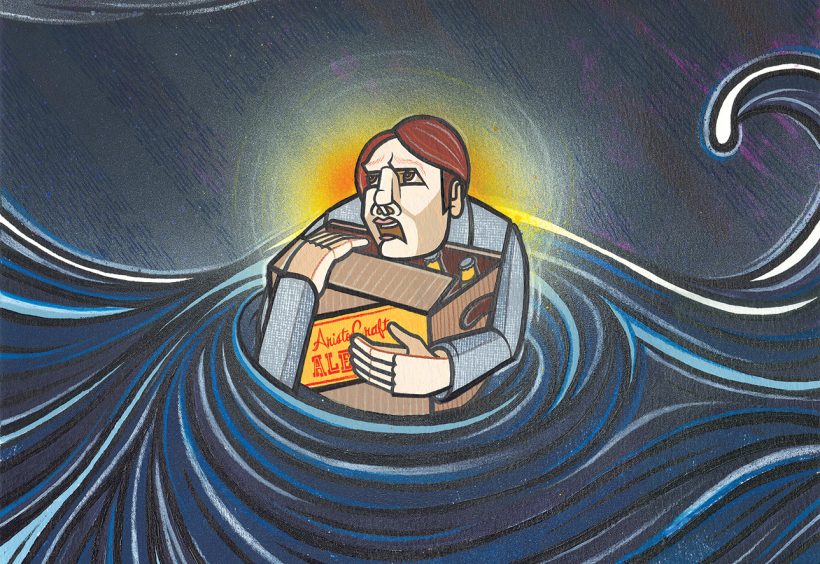 Illustration by Greg Puglese
It was a Saturday, the last one of the summer, and Nima Hadian smiled as he watched silver pushcarts careen around his store, weaving through the pyramids of cases rising from the floor of Shangy’s, Hadian’s massive Emmaus, Pa., beer distributorship.
The same afternoon, about 50 miles south in Philadelphia, Tom Peters, owner of Monk’s Café, pored over his books. The margins have shrunk—Peters’ gross profit has fallen more than 20 percent—as a storm-front of ever-increasing expenses collides with the economy’s recent bottoming-out.
The question is: How much darker will things get? As the country peers ahead toward an all-but-certain future, will the craft beer industry falter? In tight times, will drinkers “buy down,” as some are predicting? Or will craft beer rise above—will it keep charging forward, and by doing so, prove that American beer drinkers have come to demand quality over quantity, flavor over fizz? Will it prove that craft beer is now a fact of American life?
Down the chain, from CEO to brewer to distributor to restaurateur to drinker, the answer to that last question is, nearly uniformly, yes. It’s an answer buttressed more with conviction and data than naiveté and reckless hope—it’s an answer that, if correct, will prove that craft beer in America has arrived for good. And when the storm clears, craft beer may be stronger than ever.
“People who are into craft beer aren’t going to stop drinking craft beer,” Peters says. “They’ll drink less, but nobody’s going to go back to Bud.”
That reaction seems to be standard across the industry, despite the promise of turbulent times ahead for craft beer and America alike. On-premise sales are already suffering, although distributor and retailer sales are holding strong—Shangy’s grew 65 percent from last year in wholesale, 38 percent in retail. But as long as the country emerges intact, so will craft.
America’s tastes and demands have changed. For the mass of Americans who have turned to craft, the decision won’t be to buy down, but to simply buy less. The waves of macro-to-micro converts may dwindle in lean times, but the committed, the Born-Again Imbibers, won’t look back. “Gas is $5 a fucking gallon, the stock market’s crashing, then you see dudes with hand trucks full of Stone 888 and Paulaner Salvator,” Hadian says.
Now, it’s one thing to flourish in good times: As far as beer was concerned, disposable income pried open wallets and primed the palates of would-be converts. But it’s something entirely different to see growth in bad times. And craft beer’s done just that, showing a resiliency that purchases like, say, nose jobs, haven’t, according to the Wall Street Journal. In many ways, the craft beer industry has ducked financial curveballs. It slowed during the dot-com boom, but it’s been spreading like a rumor for the past five years.
“We haven’t seen people turning to craft beer because economic times are good,” says Paul Gatza, director of the Brewers Association. “And we haven’t seen people turning away when times are bad.”
According to a Brewers Association report in July, craft beer sales grew 11 percent in the first half of 2008, compared to the same period in 2007. This, as Americans were pulling their cars off the road and canceling summer vacations. This, as malt prices shot up by 60 percent and the shortage caused hop prices to increase fivefold. Even with those rising costs, the BA counts 63 brewery/brewpub openings this year, to only 12 closings, according to Gatza. “Beer is a part of people’s lives,” Gatza says. ”They’ll give up a lot of other things before they give up beer.”
And lately, as craft has grown, sub-premium (beers like Keystone Light) sales have fallen. More importantly, so have imports, which are headed for their first down year since 1989, according to Gatza. This is a market that craft must exploit in order to grow, given the massive overlap in customer profile.
“Import is where our growth has to come from,” says Alan Newman, president and founder of Magic Hat. “Imports were already playing to the same price point as craft. They were already going outside the mainstream, like craft.”
But times are beginning to get a little leaner for certain parts of the sector, as on-premise sales are hurting. A Nielsen/Bevinco survey reported that 40 percent of bar owners reported a decrease in consumer traffic and 25 percent claimed a reduced amount of drinks ordered; on the consumer side, 65 percent of nightclub and 55 percent of bar patrons are going out less than they did last year.
Despite all this, beer’s still afloat. Of the proprietors, 49.8 percent said that beer’s showing the “best” sales trend, followed by 40 percent for spirits and just 11.1 for wine. Compare a bottle of $12 Shiraz—mid-to-low market for wine—with a $12 bottle of Imperial Stout or Double IPA—high market in beer. Beer’s become, as Dogfish Head founder and president Sam Calagione calls it, “an affordable luxury.”
“I think the big brewers will be hit a little harder than the small breweries, which sounds counterintuitive, because ours are more expensive, but I got calls last week saying, ‘I just got laid off from Wall Street and I can still buy beers for less than $10 for a sixer,’” Calagione says. “It represents a connoisseurship—people can’t buy an SUV or a vacation home, but they can treat themselves to world-class beer.”
In Burlington, Vt., Newman can’t believe the continued growth—that even though on-premise sales are falling, off-premise sales are more than making up for it. Compared to the first half of 2007, Magic Hat grew 40.1 percent in the same period in 2008.
“I spent the first quarter screaming to our company and to people in the industry, ‘Watch out, 2008, it’s gonna be a tough year, we can’t possibly have another good year,’” Newman says. “You’ve got declining disposable income and prices going up. You can’t possibly have both of those and succeed. It has to impact sales, and if it is, we’re not seeing it. I don’t get it.”
Head south. Way south. Planted halfway between Atlanta and the Alabama border is Arbor Place Beverage Depot, where beer manager Josh Busby’s seen craft beer revitalize the store, which caters both to locals and migratory Alabama natives fleeing the statewide cap on 6-percent-ABV beer.
Busby got the go-ahead to build his craft section four months ago. Over the next quarter, total bottom-line sales in the store increased 2 percent, thanks almost entirely to the craft selection. Not only are people refusing to settle for swill, they’ll get in their cars, dump their paychecks into their gas tanks and drive an hour for good beer.
“Five years ago, [craft] would’ve died on the vine,” Busby says. “But people now are so hardcore about it that it doesn’t matter what you’re paying for it. Some of the crossovers [newcomers to craft beer] will die off,” he continued. “But for others, if Natural Light starts putting $5 bills in each can, you still just can’t drink it.”
Look west, where Coaltrain Wine and Liquor in Colorado Springs has a revolving clientele of craft drinkers that ranges from Colorado State students to local, blue-collar workers, says store general manager Austin Sherwood. Now turn back to the Northeast, where Mike Burke, owner of Quotations Pub in Media, Pa., will tell you that the only reason he’s still got a bar to call his own is that he took Quotations, once a dive-y sports bar, and converted it into a craft haven.
In 2004, he had Bud, Miller, Sierra Nevada and Yuengling on draft. Now he has 11 rotating craft taps. He stopped carrying Bud on tap in 2004.
“Craft has been the engine,” Burke says, adding that he’s seen a trend of customers eating at home and then going out to drink. Once there, they’re choosing to drink a few craft ales instead of throwing back six to eight light lagers, or even instead of drinking wine, recognizing the ABV-per-dollar value in a good, strong craft. “When you’re sitting at home and things aren’t upbeat, it’s one thing to go to the Acme or Genuardi’s and get food and save the markup,” says Burke. “It’s another thing to sit in front of your TV and drink a beer, so you still go out.”
However, not everyone will emerge unscathed. Craft beer, as a form, looks to be safe. But then there’s the fact that a 4-percent market share by volume (6-percent by dollars), according to Brewers Association numbers, simply won’t be able to accommodate a flush of craft breweries. It’s a growing share, certainly, but until it gets to about 8 to 10 percent, smaller breweries will struggle to compete, especially in light of the ingredient costs, say both Newman and Gatza.
Restaurants and bars, too, will struggle, as costs of operation explode and smaller margins become harder and harder to absorb. Places like Monk’s Café and Quotations should survive, but other corner pubs may fold.
Most dangerously, converts may take a hiatus—that’s Peters’ biggest fear, he says, and it’s one shared by most of the people interviewed for this story. The momentum gained over the past few decades, most acutely in the past five years, could slow if people stop “crossing the bridge,” in Calagione’s words.
But nothing suggests, not yet at least, that the conversion will stop. And as long as young people, the torch-carriers of the movement, keep packing beer festivals, roaming beer stores and evangelizing their friends, craft beer will stay alive, a sapling swaying in a hurricane.
Says Busby: “We can speak for the rock-solid beer community that says, ‘Do your worst, we survived the hop shortage, we’ll survive this, too.’” ■

