
Social Lubricant, Social Media: Good Beer and the Internet
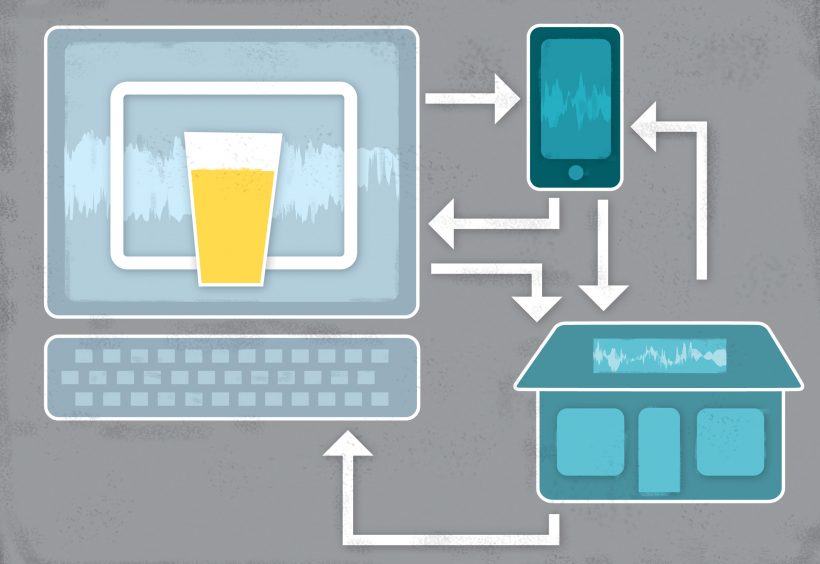 Illustration by Taylor Seidler
Assuming that you have a Facebook account, who’s on your list of friends? Have you connected with the head brewer at your favorite brewery? Maybe you regularly post witty comments on the Facebook wall of your local good-beer bar.
The internet and social media have changed the way we connect with those who sell us the beer we love. Now we can actually communicate directly with them and tell them what we do and don’t like about what’s going on with their beer.
It just makes sense that our favorite social lubricant meshes so nicely with the online phenomenon known as social media. Good beer lovers knew this long before anyone ever heard of social media or websites like Facebook and Twitter. By connecting at BeerAdvocate.com and RealBeer.com, good-beer lovers developed their own social networks where they could broadcast beer news, post reviews and even swap bottles of beer.
Like brick-and-mortar businesses, breweries and beer bars were not quite so quick to jump aboard. But as the success of social media was demonstrated in other areas, and as beer geeks who came up using those beer network sites opened their own beer businesses, the internet and its array of human connections became a natural extension of any beer business.
It has become cliché to talk about how people and businesses are using these networks. Actually, it has become two oxymoronic clichés. One says that the internet is an unprecedented revolution in the way that businesses connect with customers. The other says that social networking websites are a big waste of time where people do nothing more than tweet and retweet what they had for breakfast.
The Website and Beyond
Almost every business has some sort of website these days. Some are about as interactive as a Yellow Pages entry, while others are plugged into the latest trends and tools for connecting with customers.
Old Chicago, a popular chain of casual dining restaurants noted for a well-stocked beer selection, is finding their website to become a natural extension of the vibe of the establishment as well as a program known as the World Beer Tour. Members of the World Beer Tour earn prizes as they drink their way to the ultimate goal of 110 beers consumed.
“We have a million people in that club,” says Tracy Finklang, Old Chicago’s corporate beverage manager. “And we have them attached to us electronically. So, we get a lot of feedback from these highly engaged, highly vocal, very interested patrons who let us know on a daily basis what they want.”
But a website and an email list are not just about getting feedback from customers. Greg Engert, beer director at Birch & Barley, a fine dining restaurant in Washington DC, and ChurchKey, the beer bar upstairs, hosts fairly regular beer dinners and new beer introduction parties. The nature of his business is that these do not happen along any sort of set schedule.
“We have an email list that we use that’s huge,” says Engert, on updating his customers about upcoming events. “I’m big with social media. We do a lot of advertising through Facebook, Twitter, as well as Beer Advocate and Rate Beer, which are two great beer websites that are very current. I also am constantly twittering about all the new beers and casks we do.”
Bridging the Gap between Beer Geekery and Casual Customers
We beer geeks want details. We look for information like brewing methods and beer stats (such as IBU and original gravity). We like to argue about whether or not a beer is true to its style or pushing the boundaries. There is a reason we call ourselves “geeks.”
The casual beer drinker just wants a beer that tastes good. He/she might be interested in trying new things, but doesn’t necessarily need a history lesson or a seminar in biochemical reactions to enjoy a beer.
The folks selling beer to both camps have to find a way to bridge that gap and satisfy both. “When you get too technical with stuff, people’s eyes roll back in their heads. For all of us geeks who get it, great. But I bet you that if you walk into most restaurants and say, ‘What’s the ABV of Dogfish Head?’ nobody’s going to know,” says Finklang. “It’s like when wine sommeliers start to talk about the terroir. You have to keep it funny and light, and pertinent to people. That’s what we do on our website: try to keep it accessible to people who aren’t beer aficionados while being comprehensive enough to keep the beer aficionados happy.”

Illustration by Taylor Seidler
An Authentic Voice
Social media has to be about more than just marketing. Most of us are following people on Twitter or subscribing to mailing lists, getting regular updates from at least one brewery or beer shop. Announcements about upcoming beers and beer events roll in regularly with lots of great information, but sometimes that can get lost in the noise of the Twitter feed or inbox.
The big innovation of social media is that it creates an authentic voice for the business. Folks in the beer business are a passionate lot and this always comes through when they talk about what they do for a living.
According to Greg Koch of Stone Brewing Co., this is all just a different way to have that conversation. From the brewery’s website, users can link to six different Twitter accounts, a blog and a Facebook page, all of which are updated regularly. He says of his Twitter account, @StoneGreg, “It’s the actual, real me. I’m not sending out marketing messages. I am co-founder of the brewery and I am a beer geek. I enjoy the conversation about craft beer so that’s a natural focus for me, just as it is.”
Koch does not completely avoid making announcements about upcoming events, but he insists he only does so “if I’m doing something that I think others might be interested to know … my calls to action are more focused on ethics and our food system, and sharing things that I think are important to us to share with each other—important facts, or new information or news stories.”
The truth about those two clichés—earth-shattering innovation vs. big waste of time—at least in the business of beer, lies somewhere in between. Yes, these networks are a new way that customers and businesses can connect, but the personal aspect is also vital. A real voice from a real person, talking about the business and beer that he/she loves, is what makes the “real” connection. ■
 Previous: Mountain Sun
 Next: Baltimore