Eric McKay and Patrick Murtaugh, founders of Virginia’s Hardywood Park Craft Brewery, talk about their motivation for offering low calorie, low alcohol beers under a new brand.
According to the Brewers Association, self-distribution in some shape or form is allowed in 37 states and the District of Columbia. This is how growth begins for many craft brewers.
Beyond the classic English and American styles, author Joshua M. Bernstein indexes standout IPAs by grain, color, and strength. Fringe categories like “yeast-driven” and wood-aged get a nod, too.
Glassify turns the bottom of a pint glass into a mini-computer that’s able to interact with a mobile device via a chip inserted during the manufacturing process and offer tailor-made deals through the Glassify app.
As craft brewers push to distinguish themselves from Big Beer, revenue from higher-priced premium beers is increasing faster than any other craft segment. Will that make the $8 six-pack a thing of the past?
Each beer in Cape May’s Barrel Aged series is named for a different part of a boat. The illustration for The Skeg, a golden sour ale, features the fin-like structure on the bottom of the boat.
Partners Dan Nothnagle, Todd Dirrigl, Geoff Dale, and Brian Johnson can’t live without these five things at Three Heads, their funky and hop-forward brewery in Rochester, N.Y.
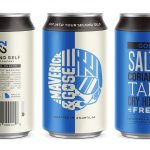
Second Self embraced the “Top Gun” nostalgia with its summer seasonal, creating a video spoof of the famous volleyball scene and including movie quotes on the bottoms of cans.
When creating the Double IPA’s label art, capturing the evolution of a brewer into a hop monster in a single image took about three months of collaboration between the Florida brewery, its branding agency and an illustrator.
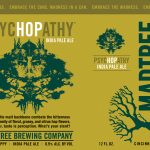
To create the art for MadTree’s IPA, designer Margaret Weiner made a composite of inkblots that combine the shape of a hop bud, a maniacal face, and branches and roots.
Tim Annis is an MBS student and a beer geek who couldn’t believe his luck when his professor at the Wisconsin School of Business announced their assignment: develop a branding strategy to revive Capital Brewery in Madison.
If you drink a beer, and your friends aren’t instantly notified about it, did it really happen? How is technology changing the beer drinking experience for so many enthusiasts, and why are they frantically sharing their experiences anyway?
Beginning in the mid-1980s, microbreweries started to think of tap handles as promotional tools. Now, numerous beer-focused bars have what amounts to rotating art exhibits thanks to companies such as Taphandles in Seattle.
While the internet has given beer lovers access to information and communication avenues that we could never have imagined decades ago, the value of many social media options to breweries is harder to gauge.
BrewDog announces location in Columbus; Minnesota allows Sunday growler sales; US breweries win at Australian International Beer Awards; AB InBev trademark application suspended; Alabama craft beer law limits brewery expansion; and breweries and brewpubs now open or coming soon.
In 2007, when BeerAdvocate became the country’s first monthly beer magazine, the combined output of 1,406 craft breweries represented less than four percent of the total market in the US.