
From the Brewery to You
Packaging Beer
Packaging is as vital to good beer as proper brewing and serving methods. Beer is actually a fairly delicate product, making it relatively easy to damage. Containers themselves might not be quite as sexy as what’s inside them, but they’re still worth knowing about.
A well-brewed beer has three main enemies as it travels from the brewery to your glass—light, heat and oxygen. A good beer container should prevent exposure to light and oxygen. However, there is not much that packaging can do about heat; that is all in the hands of the distributors and retailers.
Besides protecting beer from light and oxygen, beer packaging also needs to maintain pressure. In order to produce the right amount of fizz in the beer, the container needs to be airtight, strong and well-made enough to resist the internal pressure of carbonation.
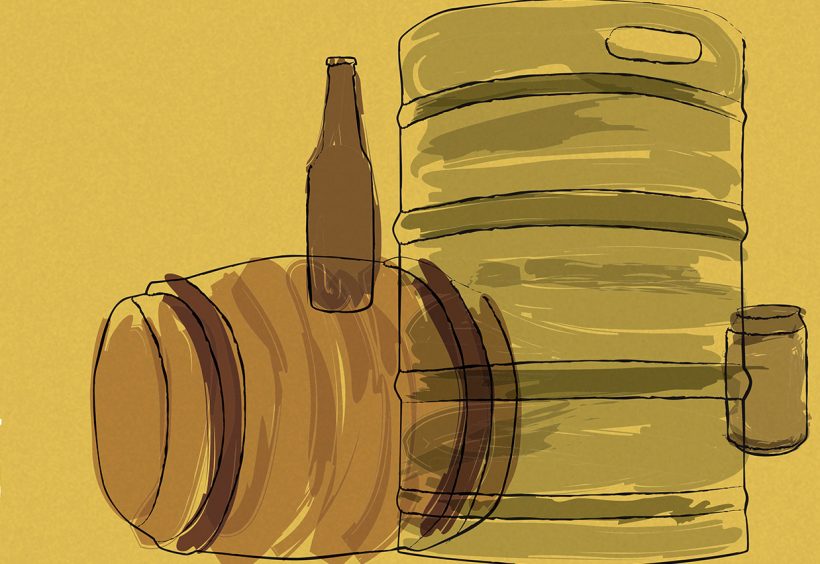
Over the years, brewers have come up with four basic types of packaging—casks, bottles, kegs and cans. Each type of package protects beer in different ways, and with varying degrees of success. The result is that the same beer served from each of these containers can taste quite different.
Casks
Although a few brewers still use wooden casks, most modern casks are metal. Traditionally, brewers fill casks with unpasteurized, still beer along with a measured amount of sugar, and then seal them. Since there is still yeast in the beer, the sugar kicks off a secondary fermentation that carbonates it.
Casks have been around since before brewers understood yeast. Consequently, they do not completely address the protection needs of beer, and they require the most amount of care. When casks arrive at their destination, they must be stored on their side in a cool place until that secondary fermentation is finished, which is determined by the pub or restaurant; so casks need to be handled by someone properly trained and experienced with casks.
Once tapped, casks allow the beer to come in contact with oxygen, and the clock starts ticking; the beer must be consumed within a matter of days before it spoils. The oxygen introduced produces diacetyl that adds a buttery or butterscotch flavor to the beer. Although diacetyl in a beer at detectable levels is generally considered a mistake, it does not have an entirely unpleasant taste and fans of cask ale embrace it as part of the experience.
The cask ale tradition is strongest in the United Kingdom, where it is jealously guarded by the Campaign for Real Ale, Pubs and Drinkers’ Rights (CAMRA). The organization identifies unpasteurized, package-conditioned beer as the only real beer, making casks and a few bottles the only acceptable containers. CAMRA is an interesting organization. Criticized as strident and too unyielding in its definition of beer, nobody denies that it played a key role in saving the cask ale tradition from near extinction in the 1960s and ’70s.

Bottles
Bottled beer has been around for a long time. Some brewers fill bottles with still beer and a bit of sugar, like with casks. The secondary fermentation in the bottle produces carbonation and a thin layer of yeast sediment in the bottom. Other brewers carbonate their beer at the brewery then fill the bottles with it. This gives brewers more control over the final product by allowing them to control the level of carbonation in their beer.
Although some brewers still use corks, most seal their bottles with the familiar metal cap. A liner on the inside of the cap seals the bottle and the metal edges of the cap crimp around the lip of the bottle to hold it in place and maintain the seal. A well-sealed bottle protects beer from oxygen effectively, and for a long time.
Most beer bottles are made of brown, green or clear glass. All three colors let in light, although brown lets in a lot less than the other two. If you have ever had a skunked beer, also called light struck, then you know why this is a problem. The unpleasant odor and flavor is caused by ultraviolet light hitting certain molecules in beer, a process that can happen very quickly. So, bottles need to be packaged and/or labeled in a way that prevents light from getting through.
Kegs
The beer keg is the modern evolution of the cask. Kegs solve the oxygen problem of casks. And, being made entirely of metal, there is no chance that kegged beer will become light struck.
Kegs work by using pressurized gas, either carbon dioxide or a carbon dioxide and nitrogen mixture, to force the beer out. As beer is dispensed from the keg, more gas is forced in, maintaining the pressure on the beer and thus keeping it carbonated and protecting the beer from oxygen.
Cans
Cans offer the same protection as kegs. And, since they only contain single servings, there is no need to rig up a pressure system. But what about that metal taste? One perennial complaint that I hear about beer cans is that the beer they contain takes on a metallic taste. Let’s consider this. In the first place, only one of the four common beer containers, bottles, is not metal. No one complains of draft beer tasting like metal. Secondly, beer cans are lined on the inside. The beer actually never comes in contact with metal.
So, where does that damned metal taste come from? In fact, it is not a taste at all. The senses of taste and smell are closely related. If you have ever noticed how bland food can sometimes taste when you have a cold then you know what I am talking about. That metal taste is coming from the smell of the beer can. When you drink directly from the can, you are shoving a big slab of metal in your face. It is no wonder people think that canned beer tastes like metal.
Use a glass. Problem solved.
Pasteurization
No conversation about beer packaging is complete without a mention of pasteurization. This process, designed to kill any living microbes in beer (including yeast), is used by some brewers to sterilize and stabilize their product. Both pasteurized and unpasteurized beer is sold in bottles, kegs and cans.
When it was first introduced in the brewing industry in the late 1800s, it was revolutionary. These days, it is disdained by some folks in the beer community. Beer, they explain, is a living thing and should be enjoyed as such. Pasteurization and over-filtration takes away the flavor of beer. The CAMRA website even claims that the process produces a “sort of burnt sugar flavor.”
Whether that is the case or not—I’ve never noticed burnt sugar in my beer—pasteurization is not as vital as it once was to providing the market with good beer. With modern sanitation techniques and good use of refrigeration up and down the supply line, there is little chance that unpasteurized beer will spoil before it gets to you.
Why a six-pack?
Have you ever wondered how the six-pack became the standard? It seems a little arbitrary when you think about it. Citing popular beer lore, Bob Skilnik explains in his book, Beer & Food, that it was designed for women. Back in the ’30s, when the six-pack starting becoming popular, six bottles seemed to be the right weight to ask a woman to lift while she was at the grocery store. Eight bottles, apparently, would have been just too much of a burden. ■
 Previous: Brau Brothers Brewing Company
 Next: Louisville