Beer Can Speak
Friendly brews for the seeing impaired
Cans or bottles? It’s an ongoing debate, oftentimes a bitter one, and I’m not talking in regard to the beer inside.
The brew-haha came to a rolling boil a couple of years ago, when Sam Adams founder, Jim Koch, released his Beer Drinker’s Bill of Rights. One major tenet: “Beer shall be offered in bottles, not cans, so that no brew is jeopardized with the taste of metal.”
For the number of craft brewers who can their beer, the statement was a slap in the face. Dale Katechis, owner of Oskar Blues Brewery in Lyons, Colo., called Koch’s statement a “Bill of Wrongs,” and joined other can-do craft brewers in defending aluminum, saying cans give beer a longer shelf life, protect it from the damaging effects of light and cool it down faster. He went on to say that cans are easier to get into glass-averse places, such as golf courses, and that a lining keeps the beer away from the aluminum—so heavy metal does not actually get into the beer.
My first experience with canned craft beer came years before Katechis and crew became the poster boys for cans. Back in the ’90s, Horizon Air approached what was then Portland Brewing Co. and asked them to can their popular bottled McTarnahan’s Amber Ale so the airline could serve it on board its planes. A glass snob, I conducted a blind tasting between both the bottled and canned versions (which were shipped to a canning line in Canada and then shipped back) and was surprised when I preferred the canned version. I conducted the experiment several more times, and each time I chose the canned Amber.
You’d think I had learned. But a few months ago, while on board a Frontier Airlines plane, the Newcastle I ordered came in a can. It was the best damn Newcastle I have ever had. Logically, it really didn’t surprise me that the canned version was better. What surprised me was just how much better it was.
While canned craft beer is an innovation in itself—at least here in the United States—another recent development in Japan might soon make canned beer popular within a group of individuals with special needs.
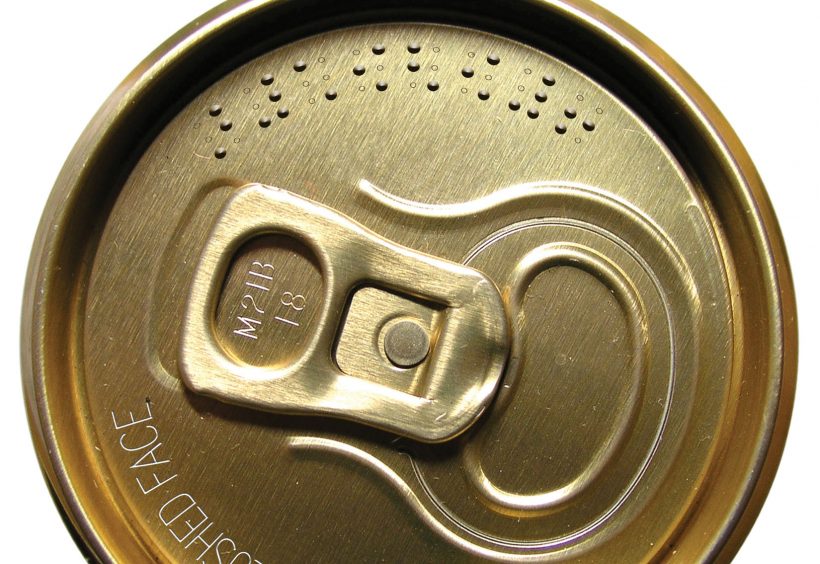
Following a recent practice of putting raised-dot Braille lettering on subway station handrails, the Japanese have taken the beer can to new heights by making the information on their cans more user-friendly for the visually impaired.
Because of a genetic difference, many Asians are susceptible to “alcohol flush reaction,” an allergic reaction brought on because their bodies can’t metabolize alcohol as easily as most people. While not fatal, it can be uncomfortable, causing redness in the face, neck and shoulders and, in some cases, nausea, dizziness, headaches and even the swelling and itching of body parts.
To help blind people differentiate between cans of beer and other canned beverages, many Japanese companies have started printing short words in Braille such as “alcohol,” “beer,” or, in the case of one marketing-savvy brewery, “Kirin,” on the tops of cans. For those who lack the enzyme to metabolize alcohol, the Braille serves as a helpful deterrent to an evening of discomfort. For those who can enjoy beer without those nasty side effects, the Braille labeling can help assure the visually impaired purchaser that he or she won’t be stuck with soda, coffee or tea when only beer will quench their thirst.
As to why Kirin labels the tops of its cans in Braille and Sapporo doesn’t, it’s simple. Space is tight on the can tops, and there just isn’t enough room. ■
 Previous: Beer Wares