Founding Brew: Rebuilding America’s Relationship with Beer
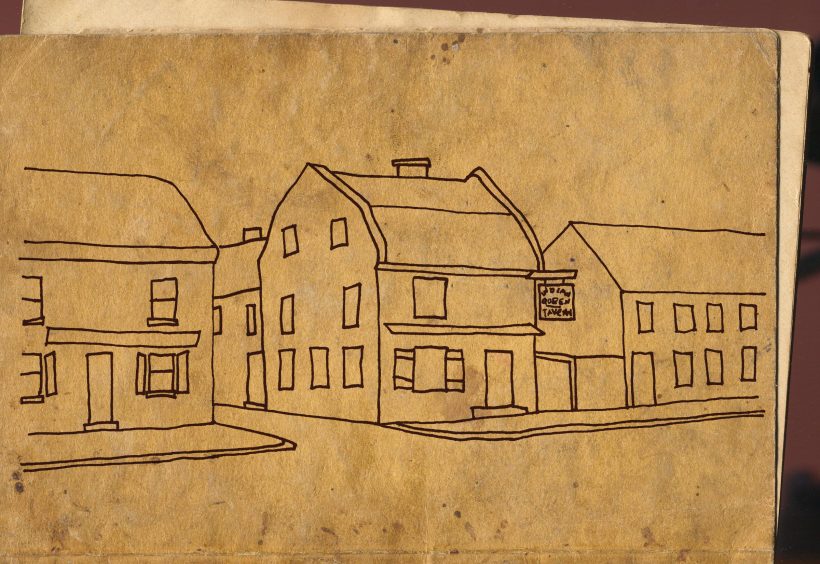
On a Philadelphia night in late June, sitting in a tap room as the air fizzed with flies and was thick with the adolescent summer heat, three men pored over the day’s work. That night, amidst “the temptations of pipes and bowls, cards and dice, beer and rum” at the Indian Queen Tavern, a new form of government was born, in the words of historian Charles Mee.
The three Constitutional Convention delegates in the tap room on June 30, 1787—Roger Sherman of Connecticut, and John Rutledge and James Madison of Virginia—came together in the same tavern where Thomas Jefferson wrote a draft of the Declaration of Independence. They left with the idea for the republican model of government.
Day after day during the Convention, delegates finished their work and filtered out into Philadelphia’s taverns. And when the Constitution was ratified in June of 1788, a parade ensued throughout Philadelphia, at which the only alcohols allowed were beer and cider. The day went so well that a newspaper story ran, reading, “They drank nothing but beer and cyder. Learn reader to prize these invaluable liquors and to consider them as the companions of these virtues which can alone render our country free and reputable,” according to Gregg Smith’s Beer in America.
American daily life defers, even now, 232 years after the Declaration’s signing, back to the Founding Fathers’ dreams. So for these men for whom beer was a staple in their own daily lives, these times proffer questions. Looking back, we survey a country where beer was once the agitator of rebellion and omnipresent companion to social discourse. Behind us is Prohibition and its lasting ramifications, manifested in the archaic beer laws across many states. Behind us is the mass industrialization of beer, but also the craft explosion; ahead of us—possibilities. So it seems natural, in this most patriotic of months, to ask, “Is this what they would have wanted?”
Today, American brewers and drinkers are still mending the wounds administered by Prohibition. “Ever since [Prohibition], we’ve been trying to come to grips again with an acceptable social consumption of alcohol even though we have a very split-minded view toward it, whereas it’s legal but only legal in a sense that it’s tolerated,” says Chris O’Brien, author of Fermenting Revolution.
Eighteen states, after the repeal of the 18th Amendment in 1933, chose to retain monopolistic control over some or all of the alcohol within their borders, according to SUNY Potsdam’s David J. Hanson. Nine of those 18, including four of the original 13 colonies, Pennsylvania, North Carolina, Virginia and New Hampshire, still do to this day.
In Pennsylvania, once the center of American brewing culture, all liquor stores are state run and all beer sold in beer stores (“distributors” in Pa. lingo) must be sold in cases. No six- or even 12-packs.
In Mississippi, a vestigial law from the post-Prohibition era puts a cap on beer at 5-percent ABW. That rules out about one-third of the world’s beer styles, as estimated by Mississippians for Economic and Beverage Advancement. Those styles include Barleywine, most ales ever touched by Trappist monks and virtually everything with the words “dubbel” and “trippel” or “imperial” in their names.
In the public forum, beer and other forms of alcohol still often play the parts of villains, with pundits (neo-drys, in post-Prohibition parlance) decrying them.
“There are a lot of enemies of alcohol that think of it as a great destroyer of civilization,” says Greg Kitsock, beer columnist for the Washington Post and editor of Mid-Atlantic Brewing News. “One of the great contributions of alcohol, beer especially, is as a social drink. It’s not like injecting yourself with heroin where you do it alone and it puts you in a dream state.”
In many ways, however, the clouds are beginning to part. States like South Carolina, which just popped its 6-percent ABV cap, have begun to change. Craft brewing has never been more alive, with more varieties of ingredients available than ever before. And as homebrewing gains popularity—remember, homebrewing has only now been legal post-Prohibition since 1978, meaning that George Washington would have been arrested for his daily activities—we see a return to American roots, a welcome reset.
“Temperance meant not drinking too much, that you’d abstain from hard liquor,” Kitsock says of the Founding Fathers. “Virtually nobody called for complete abstinence.”
In the late 18th century, writes Smith, Americans believed three things about beer: That it was better than drinking (commonly contaminated) water; it was a “healthful supplement” to the family diet (an opinion reinforced by prominent physician Benjamin Rush); and that it was an “acceptable way to promote social discourse, with an overall positive impact on the community.”
“No one in New England escaped the touch of beer,” says Smith. “Everyone drank it, from the lowly farmhand to the affluent merchant.”
Inside the house, it was the wives’ role to brew, so much so that Gen. John Hammond wrote, “They will be adjudged by their drink, what kind of housewives they are.”
Books were printed for families about how to brew. One, The Complete Family Brewer (1802), promised to teach a method “so easy to make, that a child of ten years of age may learn to do it in five minutes.” With the scarcity of ingredients available, people had to get creative. Here, we see American ingenuity dig in. Everything with a trace of sugar was open game for fermentation, from “pumpkin chips to parsnip tips,” O’Brien says. Some people even tried using artichokes.
Many of the Founding Fathers themselves were brewers. Washington, although he made more money as a distiller, was an avid fan of Porter, and even wrote a recipe for a molasses-based beer in his journal, now on display at the New York Public Library.
Jefferson brewed later in life, devoting a quarter of his house to a brewery, Kitsock says. A wine lover first, the third president even implored James Madison, his successor, to consider forming a national brewery. It was, in his view, “The greatest importance as it would unquestionably tend to improve the quality of malt liquors in every point in the Union.”
Sam Adams dabbled a bit, too.
But their real business happened in taverns. Outnumbering all other institutions in almost every town, taverns served as a general meeting place for business and pleasure alike, acting as conduits for political discourse especially. “From the very start, smoky tavern rooms and deals made over a couple beers were part of the American political scene,” Smith writes.
“It might seem odd today to begin civil society with a bar, but in eighteenth-century Anglo-America it made perfect sense,” writes Daniel B. Thorp in his essay, Taverns and Tavern Culture on the Southern Colonial Frontier.
The founding of the District of Columbia took place in Suter’s Tavern, also known as the Fountain Inn.
“If you get people well-oiled, it gets a little easier to reach a consensus,” Kitsock says.
“Nary a gathering of men was convened without alcohol,” O’Brien says.
The Boston Tea Party, on Dec. 16, 1773, took place after Samuel Adams and John Hancock met with the Sons of Liberty in Boston’s Green Dragon Tavern “to conspire and incite,” writes Smith. The wealthy Hancock had donated barrels of beer, and the Sons consumed plenty of it before offering the infamous cargo to the Atlantic.
Here, we see one of beer’s principle glories in American history: the fermenting of discontent and issuing the final push toward rebellion. For an undermanned, undertrained and historically overwhelmed group of colonists to declare war on the world’s premier power, a little liquid coercion was required. “I’m not saying [the Revolution] would have been impossible, but beer oiled the machinery of sedition and rebellion,” Kitsock says.
It also kept the troops fighting. Part of each soldier’s daily rations included a quart of spruce beer or cider. In Washington’s unit, liquor was banned, beer espoused. When the general assumed the presidency, he pushed himself to buy only American ingredients, giving up his beloved British Porter and cheese in favor of the stateside brand.
But in the end, perhaps the most admirable quality of the Fathers’ relation to beer lies in that relationship itself. They valued beer for what it is. To count drinking beer as anything less than a curious collusion of its components and our chemistry is to confiscate its true magic.
Somewhere, America lost that relationship. But, as brewing erupts again, we seem to be rebuilding it.
“I think the damage has been done,” O’Brien says. “And the craft brewing movement is in part a way to correct that, to make a communal movement based around the experience and not the transaction.” ■