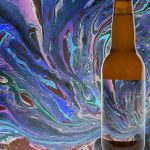
To create the label art for Nathalius, co-founder Karl Grandin filled an aquarium with Omnipollo beer and oil paint, swirling it to create different shapes, while photographer Gustav Karlsson Frost “manically captured the process.”
Of all the ingredients an experimental brewer can challenge palates with, processed extracts could be the most risky. But in the comic-book universe that Garage Project created, Mecha-Hop, an “Industrial Process Ale,” was designed as the opposite of an organic brew: Umami Monster.
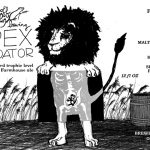
Apex Predator—and every Off Color label—is black and white. But what may seem simplistic—a pen-and-ink drawing that started as a Sharpie sketch on a bar napkin—is, of course, not so much.
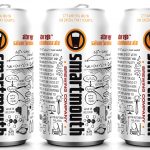
Smartmouth has a way of winning people over to the nerdy side. From the metabolic flows of fermentation to the yeast pitch rate formula, the cans become a resource for people to study while they drink.
Artist Keith Neltner’s rendition of a real-life rooster who once “ruled” the farm owned by Cecil Fecker, Nathan Hukill’s grandfather, was designed to wrap the brewery’s first release, an Imperial IPA brewed with nine hop varieties, five malts and a botanical blend.
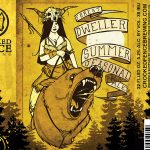
The name “Forest Dweller” could inspire all sorts of imagery. Leave it to Crooked Fence to come up with a primitive-looking woman riding a bear with lightning bolts coming out of its mouth.
Referencing the infamous Cuyahoga River fire of 1969, the revamped image for Burning River Pale Ale took inspiration from recycled materials to help symbolize Burning River’s environmental message, and incorporates newspaper clippings from the fire and text from the 1972 Clean Water Act.
Most breweries don’t release their first packaged beer with a label depicting their hometown getting sucked into a void of nothingness. In the image, a classic New York street corner—historic brownstone, sign-studded street lamp and all—is flying into a vacuum.
Hop, Drop ‘N Roll’s minimalist can design tells you what to expect from that first sip. The touch of yellow alludes to citrus, and the sleek classic car suggests a smooth body. That subtle artistry sets NoDa’s cans apart, and also reflects the brewery’s origins in the bohemian enclave of NoDa, in Charlotte, N.C.
All of that Scoville imagery on the label serves as a semi-serious warning of the insane heat level in Twisted Pine’s Ghost Face Killah, the world’s spiciest beer.
If you’re a fan of the Chris Robinson Brotherhood, the blues-rock band formed by Black Crowes singer Chris Robinson, you know that Anchor’s Brotherhood Steam Beer can is a new experience for Captain Nebula, the “intrepid interspace gnome” who appears on CRB artwork.
For anyone familiar with craft beer brands, the name Fullsteam instantly conjures a visual of the brewery’s logo, the chunky font with that enigmatic backwards “F.”
For Jester King’s “creative czar” Josh Cockrell, it started with the peach, the base of the beer. When he learned that peaches originated in China, he dug into the country’s folklore and discovered the tale of “The Shared Peach.” A man shares a peach with his same-sex lover, wanting him to share in its beauty.
How a label that one East End employee described as “SpongeBob on acid” made it past the feds seems to stump everyone involved in Illustration Ale, a beer created to to showcase local artists and benefit the ToonSeum, a museum of cartoon arts in Pittsburgh.
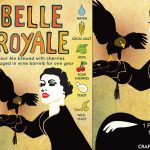
Mad Bruin, Lustrum and, of course, Belle Royale Sour Cherry Wild Ale, are just a few of Driftwood’s sour labels featuring some fierce fliers inked by artist Margaret Hanson. The latter was designed to pay homage to the Parisian artist Henri de Toulouse-Lautrec.
Adroit Theory’s aesthetic leans dark—think a little bit of goth, a little bit of motorcycle club and a whole lot of rock ‘n’ roll. You can see it in the label of its first beer, B/A/Y/S.
No Half Acre label looks quite like another. In the story of the StickyFat bear, the slightly dopey, lethargic beast waits for the season’s hops to swell with their sweet, sticky oils, before he plods in and eats his fill.
As the craft brewing industry continues to grow, its design approach should become more focused, allowing it to explore new audiences and markets. While I’m not suggesting the industry lose its sense of fun, it is perhaps time that the design equivalent of fart jokes steps aside for a more thoughtful sensibility.
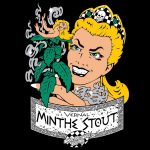
Lana Lovibond, the blond heroine of the comic book that Ska Brewing Company created when it launched 19 years ago, stars in the Vernal Minthe can design, appearing as the Greek goddess Persephone.