Why We Need Extreme Beer: A Look at a Truly Life-Changing Phenomenon
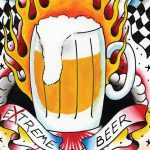
 Illustration by Derek Welch
What was the first beer that really caught your attention? Think back.
I’d be willing to bet that it had flavors and aromas you’d never experienced before. It probably had more intensity than any other beer you’d tried up to that point in your life. Now, what was the first beer that made you realize how vast the world of beer really is?
I view the two beers as being different. That first beer may have caught your attention simply by being something that wasn’t straight Bud. But as cool as the first really different beer was, the second beer was the one that was truly mind-blowing. You’ve probably had a few of these. One of the things I love most about beer is that no matter how many times your mind has been blown, it will always be blown again. And there are really only two ways to blow the mind of an experienced, worldly beer drinker: Make a classic style to absolute perfection or make a beer that is unlike anything brewed before.
That’s Extreme Beer.
Inasmuch as there has always been some beer that held the mantle of “extreme” (Anchor Liberty, anyone?), the modern history of Extreme Beer begins in the mid-’90s with the introduction of some key concepts. At the 1996 Oregon Brewers Festival, Rogue launched a beer dubbed I2PA. Goose Island celebrated its thousandth batch by making a massive Stout and aging it in bourbon barrels. Sam Adams debuted a 17 percent ABV monster called Triple Bock. And in Portland, a small brewery called Hair of the Dog opened up with a 10 percent beer based on an obscure 19th century German recipe and a mission to only brew similarly esoteric beers.
From I2PA flowed the entire Imperial/Double IPA style, and from that came wave after wave of extreme takes on existing beer styles. Rogue themselves added an Imperial Pilsner to their lineup before other brewers took on such concepts as Imperial Porter, Imperial Red, Imperial Oatmeal Stout, Imperial Brown, even Imperial Wit.
Though I2PA seems like a natural starting point, it could just as easily be argued that another Rogue beer, Old Crustacean, was a key inspiration in the drive towards the total, absolute hop juice that we see in today’s Imperial IPAs. When I first got into the whole beer thing, a beer of 45 IBUs could easily have been viewed as an IPA, but today that seems a bit low. A beer of 100 IBUs, as I brewed at home a few times, would have been considered undrinkable back then. Yet, today, beers like Devil Dancer Triple IPA and Dogfish Head 120-Minute IPA push the envelope of hoppiness beyond anything the world has ever seen.
The role of homebrewing in the development of Extreme Beer cannot be understated. The aforementioned, highly influential Bourbon County Stout from Goose Island was reportedly inspired by the product of a local homebrew club. Many professional brewers started as homebrewers. The small batch sizes are ideal for experimentation. Plus, the only person the brewer has to please is him or herself. No doubt homebrewers have dumped many, many gallons of failed attempts to push the envelope down the drain. There can also be no doubt that many envelope-pushing homebrew recipes have made it into commercial production once the brewer gets a professional gig of his own.
The closest approximation to this in the commercial brewing world are brewpubs. Some brewpubs are content to brew the same standards year in and year out. Others are constantly trying new things. Some of these are destined for the scrap heap, others turn out to be classics. Moreover, because these joints are constantly introducing new beers and are invariably run by talented, passionate people, they have a built-in buzz-generating capability that is only amplified when they hit upon a classic. Brewpubs like Quebec’s Dieu du Ciel!, Chicago’s Kuhnhenn and California’s Pizza Ports generate excitement far beyond their local markets for their innovative products.
Among brewpubs, even the most dedicated purveyor of Extreme Beer will have some not-so-extreme brews on tap. And at the outset of the craft beer movement, the same seemed to be the case for micros, too. While nobody is going to accuse Hair of the Dog of making money hand-over-fist, they were able to cobble together a living on esoteric beers. Now, some of our favorite extreme brewers like Jolly Pumpkin, Lost Abbey, AleSmith and the dearly departed Heavyweight, operate with that same single-mindedness. And other brewers, like Dogfish Head, Avery and Russian River, make Extreme Beer a large part of their portfolio as well.
As the recent beer renaissance spreads beyond North America to the far corners of the world, brewers elsewhere are tackling the concept with gusto. Consider the radical experiments with spices, sourness and barrels (sometimes in the same brew) at BFM in Switzerland; the super heavyweight contenders from Hakusekikan in Japan; the sour brews from Panil in Italy; the giddy insanity of Dany Prignon’s Fantôme beers; and the brash experiments from Nørrebro in Denmark. Extreme beer is everywhere. Beer lovers across the globe are having their minds blown as you read this.

Illustration by Derek Welch
And blowing minds is good for business. There aren’t too many circles which the gospel of craft beer has not reached. Everyone is aware of such things as Amber Ale and Porter. But even the tastiest Porter won’t make too many headlines. Having a large national craft brewer go toe-to-toe with an upstart for the title of the World’s Strongest Beer, however, will make headlines. Sam Adams followed its three vintage releases of Triple Bock with Millennium and Utopias. Dogfish Head countered with World Wide Stout and then an even stronger version of that same brew, and added Raison d’Extra into the mix. This unofficial 24 competition smashed previously held notions about the upper limits of beer. When 120-Minute IPA came out, it not only cracked the 20 percent alcohol barrier but also tested the barriers of hoppiness. It remains at the outer edges of Extreme to this day.
But as some brewers pushed the envelopes of alcohol and hoppiness to ludicrous levels, others explored different extremities. The New Belgium Brewery’s La Folie was not the first North American attempt at a Flemish-style Sour Ale but was widely regarded as the most convincing one to that point. Since then, Sour Ales have become another frontier for Extreme Beer. Brewers like Pizza Port (now Port Brewing/Lost Abbey), Russian River and New Belgium have led the way in the field of Sour Ales, but other brewers have met with success as well. In Washington State, for example, LaConner made a Framboise that was probably the best Sour Framboise I’ve ever had. Across the Columbia, Portland’s Rock Bottom made a blended Sour Ale that they christened Ned Flanders. That brew combined multiple elements of extreme brewing, including unusual ingredients, barrel-aging, acidity and blending.
The incorporation of multiple elements is the latest evolution in the emerging field. Fruited beers are being aged in wine barrels. Unusual flavorings are being added to barrel-aged brews. Big hop monsters are finding their way into barrels. Hell, for some beers it takes an entire paragraph just to describe the concept. Consider the Epic Ale from Portland’s Roots Organic Ales: They took cherry wood and soaked it in Glenlivet, cognac and cherry juice. Then they smoked 60 pounds of malt over this wood. Then they used this malt to help create a 14 percent Barley Wine. A brewpub near me—one that is anything but extreme—made their Winter Ale last year by roasting pumpkin in a wood oven with maple syrup, brown sugar, cinnamon and nutmeg. They added this to a strong, dark brew along with anise, vanilla and licorice root. Niiice.
It seems as though the only limit to Extreme Beer these days is taste. No matter how bizarre the ingredients, how ridiculous the quantities or how unconventional the production method, it still has to taste good. I can think of a few high-profile flops in the field of Extreme Beer, but some of the absolute worst were thankfully under the radar. Like a certain Garlic Pilsner, and that wormwood IPA that almost destroyed my tongue forever. But it’s all in good fun. It is inevitable that any brewer who pushes the envelope will, at some point, brew up a total gong show. It’s worth it, though, because it is the lack of any fear of failure that drives small brewers to explore these boundaries.
Extreme Beer has become the phenomenon it is because it speaks to the very essence of the craft beer movement. These are the beers that inspire people to get into the business. They’re the beers that inspire people to question their previous notions about what beer can be. The excitement that is generated when a heretofore unknown concept is unleashed on the public is exactly the type of visceral experience that you cannot get from macro brews, or even from other branches of quality alcoholic beverages. Beer, to an extent that no other drink can match, has maintained its relevance by reinventing itself to meet the needs of each successive generation. And what this generation needs are mind-blowing, palate-jarring Extreme Beers. ■