Brew Your Own Beer!
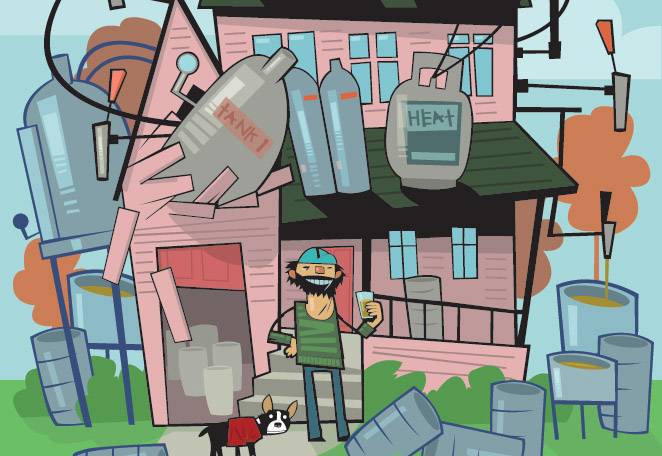 Illustration by Thom Glick
Homebrew Basics
Things that I wish someone told me when I first started.
Read and read some more
Time to learn! Think of this as a long-term college class, but not like the boring stuffy ones you skipped after paying tuition and grabbing a stack of books you wouldn’t crack until exams hit. Start with a comprehensive guide and focus on the early chapters. As you gain experience, keep returning to your tomes and harvest more ideas and techniques.
Relax and enjoy yourself.
“Relax. Don’t worry. Have a Homebrew.”
Charlie Papazian coined the homebrewer’s mantra. Let it roll around in the back of your mind to ease your troubled brow when you screw up. Scorch the extract? Relax! Forgot some hops? Relax! Accidentally get drunk and mess up a ton of stuff? Relax! Plenty of chances remain to make better beer.
In the end, what matters is that if you are not having fun, you could brew a beer that puts Westvleteren 12 to shame and to you it will taste like a warm can of goat pee.
Clean & sanitary
This is a no-brainer. If you want your beer to be clean, you need to keep your equipment and your process clean. Be gentle cleaning plastic; if you scour you will leave scratches, potential harboring sites for bacteria. Make an upgrade in your sanitizer from bleach to iodophor or Star San. Worry about cleanliness and sanitation for anything that touches the beer after the boil.
Starters
Liquid yeast is a true marvel. Reaching the full range of flavors and guaranteeing a complete and clean ferment is best achieved with a starter. Boil a quart of water and 3.2 ounces (by weight) of dry malt extract (DME). Cool the starter and pour into a sanitized growler. Pitch your pack of yeast and cover the growler with foil. Let it ferment for a day, pick up and stir the growler periodically. After your beer cools, sanitize the neck of the growler and pitch the starter.
Know your ingredients
Do you cook dinner with a new recipe without tasting your ingredients? Would you know when to use a tomato if you had never tasted one? Don’t let your brewing fall into this trap. Explore the flavors and aromas of your ingredients. Chew different malts. Hold them on your tongue and see how the flavors change as the starch slowly converts to sugar. Take a hop pellet and boil with a small amount of water. Cool and breathe in the perfume; take a sip and experience the unadulterated flavor.
Steep some grain
Time was, you grabbed a can of malt syrup, a bag of hops and a pack of yeast and that’s how you brewed your first batch of beer. Makes serviceable beer, yes, but not astounding beer. With the selection of malts available, it would be a shame not to use them as spice for even your simplest brews. Steeping specialty malts (Crystals, Munich, etc.) in hot water gives you a fresh grain aroma and flavor that cannot be beat. All it takes is water, a strainer and some cheesecloth or a grain bag. Easy, cheap and effective!
Late extract boil / full boil
You cannot make a pale beer with extract. It is the oldest truism in the world of extract brewing. A recently discussed technique takes part of your extract and adds it as normal. Boil per your recipe and in the last 5 minutes add the remainder of the extract. Voila! You have a pale extract beer! If you can, instead of boiling a small portion of wort, boil a full five gallons.
Cultivate local resources: join a club
They don’t bite and there’s a ton of info there. You have BeerAdvocate.com, but for all the advice and the opinions espoused there, we can’t taste your beer. Grab hold of the people around you, the local homebrew shop, the local homebrew clubs. Feed them your beer and learn from them.
Steal/Revise/Reuse
Newton credited his breakthroughs to the work of his predecessors. Take heart from this. Borrow the work of others. Find award-winning recipes and use them. Explore them and modify them for your system and techniques. It is a great way to learn what works for you. After all, no one worries about the origin of your recipe, just the beer.
Ask the question
Yes, there are stupid questions, Virginia, but you will never know the difference if you don’t ask. We have all been there and we all know the answers. Help yourself out and ask. We won’t snicker… much.
www.HelpMe.pls
Instant help is only a click away—honest.
Brewing forums
One of the powers of the internet is its ability to generate a sense of community. At your fingertips is the largest group of homebrew clubs chock-full of experienced brewers ready to teach and inspire. Major homebrew suppliers provide some of the best forums and do not interfere with the flow of knowledge. Every forum has their own set of experts and personality, so search around and find the one that fits you. (beeradvocate.com, brewboard.com, forums.moreflavor.com, forum.northernbrewer.com)
Beer recipes
Painters and chefs study the art of masters and so should you. Thankfully, brewers are less secretive than painters or chefs! Online you will find recipe archives that are far-ranging in their coverage. Be careful! Older archives are full of untried recipes or use outdated techniques and ingredients. Look for recipes from award-winning brewers and other trustworthy sources. (beertools.com, maltosefalcons.com/recipes)
Podcasts: The Brewing Network, Basic Brewing, Beer School
The availability of cheap, high quality audio equipment and increased broadband usage means that more authors are producing top-notch “radio” shows focusing on brewing and beers. Some broadcast live, integrate the audience via phone and chat to allow you access to knowledgeable professional and amateur brewers. (thebrewingnetwork.com, basicbrewing.com, beerschool.com)
Beer Judge Certification Program’s styles
Even if you have no interest in competing or judging homebrewed beer, the BJCP can be of use to you. Their listing of exam study materials and guides makes a complete crash course to advance brewing and beer understanding. However, the heart of the BJCP is the style guidelines. Available online and free for perusing, here you can grab the distilled essence of what the official styles mean. The commercial examples provided give you a chance to taste, compare and learn. (bjcp.org)
Email lists
Before the rise of the online forum, communities revolved around the mailing list. Even today in this fragmented internet, several email groups continue to provide daily reassurance and aid to brewers. Most are open to the public, just sign up and step back to receive your morning brewing information. The AHA TechTalk does require an AHA membership, but you get their other perks as well. (AHA, HBD.org, JudgeNet, Mead Digest)
Required Reading
The krausen of the crop—books for making better brew.
The Complete Joy of Homebrewing (Charlie Papazian)
On its third edition, Charlie Papazian’s Complete Joy of Homebrewing encourages new homebrewers with an easygoing attitude. Relax! Don’t worry! Have a homebrew, indeed! Charlie focuses on the basic knowledge needed to get you running.
How To Brew (John Palmer)
Self-described mild-mannered metallurgist John Palmer wrote How to Brew to update the brewing world with the latest information. What he created is a true brewing omnibus, covering the gamut of brewing techniques. While the first edition is available free on the web, the greatly expanded third edition is print only.
Designing Great Beers (Ray Daniels)
After absorbing the techniques needed to brew, you can sharpen your recipe formulation skills with Ray Daniels’ Designing Great Beers. It starts with a tutorial that walks you through hand-calculating your gravities, bitterness and color. The bulk of the book analyzes styles from commercial and award-winning homebrew examples.
Radical Brewing (Randy Mosher)
Brewing your standard Ales and lagers gets boring after a while. When the time comes, grab Randy’s inspirational bible on radical brews. From sugars and spices to obscure or forgotten historical styles, you can find it in here. When I need a new idea, I turn to this book. Be prepared to take notes and watch your brewing to-do list grow.
Style/Recipe Book of Choice (e.g., Clone Brews, Brew Like A Monk, Brewing Classic Styles)
We all have favorite styles of beer and Brewers Publications has a book to help you. Name a style, someone has probably written a book on it. Each volume covers the history, ingredients and techniques associated with that style. Recipes cover the breadth of the subject. If you want wider coverage, check out the Clone Brews books or Jamil and John’s new Brewing Classic Styles.
Advanced Homebrew Tips
Serious tips for stellar brews.
Chiller
Buying ice or watching and waiting hours for your beer to cool gets old and it could potentially lead to off flavors and infections. So buy a copper chiller and use water to speed your way to pitching temperature. Immersion chillers are cheap and easy to maintain, and counterflow chillers are more work but more efficient.
Refractometer
Are you sick of wasting all that precious sweet beer on gravity samples? Does it take too long to chill a hot sample when monitoring run-off? Spend $30–50 on eBay and buy an ATC refractometer. It uses a couple of drops to measure your gravity in Brix. Software even allows use on fermented wort by correcting for the alcohol.
Stir plate
Give your yeast starters a power boost. Using a magnetic stirrer on a foil-capped growler can increase viable yeast yield fourfold. For $40 you can save time, effort and starter materials and ensure your beers a rocking start to the fermentation party.
Pressure cooker
I’m a lazy man. Efficient practices allow me to relax. A 20-quart pressure cooker makes your starter chores easy as pie. Mix DME, water and yeast nutrient in canning jars, shake and pressure-cook for 15 minutes, and you have sterile, shelf-stable starter wort. Now to make a starter just sanitize a growler, pop the can top, pour and pitch! You can also make sterile media for creating yeast plates and slants.
Kegs—do it quick as keg prices are rapidly rising
What can beat the joy of a freshly poured glass of beer: How about a glass from one big bottle instead of 50 little bottles? Not only do you get a ton of control over your carbonation levels (via force carbonation), you really save a ton of time and energy by cleaning kegs instead of bottles. Plus, you can nurse all your Sam from Cheers fantasies while you pull the tap for your next draft. You best hurry up and get your gear: The cheap old kegs of the past are rapidly disappearing and prices are shooting up!
Attend a conference
Every June, homebrewers unite at the AHA’s National Homebrewer’s Conference. In addition to professional and homebrewed beer tastings, the conference is host to a variety of presentations by homebrewers and professionals. Over the three days you will also meet homebrewers of every stripe who can inspire you.
Fermentation control
Letting your beer ferment too warm wastes the time and effort of your brew day. Take control of your fermentation temperature and stamp out the head-inducing fusel alcohols and nauseating out of control esters. Fridges and override thermostats make the perfect combination, just run the fridge about 8 degrees cooler to hit perfect temperatures.
CO2 rack
Your beer has cleared in the carboy after weeks stationary. What do you do? Pick it up and mix the gunk just to rack it. Smart idea! Who wants to pick up a full carboy? Check maltosefalcons.com/tech/ for tips on CO2 pressure racking and watch your transfers made simple!
Water—Ward Labs or water department reports
Targeting a particular style and taste profile requires knowing how your water affects ingredient perception. If you use municipal water, you are in luck. Your water department publishes an annual report, free to customers, that lists major mineral levels. For more precision on your water, order Ward Lab’s W-6 test for $15 and get the facts.
Enter a competition
Sure, you can brew the way you like. But can you thread a needle, and accurately hit a desired style? Competing challenges you to refine your technique and the way you think about brewing. The unvarnished feedback of good judges from multiple competitions highlights characters of your beers that you never overtly notice.
Award-Winning Tips
Turn your homebrew into bragging rights.
Aim high
To win big in a competition your beer has to stand out, so aim high. Push your gravities and bitterness to the ceiling. Emphasize the characters listed in the guidelines. Judges look for these aromas and flavors first. Ignore this advice though for styles with distinct classic examples (California Common) and session beers as the judges will ding you for deviating.
Enter the style you have
When entering a beer, let go of your preconceived notions and taste the beer blindly. What did you make? You wanted a stout, but is it a passable porter? Enter what lands in your glass. The judges never see a recipe sheet so they won’t know that you used non-traditional ingredients and techniques.
Bottle presentation
Judges are not immune to the aesthetics of your bottles. Dirty bottles, rusted caps, partial labels or a low fill level make a bad first impression on the critics. Spend extra time cleaning to get your old bottles spotless, or buy new bottles. Gaining or losing a point can mean first place or no place.
Research
This is the fun part. Research a style’s classic examples. Take notes and decipher the secret ingredients. If it exists, read the classic style series’ book. Explore the brewing company’s website and glean the nuggets of info hidden within. Review and formulate all while enjoying a glass of fine beer.
Target the obscure
Some styles, such as American Pale Ale and IPA, are flooded with entries. Medals are easier to win in less popular categories. In particular, since many brewers cannot ferment cold, lager styles will always have fewer entries. Step out of the norm and grab a medal!
Rule of origins
To nail a style, use the native ingredients. Brew with the local malts, hops and yeast. For instance use domestic two-row malt for an IPA, but use Maris Otter for a Bitter. Mimicking a beer is easier when you don’t handicap yourself with foreign ingredients.
Smaller competitions
Not only are your chances greater for winning a medal at a smaller competition, but a judge has more time to focus on your entry. Faced with a table of 12 beers to evaluate, I know that I push a little harder to finish each beer. A smaller flight I take more leisurely with more time discussing your beer with the panel.
Brewing calendar
To become a monster award-winning brewer requires planning. Target a specific competition (AHA Regionals / Nationals) and work back from the entry dates to find when you must brew a style of beer for it to be optimal. For instance, brew your barleywine a year ahead and save your mild and bitter brews for the weeks just prior.
Control your fermentation
Judge-training emphasizes finding flaws. Restraining your fermentation to the lower temperatures reduces aromatic flaws. Careful! Some styles, such as Hefeweizen, require a charge of esters and phenol, and judges consider their lack a flaw.
Become a judge
There is no better way to know what a judge is looking for than to become one. BJCP training covers the breadth of brewing styles and techniques with special emphasis on common flaws and their causes. Get into the mindset of a judge and know what they’re looking for! ■
 Previous: Question Quality