
A Closer Look at GABF: 2012, and Beyond
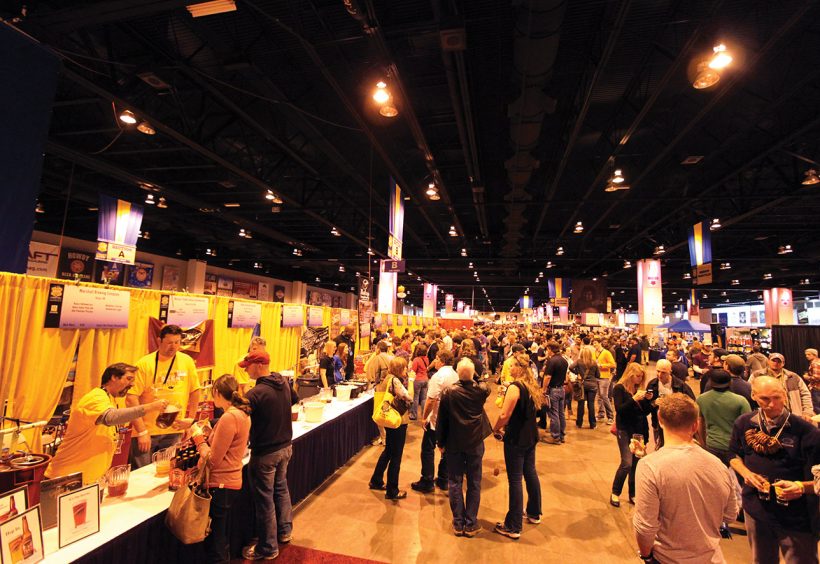
The Great American Beer Festival (GABF) is one of the largest events of its kind, and this year’s was the biggest yet: 49,000 tickets sold, and 580 breweries pouring 2,700 beers in the massive Denver Convention Center. This year, the awards ceremony was moved to the Wells Fargo Theatre in order to accommodate 110 more breweries, a 23-percent increase from last year. But as the craft beer segment continues to grow, some brewers and GABF regulars are questioning what direction the Brewers Association plans to take the festival.
“The [Brewers Association] staff, board and event committee spend a lot of time discussing how to strike the best balance to keep the event fun and safe while getting as many craft beer fans into the hall as possible,” writes GABF director Nancy Johnson in an email. “While the number of festival attendees has stayed steady in recent years, we have grown the festival in other ways … but we’ve made a conscious decision not to sacrifice growth for quality. Our goal is to keep the festival experience fun and educational.”
But some regulars, like BeerAdvocate columnist Andy Crouch, say that they’d like to see a more concerted effort to accommodate the beer geeks who come to learn.
“In terms of this festival, it’s fantastic, because there’s a great diversity of offerings,” he says. “[What] I would say of the [Brewers Association’s] education efforts is that they seem to have grown stale and taken a backseat to the general growth of the festival. The [Brewers Association] does a good job with the salons at SAVOR, and I would like to see that enthusiasm extended to the GABF.”
One way the Brewers Association tried to enhance the educational aspect of this year’s fest was by tweaking the volunteer program. They offered complimentary access to the Beer 101 course on craftbeer.com to all volunteers, who are often the only people available to answer questions about the beers. And as Barbara Fusco, sales and marketing manager of the Brewers Association, explains in an email, volunteers were also assigned “to a brewery booth for the duration of their shift, rather than having them move around as in previous years,” and volunteers were assigned to the same brewery across sessions “to create a knowledgeable and consistent presence.”
Art and Katie Gallagher, founders and co-owners of Morgantown Brewing Co. in West Virginia, were very pleased with the volunteer assigned to their booth, Dave Johnson. “Basically [he and the other pourers] just shadowed our brewers, listened to the different pieces of information that they were giving out as folks were coming up to the table,” says Katie. “He’s a homebrewer himself and is really knowledgeable about the industry.”
Then again, there were incidents such as when one consumer asked a volunteer what style a beer was, and she replied, “It has a caramel undertone, and it’s made with hops and barley.” That was the first session of the fest. On Saturday, at the third session (also the members-only session), the same volunteer was able to answer, “Helles, with a sweet undertone,” but when pressed for details, did not have more information.
Fusco says it’s the goal of the Brewers Association and most breweries to make volunteers part of their team—and most are successful—but with 2,800 volunteers, she admits, “It’s difficult to ensure this transfer of knowledge.”
Another relatively new component of the fest was the Farm-to-Table Pavilion, a perk offered for the fourth year to Brewers Association and American Homebrewers Association members only. For an extra $55, members could sample dishes made by featured chefs to pair with selected beers. Smuttynose field manager Joe Grotto says that the well-curated group of breweries and restaurants offered relief from the often-overwhelming main floor.
But, he adds, the event wasn’t without its hiccups: Smuttynose first arrived to find that their assigned chefs from Johnson & Wales University had prepared two different truffle dishes to pair with the New Hampshire brewery’s Finest Kind IPA and Old Dog Brown Ale, while other restaurants had prepared more involved dishes. Grotto explains that the Brewers Association’s culinary consultant, Adam Dulye, had already sensed that Johnson & Wales was overwhelmed with all that was on their plate (so to speak), and called in chef Sean Clark of Steamworks Brewing in Durango, Colo., to, at the last minute, whip up two different batches of sausage that paired more interestingly with the beers.
“Overall, the event was really amazing, and I think it was a testament to how far beer and food have come,” Grotto says.
GABF director Nancy Johnson writes in an email that she’s “extremely happy with this area of the festival. Early reviews are overall positive,” and that the Pavilion was visited by Colorado Gov. John Hickenlooper and Tom Visalk, the US Secretary of Agriculture, who also toured the festival hall.
While the scene on the festival floor has grown, so has the size of the GABF competition. This year, 666 breweries entered 4,338 beers, which were evaluated by 185 judges. Even as categories swell, competition manager Chris Swersey maintains a strict ratio of judges to beers: a max of 12 beers per flight, per judge. The average judge will consume about 18 ounces of beer per three-hour session—about three beers total over the course of a full 8 1/2-hour day of judging, the same figures that applied to last year’s competition, Swersey says.
This year, the influx of entries required Swersey to recruit more judges. “The number of entries drives everything,” he writes in an email. “Beer entries per category are mapped out according to our 12 max per judge per flight rule. Then, I recruit roughly 6.5 to 6.7 judges per table. This year, we had 28 tables, so we needed 182 – 187 judges. We ended up with 185.”
“I think it’s a really great system,” says longtime competition judge Will Meyers, brewmaster at Massachusetts’ Cambridge Brewing Company. Meyers’ Heather Ale was awarded a silver medal this year. “It’s very, very efficient, it’s extremely fair. All of the beers are judged in the exact same manner, everything’s blind. Everything comes out at a good temperature in the exact same cup. So you’re judging everything on the merits of its presentation. It’s completely equal to that of the presentation and service of every other beer. And it’s always in context with the category or sub-category that you’re judging.”
Beers are judged in 84 categories—including the new Fresh Hop category, which debuted this year—and according to the Brewers Association’s style guidelines. Plus sub-categories, that covers 134 styles. Some brewers make beers specifically to win; other breweries make beers that may never win a medal. COOP Ale Works’ best-selling beer, for example, is an IPA that’s 120 IBUs, putting it over the IBU limit for an Imperial IPA according to Brewers Association style guidelines, says Patrick Lively, a brewer at the Oklahoma City, Ok., brewery.
“The competition is a game, and those are the rules by which we play the game,” Lively says. “But at the end of the day, the game is not what is played out in the market, and so really ultimately all I care about is: Is this beer going to sell, and are people going to like it?”
“We make our guidelines as broad as possible, while still providing meaning to brewers and consumers,” Swersey says. “They are not intended to force brewers to hew to stylistic boxes; in fact, most brewers prefer creating beers the way they think they should taste, rather than the way the GABF guidelines suggest.
Another commonly raised issue with the competition is geographic equitability; although 48 states plus Washington DC and Guam entered the competition, and 45 states plus DC poured beer on the main floor, regions that are farther from Denver often have a harder time making it out to pour and/or compete.
For some, getting their beer to the fest is a labor of love. Paul Kavulak, president of Nebraska Brewing Co., makes the three-hour drive to Kansas City, Mo., with their floor beers, and the eight-hour drive to Denver to hand-deliver their competition beer. “It feels good to do it, and you know everything arrived the way you intended it to,” says Kavulak.
“We’re kind of in the center of the country, so for us to move the beer is easy and get out here ourselves is easy,” adds Kim Kavulak, vice president and general manager of the brewery.
But for others, the cost of shipping beer, travel expenses and staffing are all prohibitive factors. New England and Alaska are two regions with thin representation both on the floor and in the competition.
Midnight Sun Brewing Co. in Anchorage, Alaska, hasn’t attended GABF in “four or five years,” according to vice president Barb Miller. “It’s an amazing festival, but for us, with limited travel expenses, we try to focus on the areas that we have distribution,” Miller says.
“We had to pay hundreds of dollars just to ship our judging beer here,” says Sam Hendler, co-owner of the Framingham, Mass., brewery Jack’s Abby, which had a booth and won a bronze medal in the Smoke Beer category. “It’s hard, the only real way to make it equitable [for long-distance breweries] would be to move it around from city to city, year to year, like they do with the World Beer Cup, which I guess kind of fills that niche. I don’t think they would ever do that, because [GABF is] now a staple of Denver.”
Nancy Johnson acknowledges the many factors a brewery has to consider before signing up for the fest. “At the end of the day, the decision remains with the brewery,” she writes in an email. “That said, as a trade association, we do continuously evaluate how to best serve our members and create a level playing field where possible.”
In addition to the costs of shipping and traveling, some breweries are strained by the expense of making extra beer to be poured at the fest; brewers must donate the beer poured at the festival, as the Brewers Association doesn’t buy it. But, as Hendler says, “it’s all part of the package.”
“It’s totally worth it just to be out here and have a great time, and try a ton of beer,” he says. “But is it something we can do every year? We don’t know. Hopefully.”
Festival Feedback
“Judged beers were all sent in over a month before the competition. Ideally, I think it’d be nice if we were able to get the beers out to Colorado a week or so before instead. … I noticed the presence of brewers’ booths manned entirely by volunteers seemed even higher this year. I’d second Garrett [Oliver’s] call to action to ‘stand your ground and pour.’ Not sure how brewers can be incentivized to do this, but it’s an honor to be able to pour all of our beers for such a great, huge audience and I think we should not forget to respect those patrons. … Kind of a shot in the dark, but would be great if each participating brewery had a locker space or something to store items not immediately needed on the floor in. … Would be awesome if we could use some of our combined leverage as a brewing community to block out enough rooms to offer the participating breweries an opportunity to stay in a select few places together, even if they’re not able to forecast their team’s availability/needs 4 months in advance. As always, would be great if the beer was paid for.” —Jon Carpenter, brewmaster, Golden Road Brewing in Los Angeles
“Having different areas and groups really adds a level of complexity to the event and takes away from the feeling of being overwhelmed with just a massive amount of beer to go and taste in a big room. I believe that more of these separations or groups could benefit the overall feel of the festival even more. I would also like to see additional information added to the event brochure … such as years attending GABF, brief beer descriptions, years in production and even limited release/special tapping information. … Every year I’ve attended has been better than the last and it remains, since year one, as my single favorite event of the year.” –Chad Henderson, head brewer, NoDa Brewing Co. in Charlotte, N.C.
“I so enjoy the festival mainly because it is, in my opinion, the gold standard of beer festivals. It is so well organized and well run. As far as changes/improvements, I’d love to see a people’s choice award given for each session and voted on by festival-goers through kiosks around the fest. It could be by region or by style, or simply be the best overall beer.” –Kevin Brand, founder / brewer, (512) Brewing in Austin, Texas
Porter’s Pride
Another first for this year’s festival: an official GABF beer. Brewery members of the Colorado Brewers Guild donated ingredients and collaborated on Porter’s Pride, brewed to honor longtime GABF cellar master and “beer porter” Danny Williams, who passed away in January. Among his many contributions to the festival was his groundbreaking organization and management of the competition.
“Danny did a really great job when he started it, of creating a system of gathering and sorting all of the beers for judging,” says Will Meyers, brewmaster at Massachusetts’ Cambridge Brewing Co. and a competition judge. “[Williams’ system] just kind of allows it to expand in a modular manner year after year.”
“Danny was an absolutely tremendous asset to the festival, a great friend to all of us at the Brewers Association and in the craft brewing community, and he is deeply missed,” adds Barbara Fusco of the Brewers Association.
At the awards ceremony, brewers lined up to get samples of the beer for a toast led by GABF director Nancy Johnson. Porter’s Pride contains 200 pounds of chocolate from Rocky Mountain Chocolate Co., and each medal winner was presented with a 750mL bottle after a congratulatory fist-bump from Charlie Papazian.
IPAs Rake in Record Number of Entries
This year, the American-style India Pale Ale category drew 203 submissions (up from 176 last year), requiring four rounds of judging, the first time any category has exceeded three rounds. Here’s competition manager Chris Swersey’s breakdown of the most competitive category in GABF history:
Swersey emphasizes that judges aren’t subjected to repeated IPA flights because of “the significant palate fatigue which results from tasting heavily hopped beer styles. Moving the beers from table to table removes palate fatigue, and in the instance of a category such as IPA, allows a larger sample of the judge pool to provide their input via tasting. The six finalist beers at the fourth round had to appeal to a huge number of judges to get there, meaning they had broad appeal as well as extremely high quality—the three medalists, even more so.” ■

