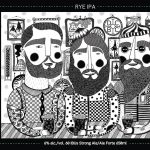
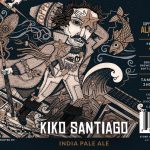
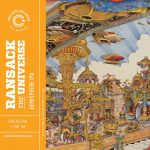
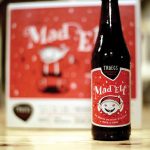
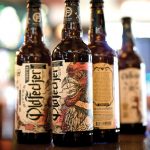
From the narrative-driven artwork of Jolly Pumpkin to the modernist pop-culture mashups of Stillwater, brewers and artists are increasingly using beer’s packaging as an opportunity to tell a story about their brand and the liquid inside.
Strolling through Kassel, Germany, where the Grimm brothers grew up, illustrator Ola Volo started thinking about the history of the Doan’s founders as a modern folklore tale.
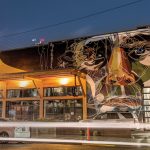
From blank brewhouse walls made colorful by local muralists to expressions of brand identity, large-scale art is a growing presence at breweries across the country. We highlight six of the most striking examples.
Tampa’s Coppertail Brewing has created its own nautical mythology based around a 4-year-old girl’s imagination and the creativity of illustrator Evan B. Harris.
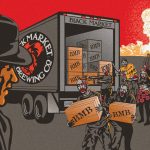
Based in Southern California, a crime-fiction narrative runs through Black Market Brewing’s branding, featuring “good guys” Ellsworth and Mia and villains like the Blacklisted crew.
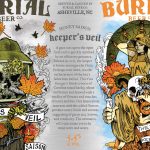
In the can art for The Keeper’s Veil, a honey Saison, each side represents an extreme—a beekeeper in the spring and summer of her life, and a dark, heavy scene of death and decay.
Partners Dan Nothnagle, Todd Dirrigl, Geoff Dale, and Brian Johnson can’t live without these five things at Three Heads, their funky and hop-forward brewery in Rochester, N.Y.
Fort Worth’s beer can house sold; CAMRA launches revitalization project; Brouwerij de Molen sells minority share; and presidential candidates inspire new beers.
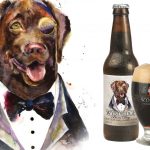
You can’t go wrong with a chocolate lab, thought Steve and Julie Groff, owners of Wyndridge Farm Brewing. And Barn Dog Chocolate Vanilla Imperial Porter’s popularity has proved them right.
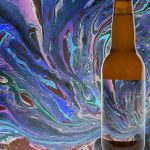
To create the label art for Nathalius, co-founder Karl Grandin filled an aquarium with Omnipollo beer and oil paint, swirling it to create different shapes, while photographer Gustav Karlsson Frost “manically captured the process.”
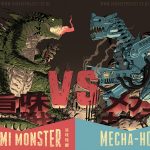
Of all the ingredients an experimental brewer can challenge palates with, processed extracts could be the most risky. But in the comic-book universe that Garage Project created, Mecha-Hop, an “Industrial Process Ale,” was designed as the opposite of an organic brew: Umami Monster.
Beginning in the mid-1980s, microbreweries started to think of tap handles as promotional tools. Now, numerous beer-focused bars have what amounts to rotating art exhibits thanks to companies such as Taphandles in Seattle.
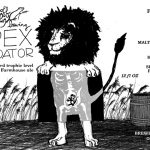
Apex Predator—and every Off Color label—is black and white. But what may seem simplistic—a pen-and-ink drawing that started as a Sharpie sketch on a bar napkin—is, of course, not so much.
Imperial Pumpkin Ale mixes it up as one of the brewery’s first labels featuring art. A nod to Tim Burton and the spirit of Halloween, the “foggy autumn night sky at a pumpkin patch” is a departure from the minimalist look of other Reuben’s Brews labels.
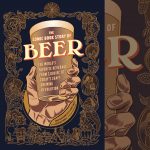
The authors of The Comic Book Story of Beer move swiftly across time and continents, dropping in on the scenes that advanced beer from accidentally fermented “gruel” to a contemporary cultural touchstone.
Brothers Mike and Ed Marszewski founded Marz in Chicago’s Bridgeport neighborhood with Ed’s brother-in-law in 2013. An intricate web of friends, designers, and brewers connects the rest of the Marz collective.
Artist Keith Neltner’s rendition of a real-life rooster who once “ruled” the farm owned by Cecil Fecker, Nathan Hukill’s grandfather, was designed to wrap the brewery’s first release, an Imperial IPA brewed with nine hop varieties, five malts and a botanical blend.
Referencing the infamous Cuyahoga River fire of 1969, the revamped image for Burning River Pale Ale took inspiration from recycled materials to help symbolize Burning River’s environmental message, and incorporates newspaper clippings from the fire and text from the 1972 Clean Water Act.
Most breweries don’t release their first packaged beer with a label depicting their hometown getting sucked into a void of nothingness. In the image, a classic New York street corner—historic brownstone, sign-studded street lamp and all—is flying into a vacuum.